Application of Organizational Culture Philosophy and Theory preventing Burnout syndrome in Educational Administration Contexts
Article Sidebar
Main Article Content
Abstract
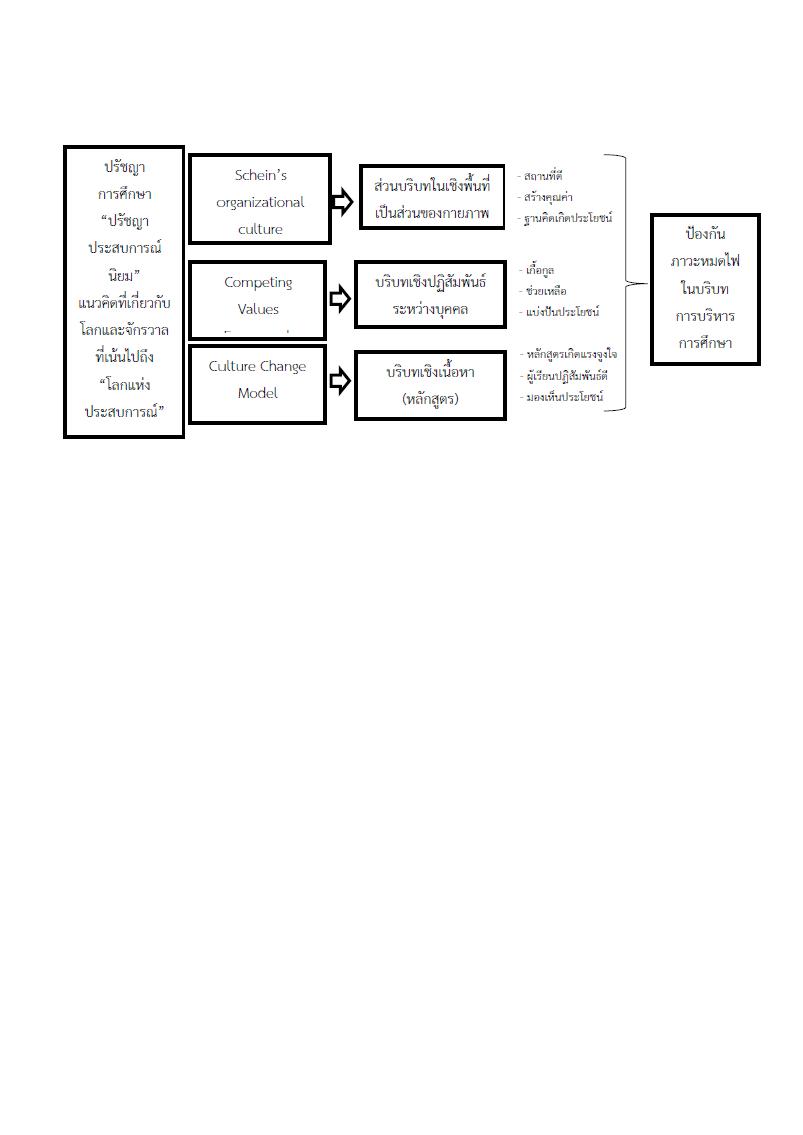
This academic article synthesizes the philosophy of education and organizational culture theories and proposes ways to apply them to reduce the risk of burnout in the educational administration contexts of school administrators. The scope of the synthesis covers experimentalism (pragmatism), which emphasizes the “world of experience” and “learning by doing,” together with three organizational culture theories: 1) Edgar Schein’s organizational culture theory, 2) the Competing Values Framework (CVF) developed by Cameron and Quinn, and 3) the Culture Change Model developed by Roger Connors and Tom Smith, as well as research evidence on factors associated with teacher burnout. The synthesis indicates that the three theories align with three educational contexts: the physical and environmental context, including tangible elements that reflect organizational cultural identity; the curriculum context, which emphasizes learner-centered and experiential learning; and the context of interpersonal interaction within educational institutions. These contexts link to key burnout risk factors: teaching experience, teaching hours, and relationships with colleagues. As an applied proposal, school administrators may use experimentalism and organizational culture theories as a framework to create positive experiences for novice teachers, allocate workloads appropriately, and promote a supportive (clan) culture. Such practices may help reduce the risk of workplace burnout and support the creation of positive organizational cultural identities; however, direct empirical research is still needed to confirm these links.
Downloads
Article Details

This work is licensed under a Creative Commons Attribution-NonCommercial-NoDerivatives 4.0 International License.
แนวคิดและข้อเสนอแนะที่นำเสนอในบทความของวารสารการบริหารและความเป็นผู้นำทางการศึกษา มหาวิทยาลัยรามคำแหง เป็นแนวคิดที่มาจากผู้เขียน หากมีความผิดพลาดใด ๆ ผู้เขียนเป็นผู้รับผิดชอบแต่เพียงผู้เดียว
ทั้งนี้ บรรณาธิการ กองบรรณาธิการ และคณะกรรมการหน่วยจัดทำวารสารฯ จะไม่ก้าวก่ายความมั่นคงในหลักการตามความคิดของผู้เขียน
ดังนั้น บรรณาธิการ กองบรรณาธิการ คณะกรรมการหน่วยจัดทำวารสาร และมหาวิทยาลัย จะไม่รับผิดชอบใด ๆ จากผลที่เกิดขึ้นจากการนำเสนอแนวคิด และข้อเสนอแนะของผู้แต่งที่เผยแพร่ในวารสารฯ
References
Bloom, B. S. (Ed.). (1956). Taxonomy of educational objectives: The classification of educational goals. Handbook I: Cognitive domain. David McKay.
Bogale, A. T., & Debela, K. L. (2024). Organizational culture: A systematic review. Cogent Business & Management, 11(1), Article 2340129. https://doi.org/10.1080/23311975.2024.2340129
Bowen, G. A. (2009). Document analysis as a qualitative research method. Qualitative Research Journal, 9(2), 27–40. https://doi.org/10.3316/QRJ0902027
Cameron, K. S., & Quinn, R. E. (2006). Diagnosing and changing organizational culture: Based on the competing values framework (Rev. ed.). Jossey-Bass.
Connors, R., & Smith, T. (2011). Change the culture, change the game: The breakthrough strategy for energizing your organization and creating accountability for results. Portfolio/Penguin.
Dewey, J. (1916). Democracy and education: An introduction to the philosophy of education. Macmillan.
Dewey, J. (1938). Experience and education. Macmillan.
Freudenberger, H. J. (1974). Staff burn-out. Journal of Social Issues, 30(1), 159–165. https://doi.org/10.1111/j.1540-4560.1974.tb00706.x
Gordon, J. R. (1991). A diagnostic approach to organizational behavior (3rd ed.). Allyn and Bacon.
Khanthondee, P. (2019). A comparative study of organizational culture between secondary school and educational opportunity expansion school [Doctoral dissertation, Silpakorn University]. [In Thai]
Kneller, G. F. (1971). Introduction to the philosophy of education (2nd ed.). John Wiley & Sons.
Koutroubas, V., & Galanakis, M. (2022). Bandura’s social learning theory and its importance in the organizational psychology context. Psychology Research, 12(6), 315–322. https://doi.org/10.17265/2159-5542/2022.06.001
Maneewan, W., & Songbundit, A. (2022). Factors affecting teacher burnout of teachers under the Secondary Educational Service Area Office 2 in Bangkok. Educational Administration Journal, 19(36), 196–207. [In Thai]
Maslach, C. (1976). Burned-out. Human Behavior, 5(9), 16–22.
Maslach, C., & Jackson, S. E. (1981). The measurement of experienced burnout. Journal of Occupational Behaviour, 2(2), 99–113. https://doi.org/10.1002/job.4030020205
Maslach, C., & Leiter, M. P. (2016). Understanding the burnout experience: Recent research and its implications for psychiatry. World Psychiatry, 15(2), 103–111. https://doi.org/10.1002/wps.20311
O’Neill, D., De Vries, J., & Comiskey, C. M. (2021). Leadership and community healthcare reform: A study using the Competing Values Framework (CVF). Leadership in Health Services, 34(4), 485–498. https://doi.org/10.1108/LHS-01-2021-0007
Piaget, J. (1952). The origins of intelligence in children (M. Cook, Trans.). International Universities Press.
Pitilerdsirikul, N., & Parsongsuk, J. (2023). Philosophy of education and educational concept. Rajapark Journal, 17(52), 511–523. [In Thai]
Poonsawad, A., Raktham, A., Chirinang, P., & Tharawas, C. (2020). Sustainable organizational culture model. Humanities and Social Science Research Promotion Network Journal, 3(3), 109–119. [In Thai]
Royal Institute. (1982). Royal Institute dictionary B.E. 2525. Aksorn Charoen Tat. [In Thai]
Schein, E. H. (1992). Organizational culture and leadership (2nd ed.). Jossey-Bass.
Skaalvik, E. M., & Skaalvik, S. (2011). Teacher job satisfaction and motivation to leave the teaching profession: Relations with school context, feeling of belonging, and emotional exhaustion. Teaching and Teacher Education, 27(6), 1029–1038. https://doi.org/10.1016/j.tate.2011.04.001
Snyder, H. (2019). Literature review as a research methodology: An overview and guidelines. Journal of Business Research, 104, 333–339. https://doi.org/10.1016/j.jbusres.2019.07.039
Thornmart, S. (2023). Prevalence and factors affecting burnout in secondary school teachers under the Secondary Educational Service Area Office in the Health Region 7. KKU Journal for Public Health Research, 16(3), 135–156. https://he01.tci-thaijo.org/index.php/kkujphr/article/view/264424 [In Thai]
Torraco, R. J. (2005). Writing integrative literature reviews: Guidelines and examples. Human Resource Development Review, 4(3), 356–367. https://doi.org/10.1177/1534484305278283
Wongwaisayawan, S. (1997). Organizational culture: Concepts, research and experiences. Four Press. [In Thai]
World Health Organization. (2019, May 28). Burn-out an “occupational phenomenon”: International Classification of Diseases. https://www.who.int/news/item/28-05-2019-burn-out-an-occupational-phenomenon-international-classification-of-diseases
