การประยุกต์ปรัชญาและทฤษฎีวัฒนธรรมองค์การกับการป้องกันภาวะหมดไฟในบริบท การบริหารการศึกษา
Article Sidebar
Main Article Content
บทคัดย่อ
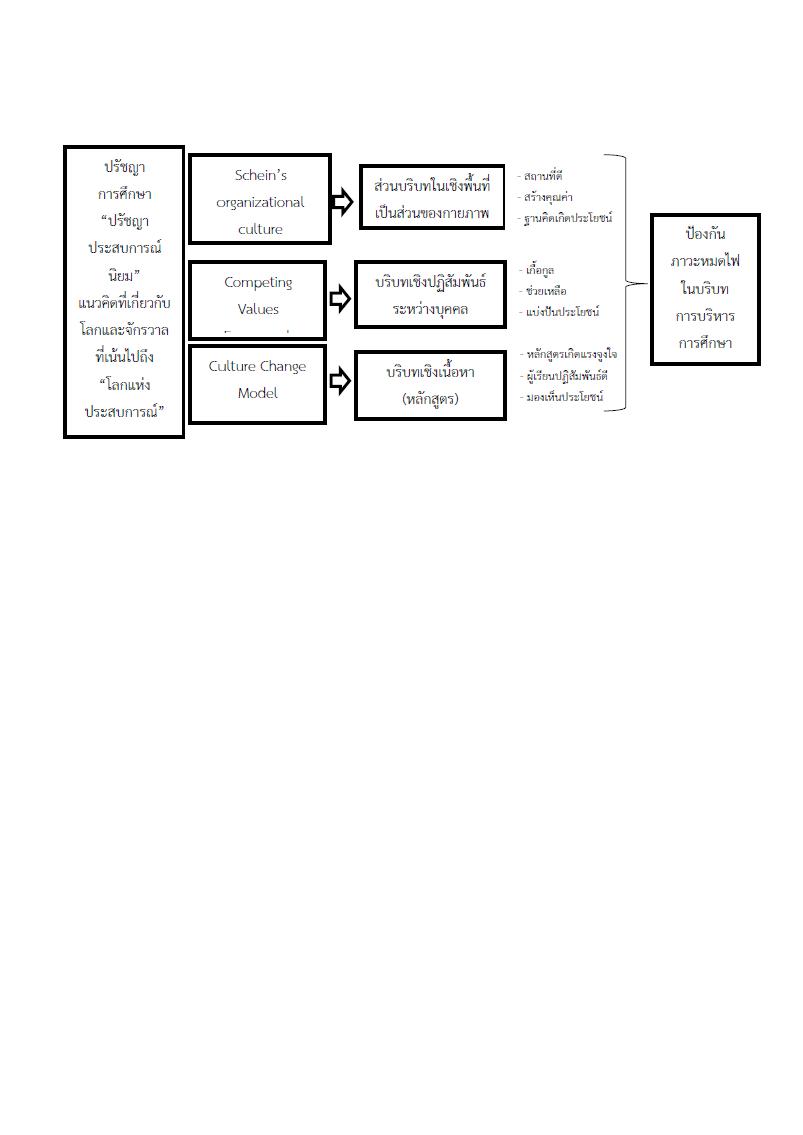
บทความวิชาการนี้มีวัตถุประสงค์เพื่อสังเคราะห์แนวคิดปรัชญาการศึกษาและทฤษฎีวัฒนธรรม องค์การ และนำเสนอแนวทางการประยุกต์เพื่อลดความเสี่ยงของภาวะหมดไฟ (Burnout) ในบริบท การบริหารการศึกษาของผู้บริหารสถานศึกษา ขอบเขตการสังเคราะห์ครอบคลุมปรัชญา ประสบการณ์นิยม ที่เน้น “โลกแห่งประสบการณ์” (The world of experience) และการเรียนรู้ โดยการลงมือทำ (Learning by Doing) ร่วมกับทฤษฎีวัฒนธรรมองค์การ 3 ทฤษฎี คือ 1) ทฤษฎีวัฒนธรรมองค์การของ Edgar Schein
2) Competing Values Framework (CVF) ของ Cameron และ Quinn และ 3) Culture Change Model ของ Roger Connors และ Tom Smith รวมถึงงานวิจัยเกี่ยวกับปัจจัยของภาวะหมดไฟในครู ผลการสังเคราะห์พบว่า ทฤษฎีทั้ง 3 มีความสอดคล้องกับบริบททางการศึกษา 3 บริบท คือ บริบทด้านสถานที่ สิ่งแวดล้อม และสิ่งที่เป็นรูปธรรมที่แสดงถึงอัตลักษณ์ของวัฒนธรรมองค์การ บริบทด้านหลักสูตร ที่เน้นผู้เรียนเป็นสำคัญ และการเรียนรู้ผ่านการลงมือทำ และบริบทด้านปฏิสัมพันธ์ระหว่างบุคคล ในสถานศึกษา ซึ่งเชื่อมโยงกับปัจจัยเสี่ยงของภาวะหมดไฟ ได้แก่ ประสบการณ์ทำงาน จำนวนชั่วโมงการสอน
และความสัมพันธ์กับเพื่อนร่วมงานข้อเสนอเชิงประยุกต์ คือ ผู้บริหารสถานศึกษาอาจใช้ ปรัชญาประสบการณ์นิยมและทฤษฎีวัฒนธรรมองค์การ เป็นกรอบในการสร้างประสบการณ์เชิงบวกให้ครูใหม่ การจัดสรรภาระงานอย่างเหมาะสม และการส่งเสริมวัฒนธรรมแบบเกื้อกูล ซึ่งอาจสนับสนุนการลดความเสี่ยง ของภาวะหมดไฟในที่ทำงาน และเอื้อต่อการสร้างอัตลักษณ์ที่ดีงามของวัฒนธรรมองค์การ อย่างไรก็ตาม ยังต้องมีการวิจัยเชิงประจักษ์เพื่อยืนยันความเชื่อมโยงดังกล่าว
Downloads
Article Details

อนุญาตภายใต้เงื่อนไข Creative Commons Attribution-NonCommercial-NoDerivatives 4.0 International License.
The authors are solely responsible for the ideas and recommendations presented in articles published in the LEAD Journal RU. If any inaccuracies occur, the authors accept full responsibility.
Moreover, the Editorial Board, Editorial Team, and Committee of the LEAD Journal RU are committed to maintaining the integrity of the principles reflected in the authors' contributions.
Consequently, Ramkhamhaeng University, the Editorial Board, Editorial Team, and Editors shall not be held liable for any outcomes arising from the authors' presentation of their ideas and recommendations within the LEAD Journal RU.
เอกสารอ้างอิง
Bloom, B. S. (Ed.). (1956). Taxonomy of educational objectives: The classification of educational goals. Handbook I: Cognitive domain. David McKay.
Bogale, A. T., & Debela, K. L. (2024). Organizational culture: A systematic review. Cogent Business & Management, 11(1), Article 2340129. https://doi.org/10.1080/23311975.2024.2340129
Bowen, G. A. (2009). Document analysis as a qualitative research method. Qualitative Research Journal, 9(2), 27–40. https://doi.org/10.3316/QRJ0902027
Cameron, K. S., & Quinn, R. E. (2006). Diagnosing and changing organizational culture: Based on the competing values framework (Rev. ed.). Jossey-Bass.
Connors, R., & Smith, T. (2011). Change the culture, change the game: The breakthrough strategy for energizing your organization and creating accountability for results. Portfolio/Penguin.
Dewey, J. (1916). Democracy and education: An introduction to the philosophy of education. Macmillan.
Dewey, J. (1938). Experience and education. Macmillan.
Freudenberger, H. J. (1974). Staff burn-out. Journal of Social Issues, 30(1), 159–165. https://doi.org/10.1111/j.1540-4560.1974.tb00706.x
Gordon, J. R. (1991). A diagnostic approach to organizational behavior (3rd ed.). Allyn and Bacon.
Khanthondee, P. (2019). A comparative study of organizational culture between secondary school and educational opportunity expansion school [Doctoral dissertation, Silpakorn University]. [In Thai]
Kneller, G. F. (1971). Introduction to the philosophy of education (2nd ed.). John Wiley & Sons.
Koutroubas, V., & Galanakis, M. (2022). Bandura’s social learning theory and its importance in the organizational psychology context. Psychology Research, 12(6), 315–322. https://doi.org/10.17265/2159-5542/2022.06.001
Maneewan, W., & Songbundit, A. (2022). Factors affecting teacher burnout of teachers under the Secondary Educational Service Area Office 2 in Bangkok. Educational Administration Journal, 19(36), 196–207. [In Thai]
Maslach, C. (1976). Burned-out. Human Behavior, 5(9), 16–22.
Maslach, C., & Jackson, S. E. (1981). The measurement of experienced burnout. Journal of Occupational Behaviour, 2(2), 99–113. https://doi.org/10.1002/job.4030020205
Maslach, C., & Leiter, M. P. (2016). Understanding the burnout experience: Recent research and its implications for psychiatry. World Psychiatry, 15(2), 103–111. https://doi.org/10.1002/wps.20311
O’Neill, D., De Vries, J., & Comiskey, C. M. (2021). Leadership and community healthcare reform: A study using the Competing Values Framework (CVF). Leadership in Health Services, 34(4), 485–498. https://doi.org/10.1108/LHS-01-2021-0007
Piaget, J. (1952). The origins of intelligence in children (M. Cook, Trans.). International Universities Press.
Pitilerdsirikul, N., & Parsongsuk, J. (2023). Philosophy of education and educational concept. Rajapark Journal, 17(52), 511–523. [In Thai]
Poonsawad, A., Raktham, A., Chirinang, P., & Tharawas, C. (2020). Sustainable organizational culture model. Humanities and Social Science Research Promotion Network Journal, 3(3), 109–119. [In Thai]
Royal Institute. (1982). Royal Institute dictionary B.E. 2525. Aksorn Charoen Tat. [In Thai]
Schein, E. H. (1992). Organizational culture and leadership (2nd ed.). Jossey-Bass.
Skaalvik, E. M., & Skaalvik, S. (2011). Teacher job satisfaction and motivation to leave the teaching profession: Relations with school context, feeling of belonging, and emotional exhaustion. Teaching and Teacher Education, 27(6), 1029–1038. https://doi.org/10.1016/j.tate.2011.04.001
Snyder, H. (2019). Literature review as a research methodology: An overview and guidelines. Journal of Business Research, 104, 333–339. https://doi.org/10.1016/j.jbusres.2019.07.039
Thornmart, S. (2023). Prevalence and factors affecting burnout in secondary school teachers under the Secondary Educational Service Area Office in the Health Region 7. KKU Journal for Public Health Research, 16(3), 135–156. https://he01.tci-thaijo.org/index.php/kkujphr/article/view/264424 [In Thai]
Torraco, R. J. (2005). Writing integrative literature reviews: Guidelines and examples. Human Resource Development Review, 4(3), 356–367. https://doi.org/10.1177/1534484305278283
Wongwaisayawan, S. (1997). Organizational culture: Concepts, research and experiences. Four Press. [In Thai]
World Health Organization. (2019, May 28). Burn-out an “occupational phenomenon”: International Classification of Diseases. https://www.who.int/news/item/28-05-2019-burn-out-an-occupational-phenomenon-international-classification-of-diseases
