
ภาวะผู้นำเชิงผู้ประกอบการของผู้บริหารสถานศึกษากับแนวทางการบริหารสถานศึกษาของรัฐ
Article Sidebar
Main Article Content
บทคัดย่อ
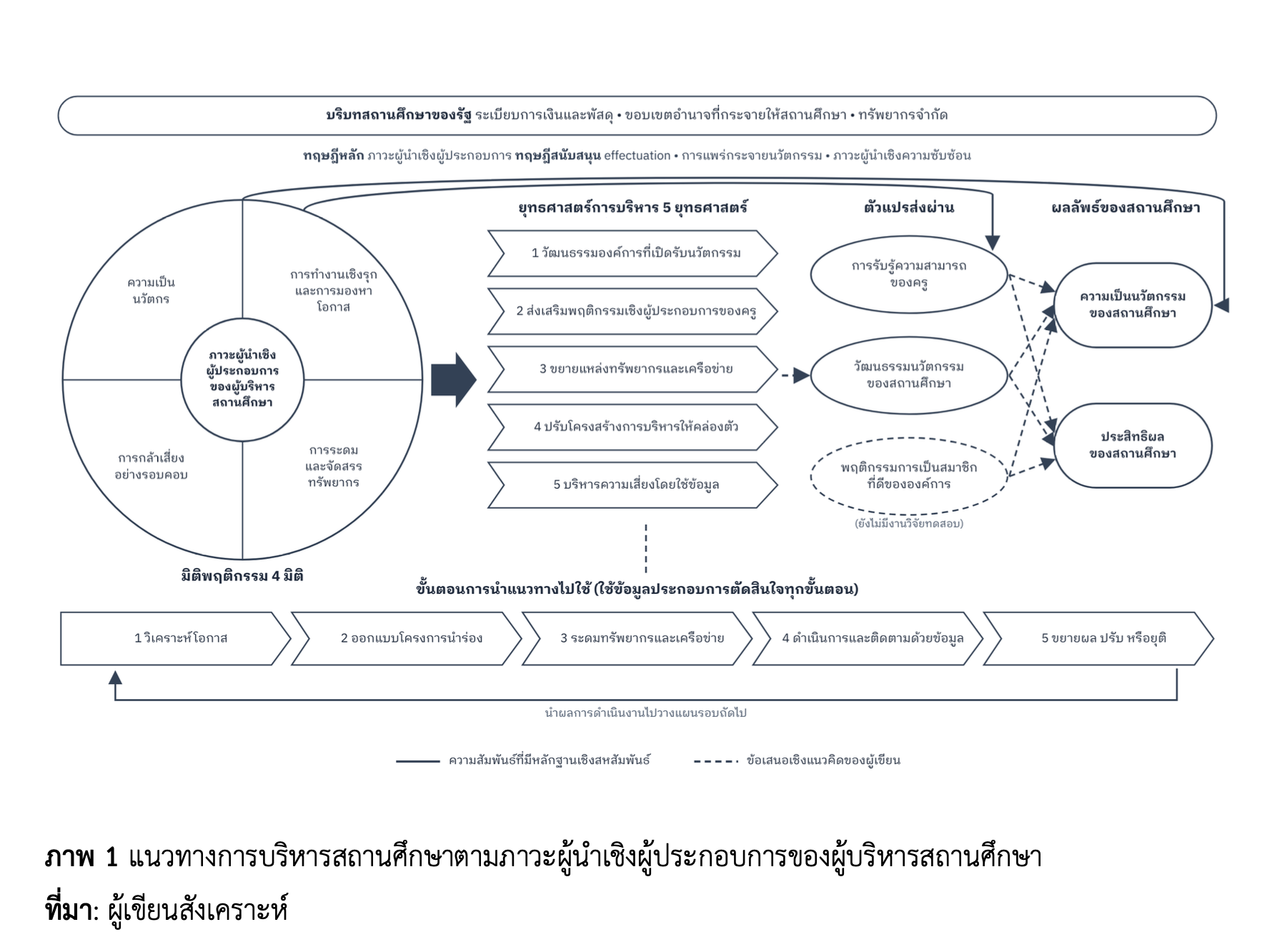
บทความวิชาการนี้มีวัตถุประสงค์เพื่อเสนอแนวทางการบริหารสถานศึกษาของรัฐตามแนวคิดภาวะผู้นำเชิงผู้ประกอบการของผู้บริหารสถานศึกษา โดยผู้เขียนเสนอแนวคิดว่าผู้บริหารสถานศึกษาของรัฐ ใช้ภาวะผู้นำเชิงผู้ประกอบการพัฒนาสถานศึกษาได้ หากมุ่งสร้างคุณค่าทางการศึกษาแทนผลกำไร และดำเนินงานภายใต้ระเบียบของทางราชการและทรัพยากรที่มีอยู่ จากการวิเคราะห์เอกสาร 30 รายการ ภาวะผู้นำเชิงผู้ประกอบการของผู้บริหารสถานศึกษาประกอบด้วย 4 มิติ ได้แก่ ความเป็นนวัตกร การทำงานเชิงรุกและการมองหาโอกาส การกล้าเสี่ยงอย่างรอบคอบ และการระดมและจัดสรรทรัพยากร แนวทางการบริหารที่เสนอประกอบด้วย 5 ยุทธศาสตร์ ได้แก่ การสร้างวัฒนธรรมองค์การที่เปิดรับนวัตกรรม การส่งเสริมพฤติกรรมเชิงผู้ประกอบการของครู การขยายแหล่งทรัพยากรและเครือข่ายความร่วมมือ การปรับโครงสร้างการบริหารให้คล่องตัว และการบริหารความเสี่ยงโดยใช้ข้อมูล และนำไปใช้เป็น 5 ขั้นตอน ตั้งแต่การวิเคราะห์โอกาสจนถึงการตัดสินใจขยายผล แนวทางนี้จะบรรลุผลเมื่อครูกล้าทดลองโดยไม่กังวลต่อ ความผิดพลาด สถานศึกษามีข้อมูลเพียงพอต่อการตัดสินใจ และการใช้ทรัพยากรเป็นไปตามระเบียบการเงิน ภาวะผู้นำเชิงผู้ประกอบการจึงเหมาะกับสถานศึกษาที่ต้องสร้างนวัตกรรมภายใต้ทรัพยากรจำกัด เมื่อผู้บริหารสถานศึกษาใช้ควบคู่กับการตัดสินใจโดยใช้ข้อมูล
Downloads
Article Details

อนุญาตภายใต้เงื่อนไข Creative Commons Attribution-NonCommercial-NoDerivatives 4.0 International License.
The authors are solely responsible for the ideas and recommendations presented in articles published in the LEAD Journal RU. If any inaccuracies occur, the authors accept full responsibility.
Moreover, the Editorial Board, Editorial Team, and Committee of the LEAD Journal RU are committed to maintaining the integrity of the principles reflected in the authors' contributions.
Consequently, Ramkhamhaeng University, the Editorial Board, Editorial Team, and Editors shall not be held liable for any outcomes arising from the authors' presentation of their ideas and recommendations within the LEAD Journal RU.
เอกสารอ้างอิง
Amorim Neto, R. do C., Rodrigues, V. P., Stewart, D., Xiao, A., & Snyder, J. (2018). The influence of self-efficacy on entrepreneurial behavior among K-12 teachers. Teaching and Teacher Education, 72, 44–53. https://doi.org/10.1016/j.tate.2018.02.012
Anderson, B. S., Kreiser, P. M., Kuratko, D. F., Hornsby, J. S., & Eshima, Y. (2015). Reconceptualizing entrepreneurial orientation. Strategic Management Journal, 36(10), 1579–1596. https://doi.org/10.1002/smj.2298
Bass, B. M., & Avolio, B. J. (1994). Improving organizational effectiveness through transformational leadership. SAGE Publications.
Cunningham, J. B., & Lischeron, J. (1991). Defining entrepreneurship. Journal of Small Business Management, 29(1), 45–61.
Edmondson, A. (1999). Psychological safety and learning behavior in work teams. Administrative Science Quarterly, 44(2), 350–383. https://doi.org/10.2307/2666999
Eyal, O., & Inbar, D. E. (2003). Developing a public school entrepreneurship inventory: Theoretical conceptualization and empirical examination. International Journal of Entrepreneurial Behavior & Research, 9(6), 221–244. https://doi.org/10.1108/13552550310501356
Fidan, T., & Balcı, A. (2016). Principal proactivity: School principals' proactive behavior forms and their levels of display. In Ş. Ş. Erçetin (Ed.), Applied chaos and complexity theory in education (pp. 29–58). IGI Global. https://doi.org/10.4018/978-1-5225-0460-3.ch003
Gracia-Zomeño, A., García-Toledano, E., García-Perales, R., & Palomares-Ruiz, A. (2025). Leadership and entrepreneurship in education and their impact on the management of sustainable educational environments. Sustainability, 17(7), Article 2911. https://doi.org/10.3390/su17072911
Gupta, V., MacMillan, I. C., & Surie, G. (2004). Entrepreneurial leadership: Developing and measuring a cross-cultural construct. Journal of Business Venturing, 19(2), 241–260. https://doi.org/10.1016/S0883-9026(03)00040-5
Jaiyasuk, S., & Amnuairat, S. (2024). The relationship between innovative leadership of school administrators and teachers' educational practices under Phayao Primary Educational Service Area 1. Udon Rajabhat University Academic Journal, 12(1), 81–93. https://so06.tci-thaijo.org/index.php/UDRUAJ/article/view/271678 [In Thai]
Jinke, L., Abdul Aziz, N. A., & Abdul Kadir, S. (2025). How significantly are principal and teacher entrepreneurial leadership related to teacher efficacy and organizational effectiveness in China? Frontiers in Education, 10, Article 1545888. https://doi.org/10.3389/feduc.2025.1545888
Kingsarakaraach, S., & Linjareung, U. (2024). The guidelines developing entrepreneurial leadership of the administrators under Phitsanulok Primary Educational Service Area Office 2. Journal of MCU Ubon Review, 9(2), 873–888. https://so06.tci-thaijo.org/index.php/mcjou/article/view/274115 [In Thai]
Kodae, H., & Sangtong, E. (2021). Guidelines for developing entrepreneurial leadership of school administrators according to teachers' perspective under the Secondary Educational Service Area Office 15. The Journal of Research and Academics, 4(4), 221–234. https://so06.tci-thaijo.org/index.php/jra/article/download/246221/169612/897060 [In Thai]
Lee, M., & Louis, K. S. (2019). Mapping a strong school culture and linking it to sustainable school improvement. Teaching and Teacher Education, 81, 84–96. https://doi.org/10.1016/j.tate.2019.02.001
Leithwood, K., Patten, S., & Jantzi, D. (2010). Testing a conception of how school leadership influences student learning. Educational Administration Quarterly, 46(5), 671–706. https://doi.org/10.1177/0013161X10377347
Ministry of Education. (2007, May 16). Ministerial regulation prescribing criteria and procedures for the decentralization of educational administration and management B.E. 2550 (2007). Royal Thai Government Gazette, 124(24A), 29–36. http://backoffice.onec.go.th/uploaded/Category/Laws/RuleMetDistEdMnt2550-02-12-2010.pdf [In Thai]
Pihie, Z. A. L., Asimiran, S., & Bagheri, A. (2014). Entrepreneurial leadership practices and school innovativeness. South African Journal of Education, 34(1), Article 704, 1–11. https://doi.org/10.15700/201412120955
Pihie, Z. A. L., Dahiru, A. S., Basri, R., & Hassan, S. A. (2018). Relationship between entrepreneurial leadership and school effectiveness among secondary schools. International Journal of Academic Research in Accounting, Finance and Management Sciences, 8(3), 258–274. https://doi.org/10.6007/IJARAFMS/v8-i3/5010
Ravet-Brown, T. É., Furtner, M., & Kallmuenzer, A. (2024). Transformational and entrepreneurial leadership: A review of distinction and overlap. Review of Managerial Science, 18(2), 493–538. https://doi.org/10.1007/s11846-023-00649-6
Renko, M., El Tarabishy, A., Carsrud, A. L., & Brännback, M. (2015). Understanding and measuring entrepreneurial leadership style. Journal of Small Business Management, 53(1), 54–74. https://doi.org/10.1111/jsbm.12086
Rogers, E. M. (2003). Diffusion of innovations (5th ed.). Free Press.
Sarasvathy, S. D. (2001). Causation and effectuation: Toward a theoretical shift from economic inevitability to entrepreneurial contingency. Academy of Management Review, 26(2), 243–263. https://doi.org/10.5465/amr.2001.4378020
Schildkamp, K. (2019). Data-based decision-making for school improvement: Research insights and gaps. Educational Research, 61(3), 257–273. https://doi.org/10.1080/00131881.2019.1625716
Sheninger, E. C. (2019). Digital leadership: Changing paradigms for changing times (2nd ed.). Corwin.
Shie, E.-H., & Chang, S.-H. (2022). Perceived principal's authentic leadership impact on the organizational citizenship behavior and well-being of teachers. SAGE Open, 12(2), Article 21582440221095003. https://doi.org/10.1177/21582440221095003
Sriprom, S., & Sodiang, P. (2024). Digital leadership of school administrator affecting innovative organization of school under Loei Nongbualamphu the Secondary Educational Service. Journal of Mani Chettha Ram Wat Chommani, 7(5), 816–832. https://so07.tci-thaijo.org/index.php/JMCR/article/view/5682 [In Thai]
Thornberry, N. (2006). Lead like an entrepreneur: Keeping the fire alive without burning the house down. McGraw-Hill.
Uhl-Bien, M., Marion, R., & McKelvey, B. (2007). Complexity leadership theory: Shifting leadership from the industrial age to the knowledge era. The Leadership Quarterly, 18(4), 298–318. https://doi.org/10.1016/j.leaqua.2007.04.002
Watthanapanich, A., & Suwannawong, A. (2025). Digital leadership of school administrators under the Secondary Educational Service Area Office Bangkok 2. Journal of Modern Academic Development and Promotion, 3(2), 842–873. https://so12.tci-thaijo.org/index.php/MADPIADP/article/view/2375 [In Thai]
Wiphawin, C., Buasuwan, P., & Sarsawang, S. (2026). Decision-making factors of school administrators using evidence-based practices affecting the administrative efficiency: A case study of the Secondary Educational Service Area Office Bangkok Area 2. Journal of Mani Chettha Ram Wat Chommani, 9(2), 337–349. https://so07.tci-thaijo.org/index.php/JMCR/article/view/10303 [In Thai]