การบริหารโรงเรียนอย่างยั่งยืนในยุคปัญญาประดิษฐ์
Article Sidebar
Main Article Content
บทคัดย่อ
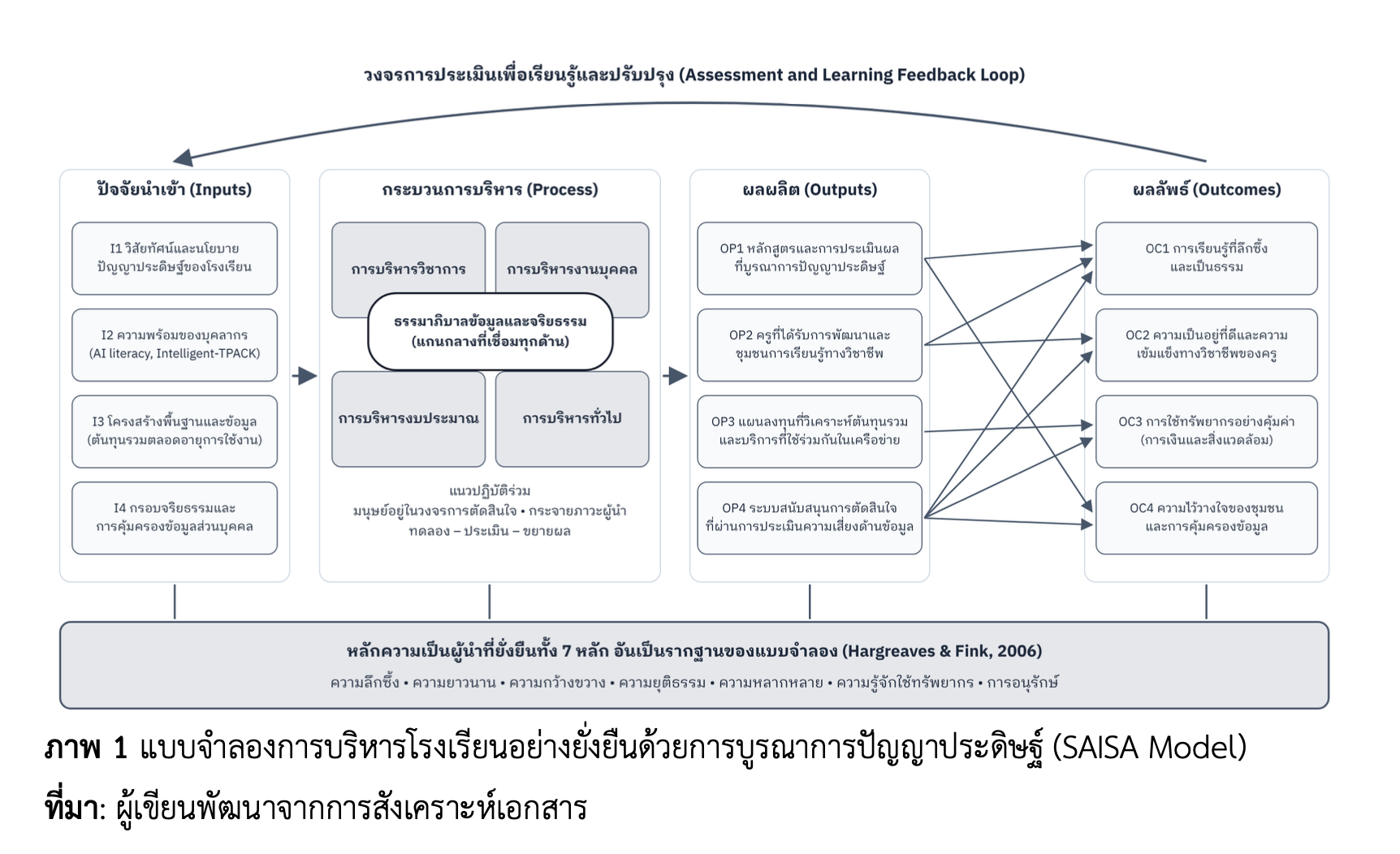
บทความวิชาการนี้มีวัตถุประสงค์เพื่อ 1) สังเคราะห์แนวคิดและทฤษฎีที่ใช้อธิบาย การบริหาร โรงเรียนอย่างยั่งยืนในยุคปัญญาประดิษฐ์ (artificial intelligence: AI) 2) วิเคราะห์โอกาสและความเสี่ยง ของการใช้ปัญญาประดิษฐ์ในการบริหารสถานศึกษาแต่ละด้าน และ 3) นำเสนอแบบจำลองและข้อเสนอแนะ สำหรับผู้บริหารสถานศึกษาและผู้กำหนดนโยบาย ผู้เขียนใช้การทบทวนวรรณกรรมเชิงบูรณาการ และการวิเคราะห์เอกสารเชิงคุณภาพกับเอกสาร 44 รายการ จัดสาระตามขอบข่ายการบริหารสถานศึกษา 4 ด้าน ได้แก่ วิชาการ บุคคล งบประมาณ และทั่วไป และใช้หลักความเป็นผู้นำที่ยั่งยืน แนวคิดระบบสังคม เทคนิค และกรอบ TPACK เป็นกรอบวิเคราะห์ ผลการสังเคราะห์พบว่า ปัญญาประดิษฐ์ช่วยให้ การจัดการเรียนรู้ตอบสนองผู้เรียนรายบุคคล ลดภาระงานที่ไม่ใช่การสอนของครู และสนับสนุนการตัดสินใจ โดยใช้ข้อมูล อย่างไรก็ตามหลักฐานจากบริบทโรงเรียนยังมีจำกัด และมีความเสี่ยงด้านความเป็นส่วนตัว ของข้อมูล ความลำเอียงของขั้นตอนวิธี ความเหลื่อมล้ำทางดิจิทัล และต้นทุนระยะยาว ผู้เขียนเสนอ แบบจำลอง SAISA (Sustainable AI-Integrated School Administration Model) ซึ่งประกอบด้วย ปัจจัยนำเข้า กระบวนการบริหาร 4 ด้านที่มีธรรมาภิบาลข้อมูลเป็นแกนกลาง ผลผลิต ผลลัพธ์ความยั่งยืน และวงจรการประเมินเพื่อเรียนรู้และปรับปรุง พร้อมข้อเสนอแนะสำหรับผู้บริหารสถานศึกษา หน่วยงานต้นสังกัด และผู้กำหนดนโยบาย
Downloads
Article Details

อนุญาตภายใต้เงื่อนไข Creative Commons Attribution-NonCommercial-NoDerivatives 4.0 International License.
The authors are solely responsible for the ideas and recommendations presented in articles published in the LEAD Journal RU. If any inaccuracies occur, the authors accept full responsibility.
Moreover, the Editorial Board, Editorial Team, and Committee of the LEAD Journal RU are committed to maintaining the integrity of the principles reflected in the authors' contributions.
Consequently, Ramkhamhaeng University, the Editorial Board, Editorial Team, and Editors shall not be held liable for any outcomes arising from the authors' presentation of their ideas and recommendations within the LEAD Journal RU.
เอกสารอ้างอิง
Baker, R. S., & Hawn, A. (2022). Algorithmic bias in education. International Journal of Artificial Intelligence in Education, 32(4), 1052–1092. https://doi.org/10.1007/s40593-021-00285-9
Baxter, G., & Sommerville, I. (2011). Socio-technical systems: From design methods to systems engineering. Interacting with Computers, 23(1), 4–17. https://doi.org/10.1016/j.intcom.2010.07.003
Bond, M., Khosravi, H., De Laat, M., Bergdahl, N., Negrea, V., Oxley, E., Pham, P., Chong, S. W., & Siemens, G. (2024). A meta systematic review of artificial intelligence in higher education: A call for increased ethics, collaboration, and rigour. International Journal of Educational Technology in Higher Education, 21(1), Article 4. https://doi.org/10.1186/s41239-023-00436-z
Celik, I. (2023). Towards Intelligent-TPACK: An empirical study on teachers' professional knowledge to ethically integrate artificial intelligence (AI)-based tools into education. Computers in Human Behavior, 138, Article 107468. https://doi.org/10.1016/j.chb.2022.107468
Chiu, T. K. F. (2024). The impact of Generative AI (GenAI) on practices, policies and research direction in education: A case of ChatGPT and Midjourney. Interactive Learning Environments, 32(10), 6187–6203. https://doi.org/10.1080/10494820.2023.2253861
Chiu, T. K. F., Xia, Q., Zhou, X., Chai, C. S., & Cheng, M. (2023). Systematic literature review on opportunities, challenges, and future research recommendations of artificial intelligence in education. Computers and Education: Artificial Intelligence, 4, Article 100118. https://doi.org/10.1016/j.caeai.2022.100118
Clausen, R., Stoddard, C., & Hill, A. (2026). Montana early warning system for dropout prevention: Data use, mediating factors, and impact. Education Policy Analysis Archives, 34(7). https://doi.org/10.14507/epaa.34.8700
Fullan, M., Azorín, C., Harris, A., & Jones, M. (2024). Artificial intelligence and school leadership: Challenges, opportunities and implications. School Leadership & Management, 44(4), 339–346. https://doi.org/10.1080/13632434.2023.2246856
Gabriel, G., Ferrão, M. E., & Prata, P. (2025). A scoping study of reviews on artificial intelligence in education. Eurasia Journal of Mathematics, Science and Technology Education, 21(11), Article em2731. https://doi.org/10.29333/ejmste/17344
Hargreaves, A., & Fink, D. (2006). Sustainable leadership. Jossey-Bass.
Hattie, J., & Timperley, H. (2007). The power of feedback. Review of Educational Research, 77(1), 81–112. https://doi.org/10.3102/003465430298487
Holmes, W., Bialik, M., & Fadel, C. (2019). Artificial intelligence in education: Promises and implications for teaching and learning. Center for Curriculum Redesign.
Holmes, W., Porayska-Pomsta, K., Holstein, K., Sutherland, E., Baker, T., Buckingham Shum, S., Santos, O. C., Rodrigo, M. T., Cukurova, M., Bittencourt, I. I., & Koedinger, K. R. (2022). Ethics of AI in education: Towards a community-wide framework. International Journal of Artificial Intelligence in Education, 32(3), 504–526. https://doi.org/10.1007/s40593-021-00239-1
Huangya, T., & Sittiwong, T. (2026). Guidelines for educational administration to promote ethical use of artificial intelligence in schools under the Phetchabun Secondary Educational Service Area Office. Journal of Buddhist Education and Research, 12(3), 605–624. https://so06.tci-thaijo.org/index.php/jber/article/view/292765 [In Thai]
Kasneci, E., Sessler, K., Küchemann, S., Bannert, M., Dementieva, D., Fischer, F., Gasser, U., Groh, G., Günnemann, S., Hüllermeier, E., Krusche, S., Kutyniok, G., Michaeli, T., Nerdel, C., Pfeffer, J., Poquet, O., Sailer, M., Schmidt, A., Seidel, T., … Kasneci, G. (2023). ChatGPT for good? On opportunities and challenges of large language models for education. Learning and Individual Differences, 103, Article 102274. https://doi.org/10.1016/j.lindif.2023.102274
Kulik, J. A., & Fletcher, J. D. (2016). Effectiveness of intelligent tutoring systems: A meta-analytic review. Review of Educational Research, 86(1), 42–78. https://doi.org/10.3102/0034654315581420
Létourneau, A., Deslandes Martineau, M., Charland, P., Karran, J. A., Boasen, J., & Léger, P.-M. (2025). A systematic review of AI-driven intelligent tutoring systems (ITS) in K-12 education. npj Science of Learning, 10(1), Article 29. https://doi.org/10.1038/s41539-025-00320-7
Long, D., & Magerko, B. (2020). What is AI literacy? Competencies and design considerations. In Proceedings of the 2020 CHI Conference on Human Factors in Computing Systems (pp. 1–16). Association for Computing Machinery. https://doi.org/10.1145/3313831.3376727
Luckin, R., Holmes, W., Griffiths, M., & Forcier, L. B. (2016). Intelligence unleashed: An argument for AI in education. Pearson.
Malek Ash, A. (2025, June 24). Three in 10 teachers use AI weekly, saving six weeks a year. Gallup. https://news.gallup.com/poll/691967/three-teachers-weekly-saving-six-weeks-year.aspx
Mandinach, E. B., & Schildkamp, K. (2021). Misconceptions about data-based decision making in education: An exploration of the literature. Studies in Educational Evaluation, 69, Article 100842. https://doi.org/10.1016/j.stueduc.2020.100842
Miao, F., & Holmes, W. (2023). Guidance for generative AI in education and research. UNESCO. https://doi.org/10.54675/EWZM9535
Ministry of Education. (2007, May 16). Ministerial regulation prescribing criteria and procedures for the decentralization of educational administration and management B.E. 2550 (2007). Royal Thai Government Gazette, 124(24A), 29–36. http://backoffice.onec.go.th/uploaded/Category/Laws/RuleMetDistEdMnt2550-02-12-2010.pdf [In Thai]
Mishra, P., & Koehler, M. J. (2006). Technological pedagogical content knowledge: A framework for teacher knowledge. Teachers College Record, 108(6), 1017–1054. https://doi.org/10.1111/j.1467-9620.2006.00684.x
Mishra, P., Warr, M., & Islam, R. (2023). TPACK in the age of ChatGPT and generative AI. Journal of Digital Learning in Teacher Education, 39(4), 235–251. https://doi.org/10.1080/21532974.2023.2247480
National Electronics and Computer Technology Center. (2022). Thailand national AI strategy and action plan (2022–2027). https://ai.in.th/en/about-ai-thailand/
Ng, D. T. K., Leung, J. K. L., Chu, S. K. W., & Qiao, M. S. (2021). Conceptualizing AI literacy: An exploratory review. Computers and Education: Artificial Intelligence, 2, Article 100041. https://doi.org/10.1016/j.caeai.2021.100041
OECD. (2023). OECD digital education outlook 2023: Towards an effective digital education ecosystem. OECD Publishing. https://doi.org/10.1787/c74f03de-en
Personal Data Protection Act B.E. 2562. (2019, May 27). Royal Thai Government Gazette, 136(69A), 52–95. https://ratchakitcha.soc.go.th/documents/17082307.pdf [In Thai]
Phungngam, P. (2026). The potential of AI in supporting school administrators' decision-making. The Journal of Research and Academics, 9(3), 337–356. https://so06.tci-thaijo.org/index.php/jra/article/view/283034 [In Thai]
Psyridou, M., Prezja, F., Torppa, M., Lerkkanen, M.-K., Poikkeus, A.-M., & Vasalampi, K. (2024). Machine learning predicts upper secondary education dropout as early as the end of primary school. Scientific Reports, 14(1), Article 12956. https://doi.org/10.1038/s41598-024-63629-0
Selwyn, N. (2019). Should robots replace teachers? AI and the future of education. Polity Press.
Selwyn, N. (2024). Digital degrowth: Toward radically sustainable education technology. Learning, Media and Technology, 49(2), 186–199. https://doi.org/10.1080/17439884.2022.2159978
Sims, S., Fletcher-Wood, H., O'Mara-Eves, A., Cottingham, S., Stansfield, C., Goodrich, J., Van Herwegen, J., & Anders, J. (2025). Effective teacher professional development: New theory and a meta-analytic test. Review of Educational Research, 95(2), 213–254. https://doi.org/10.3102/00346543231217480
Slade, S., & Prinsloo, P. (2013). Learning analytics: Ethical issues and dilemmas. American Behavioral Scientist, 57(10), 1510–1529. https://doi.org/10.1177/0002764213479366
Snyder, H. (2019). Literature review as a research methodology: An overview and guidelines. Journal of Business Research, 104, 333–339. https://doi.org/10.1016/j.jbusres.2019.07.039
Suntawan, T. (2025). Study of the needs for using artificial intelligence in school administration of graduate students, Faculty of Education, Nakhon Sawan Rajabhat University. Education Journal, Faculty of Education, Nakhon Sawan Rajabhat University, 8(2), 499–511. https://so02.tci-thaijo.org/index.php/edunsrujo/article/view/278630 [In Thai]
Tyson, M. M., & Sauers, N. J. (2021). School leaders' adoption and implementation of artificial intelligence. Journal of Educational Administration, 59(3), 271–285. https://doi.org/10.1108/JEA-10-2020-0221
UNESCO. (2023). Global education monitoring report 2023: Technology in education: A tool on whose terms? UNESCO. https://doi.org/10.54676/UZQV8501
van Dijk, J. (2020). The digital divide. Polity Press.
Venkatesh, V., Morris, M. G., Davis, G. B., & Davis, F. D. (2003). User acceptance of information technology: Toward a unified view. MIS
Quarterly, 27(3), 425–478. https://doi.org/10.2307/30036540
Venkatesh, V., Thong, J. Y. L., & Xu, X. (2012). Consumer acceptance and use of information technology: Extending the unified theory of acceptance and use of technology. MIS Quarterly, 36(1), 157–178. https://doi.org/10.2307/41410412
W. K. Kellogg Foundation. (2004). Logic model development guide: Using logic models to bring together planning, evaluation, and action.
W. K. Kellogg Foundation.
Wang, Y. (2021). Artificial intelligence in educational leadership: A symbiotic role of human-artificial intelligence decision-making. Journal of Educational Administration, 59(3), 256–270. https://doi.org/10.1108/JEA-10-2020-0216
Williamson, B. (2017). Big data in education: The digital future of learning, policy and practice. SAGE.
Williamson, B., & Eynon, R. (2020). Historical threads, missing links, and future directions in AI in education. Learning, Media and Technology, 45(3), 223–235. https://doi.org/10.1080/17439884.2020.1798995