A Development of a Charismatic Leadership Scale for Undergraduate Students in the Faculty of Engineering
Article Sidebar
Main Article Content
Abstract
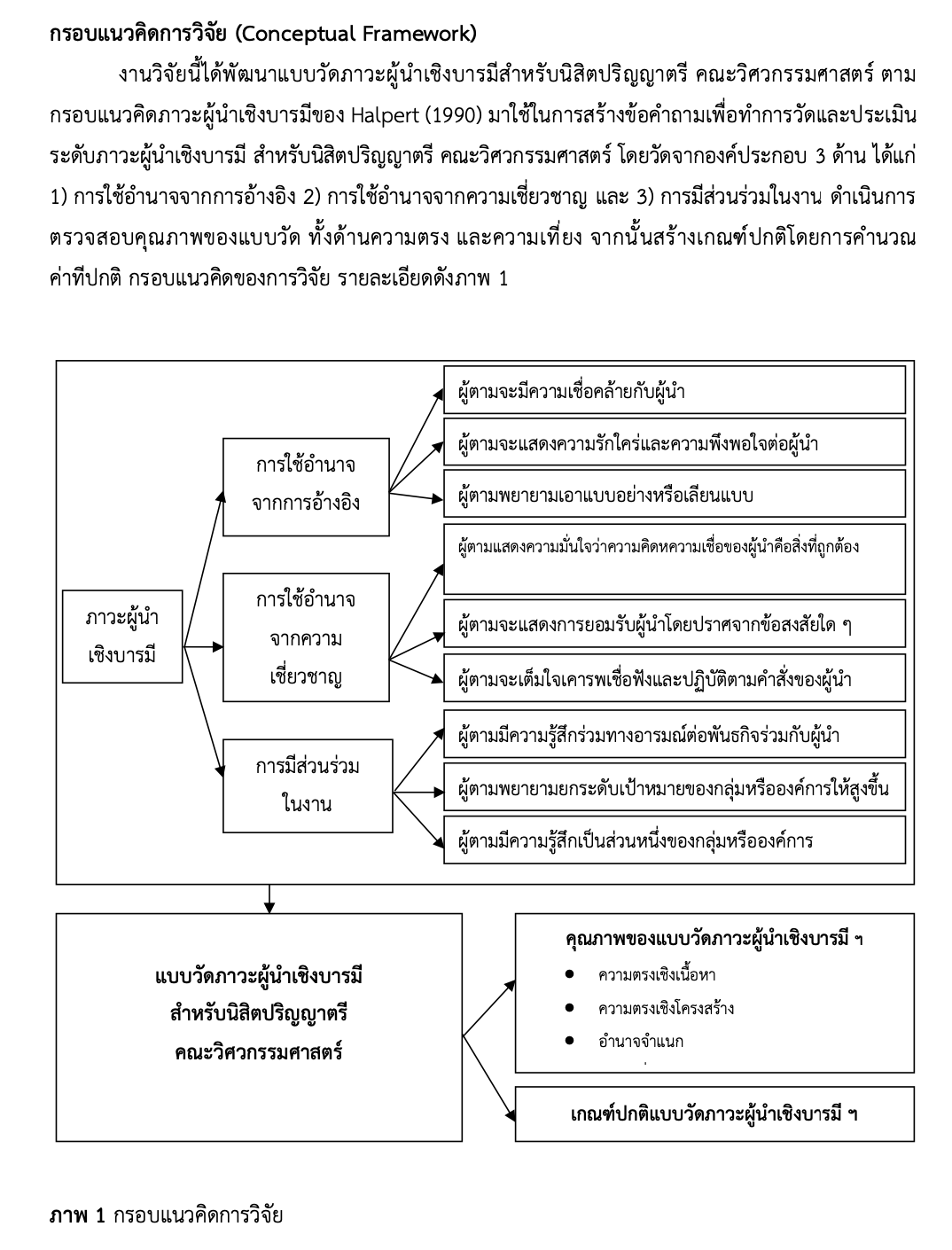
The purposes of this research were to 1) develop and test the quality of the charismatic leadership scale for undergraduate students in the faculty of engineering, and 2) establish the norms of the charismatic leadership scale for undergraduate students in the faculty of engineering. The data were collected from 254 fourth-year engineering students at an autonomous university in Bangkok, using multi-stage random sampling. Data were analyzed using descriptive statistics, content validity, and confirmatory factor analysis for discrimination, reliability, and construct validity. The research findings were as follows: 1) On the charismatic leadership scale, there were 9 questions in total, consisting of 3 components: The first component is the referent power, consisting of 3 items; the second component is the expert power, consisting of 3 items; and the third component is the job involvement, consisting of
3 items. The charismatic leadership scale for undergraduate students is a 5-point rating scale. The content validity of the scale (IOC) ranged from 0.67 to 1.00; the item discrimination ranged from 0.70 to 0.84; The second-order confirmatory factor analysis of the measurement model fitted to the empirical data (χ2/df = 1.59, RMSEA = .048, RMR = .020, CFI = .992, GFI = .998, AGFI = .996), the reliability (Cronbach's Alpha) was 0.94, and 2) The norm was divided into five levels: T66 or above, T55-T65, T45-T54, T35-T44, and T34, representing very high, high, moderate, low, and very low levels. The results indicated that the normalized T-scores for charismatic leadership among undergraduate engineering students ranged from T28 to T66.
Downloads
Article Details

This work is licensed under a Creative Commons Attribution-NonCommercial-NoDerivatives 4.0 International License.
แนวคิดและข้อเสนอแนะที่นำเสนอในบทความของวารสารการบริหารและความเป็นผู้นำทางการศึกษา มหาวิทยาลัยรามคำแหง เป็นแนวคิดที่มาจากผู้เขียน หากมีความผิดพลาดใด ๆ ผู้เขียนเป็นผู้รับผิดชอบแต่เพียงผู้เดียว
ทั้งนี้ บรรณาธิการ กองบรรณาธิการ และคณะกรรมการหน่วยจัดทำวารสารฯ จะไม่ก้าวก่ายความมั่นคงในหลักการตามความคิดของผู้เขียน
ดังนั้น บรรณาธิการ กองบรรณาธิการ คณะกรรมการหน่วยจัดทำวารสาร และมหาวิทยาลัย จะไม่รับผิดชอบใด ๆ จากผลที่เกิดขึ้นจากการนำเสนอแนวคิด และข้อเสนอแนะของผู้แต่งที่เผยแพร่ในวารสารฯ
References
Avolio, B. J. (2011). Full range leadership development. Thousand Oaks: Sage.
Bass, B. M. (1985). Leadership and performance beyond expectations. New York: The Free Press.
Byrne, B. M. (1994). Structural equation modeling with EQS and EQS/Windows.
Thousand Oaks, CA: Sage Publications.
Chawan, P. (1977). The Construction of Standardized tests for Matthayomsueksa 3.
The Printing House of The Thacher’ Council. [in Thai]
Conger, J.A. & Kanungo, R.N. (1998). Charismatic leadership in organizations.
Thousand Oaks, CA: Sage Publications.
Hair, J., Black, W., Babin, B., & Anderson, E. (2010). Multivariate data analysis (7th ed.).
London: Pearson Education Limited.
House J. Robert. (1976). A 1976 Theory of Charismatic Leadership. The Southern
Illinois University Fourth Biennial Leadership Symposium. Carbondale, Illinois:
Southern Illinois University.
Jane, A. Halpert. (1990). The Dimensionality of Charisma. Journal of Business and
Psychology, 4(4), 399-410.
Kanjanawasee, S. (2001). Classical Test Theory.Chulalongkorn University Printing House.
[in Thai]
Kanjanawasee, S. (2013). Classical Test Theory.Chulalongkorn University Printing House.
[in Thai]
Khumsung, J. (2023). Buddhist psychological leadership competencies for promoting
Thai engineers’ happiness at work [in Thai]. Journal of Applied Buddhist
Psychology for Society, 9(1), 251-264. [in Thai].
Leekitwattana, P. (2016). Research methods in education (11th ed.). Mean Service
Supply. [in Thai]
Nunnally, J. C., and Bernstein, I. H. (1994). Psychometric theory (3rd ed). New York:
Mc Graw-Hill.
Paseefol, C. (2011). Construction and development of educational measurement and
evaluation tools (2nd ed.). Chulalongkorn University Press. [in Thai]
Panpinit, S. (2011). Social science research techniques (2nd ed.). Wittayaphat. [in Thai].
Phairatkul, C. (1977). Manual for constructing standardized achievement tests for
Grade 9 students. The Printing House of The Thacher’ Council. [in Thai].
Phuttiyatanee, S. (2019). Education Measurement.Prasan Printing. [in Thai]
Suwannajaroen, J., & et al. (2017). Instructional models for promoting 21st century skills
of nursing students [in Thai]. Nursing Journal, 44(4), 177-188. [in Thai].
Weber. (1947). The Theory of Social and Economic Organization. A.M. Henderson
and T. Parsons (trans). New York: Free Press.
Yukl Gary. (2014). Charismatic and Transformational Leadership. Leadership in
Organizational. 138. Tamil Nadu, India: HT Media Ltd.
