Sustainable School Administration in the Age of Artificial Intelligence
Article Sidebar
Main Article Content
Abstract
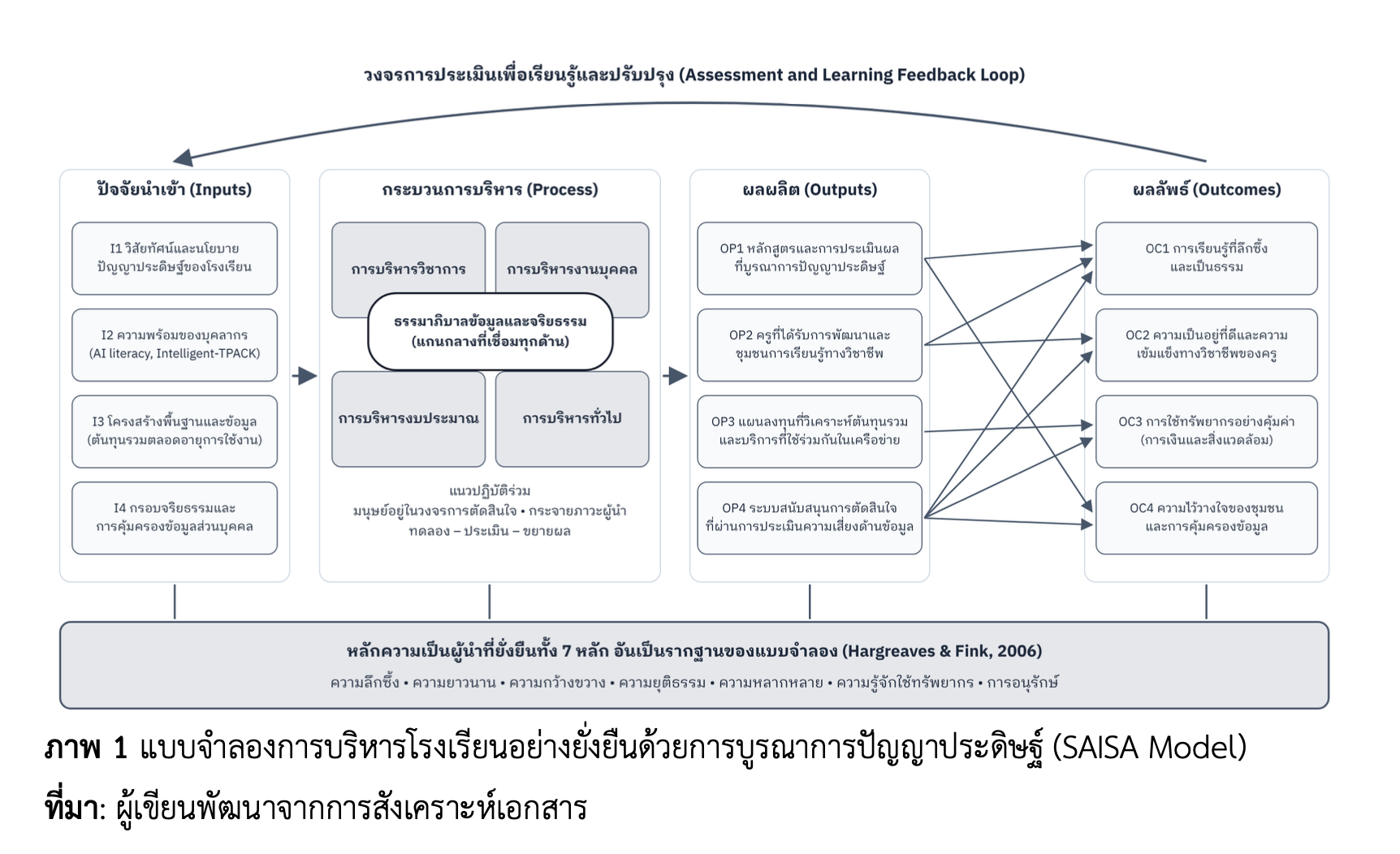
This academic article aims to 1) synthesize concepts and theories explaining sustainable school administration in the age of artificial intelligence (AI), 2) analyze the opportunities and risks of AI in each domain of school administration, and 3) propose a model and recommendations for school administrators and policymakers. The author conducted an integrative literature review and qualitative document analysis of 44 documents, organized by Thailand's four domains of school administration (academic affairs, personnel, budget, and general administration), using sustainable leadership, sociotechnical systems theory, and TPACK as analytical lenses. The synthesis shows that AI can support personalized learning, reduce teachers' non-teaching workload, and strengthen data-informed decisions. However, school-based evidence remains limited, and AI use carries risks of privacy breaches, algorithmic bias, digital inequality, and long-term costs. The article proposes the SAISA Model (Sustainable AI-Integrated School Administration), comprising inputs, four administrative processes anchored by data governance, outputs, sustainability outcomes, and an assessment-and-learning feedback loop, with recommendations for school administrators, educational service area offices, and policymakers.
Downloads
Article Details

This work is licensed under a Creative Commons Attribution-NonCommercial-NoDerivatives 4.0 International License.
แนวคิดและข้อเสนอแนะที่นำเสนอในบทความของวารสารการบริหารและความเป็นผู้นำทางการศึกษา มหาวิทยาลัยรามคำแหง เป็นแนวคิดที่มาจากผู้เขียน หากมีความผิดพลาดใด ๆ ผู้เขียนเป็นผู้รับผิดชอบแต่เพียงผู้เดียว
ทั้งนี้ บรรณาธิการ กองบรรณาธิการ และคณะกรรมการหน่วยจัดทำวารสารฯ จะไม่ก้าวก่ายความมั่นคงในหลักการตามความคิดของผู้เขียน
ดังนั้น บรรณาธิการ กองบรรณาธิการ คณะกรรมการหน่วยจัดทำวารสาร และมหาวิทยาลัย จะไม่รับผิดชอบใด ๆ จากผลที่เกิดขึ้นจากการนำเสนอแนวคิด และข้อเสนอแนะของผู้แต่งที่เผยแพร่ในวารสารฯ
References
Baker, R. S., & Hawn, A. (2022). Algorithmic bias in education. International Journal of Artificial Intelligence in Education, 32(4), 1052–1092. https://doi.org/10.1007/s40593-021-00285-9
Baxter, G., & Sommerville, I. (2011). Socio-technical systems: From design methods to systems engineering. Interacting with Computers, 23(1), 4–17. https://doi.org/10.1016/j.intcom.2010.07.003
Bond, M., Khosravi, H., De Laat, M., Bergdahl, N., Negrea, V., Oxley, E., Pham, P., Chong, S. W., & Siemens, G. (2024). A meta systematic review of artificial intelligence in higher education: A call for increased ethics, collaboration, and rigour. International Journal of Educational Technology in Higher Education, 21(1), Article 4. https://doi.org/10.1186/s41239-023-00436-z
Celik, I. (2023). Towards Intelligent-TPACK: An empirical study on teachers' professional knowledge to ethically integrate artificial intelligence (AI)-based tools into education. Computers in Human Behavior, 138, Article 107468. https://doi.org/10.1016/j.chb.2022.107468
Chiu, T. K. F. (2024). The impact of Generative AI (GenAI) on practices, policies and research direction in education: A case of ChatGPT and Midjourney. Interactive Learning Environments, 32(10), 6187–6203. https://doi.org/10.1080/10494820.2023.2253861
Chiu, T. K. F., Xia, Q., Zhou, X., Chai, C. S., & Cheng, M. (2023). Systematic literature review on opportunities, challenges, and future research recommendations of artificial intelligence in education. Computers and Education: Artificial Intelligence, 4, Article 100118. https://doi.org/10.1016/j.caeai.2022.100118
Clausen, R., Stoddard, C., & Hill, A. (2026). Montana early warning system for dropout prevention: Data use, mediating factors, and impact. Education Policy Analysis Archives, 34(7). https://doi.org/10.14507/epaa.34.8700
Fullan, M., Azorín, C., Harris, A., & Jones, M. (2024). Artificial intelligence and school leadership: Challenges, opportunities and implications. School Leadership & Management, 44(4), 339–346. https://doi.org/10.1080/13632434.2023.2246856
Gabriel, G., Ferrão, M. E., & Prata, P. (2025). A scoping study of reviews on artificial intelligence in education. Eurasia Journal of Mathematics, Science and Technology Education, 21(11), Article em2731. https://doi.org/10.29333/ejmste/17344
Hargreaves, A., & Fink, D. (2006). Sustainable leadership. Jossey-Bass.
Hattie, J., & Timperley, H. (2007). The power of feedback. Review of Educational Research, 77(1), 81–112. https://doi.org/10.3102/003465430298487
Holmes, W., Bialik, M., & Fadel, C. (2019). Artificial intelligence in education: Promises and implications for teaching and learning. Center for Curriculum Redesign.
Holmes, W., Porayska-Pomsta, K., Holstein, K., Sutherland, E., Baker, T., Buckingham Shum, S., Santos, O. C., Rodrigo, M. T., Cukurova, M., Bittencourt, I. I., & Koedinger, K. R. (2022). Ethics of AI in education: Towards a community-wide framework. International Journal of Artificial Intelligence in Education, 32(3), 504–526. https://doi.org/10.1007/s40593-021-00239-1
Huangya, T., & Sittiwong, T. (2026). Guidelines for educational administration to promote ethical use of artificial intelligence in schools under the Phetchabun Secondary Educational Service Area Office. Journal of Buddhist Education and Research, 12(3), 605–624. https://so06.tci-thaijo.org/index.php/jber/article/view/292765 [In Thai]
Kasneci, E., Sessler, K., Küchemann, S., Bannert, M., Dementieva, D., Fischer, F., Gasser, U., Groh, G., Günnemann, S., Hüllermeier, E., Krusche, S., Kutyniok, G., Michaeli, T., Nerdel, C., Pfeffer, J., Poquet, O., Sailer, M., Schmidt, A., Seidel, T., … Kasneci, G. (2023). ChatGPT for good? On opportunities and challenges of large language models for education. Learning and Individual Differences, 103, Article 102274. https://doi.org/10.1016/j.lindif.2023.102274
Kulik, J. A., & Fletcher, J. D. (2016). Effectiveness of intelligent tutoring systems: A meta-analytic review. Review of Educational Research, 86(1), 42–78. https://doi.org/10.3102/0034654315581420
Létourneau, A., Deslandes Martineau, M., Charland, P., Karran, J. A., Boasen, J., & Léger, P.-M. (2025). A systematic review of AI-driven intelligent tutoring systems (ITS) in K-12 education. npj Science of Learning, 10(1), Article 29. https://doi.org/10.1038/s41539-025-00320-7
Long, D., & Magerko, B. (2020). What is AI literacy? Competencies and design considerations. In Proceedings of the 2020 CHI Conference on Human Factors in Computing Systems (pp. 1–16). Association for Computing Machinery. https://doi.org/10.1145/3313831.3376727
Luckin, R., Holmes, W., Griffiths, M., & Forcier, L. B. (2016). Intelligence unleashed: An argument for AI in education. Pearson.
Malek Ash, A. (2025, June 24). Three in 10 teachers use AI weekly, saving six weeks a year. Gallup. https://news.gallup.com/poll/691967/three-teachers-weekly-saving-six-weeks-year.aspx
Mandinach, E. B., & Schildkamp, K. (2021). Misconceptions about data-based decision making in education: An exploration of the literature. Studies in Educational Evaluation, 69, Article 100842. https://doi.org/10.1016/j.stueduc.2020.100842
Miao, F., & Holmes, W. (2023). Guidance for generative AI in education and research. UNESCO. https://doi.org/10.54675/EWZM9535
Ministry of Education. (2007, May 16). Ministerial regulation prescribing criteria and procedures for the decentralization of educational administration and management B.E. 2550 (2007). Royal Thai Government Gazette, 124(24A), 29–36. http://backoffice.onec.go.th/uploaded/Category/Laws/RuleMetDistEdMnt2550-02-12-2010.pdf [In Thai]
Mishra, P., & Koehler, M. J. (2006). Technological pedagogical content knowledge: A framework for teacher knowledge. Teachers College Record, 108(6), 1017–1054. https://doi.org/10.1111/j.1467-9620.2006.00684.x
Mishra, P., Warr, M., & Islam, R. (2023). TPACK in the age of ChatGPT and generative AI. Journal of Digital Learning in Teacher Education, 39(4), 235–251. https://doi.org/10.1080/21532974.2023.2247480
National Electronics and Computer Technology Center. (2022). Thailand national AI strategy and action plan (2022–2027). https://ai.in.th/en/about-ai-thailand/
Ng, D. T. K., Leung, J. K. L., Chu, S. K. W., & Qiao, M. S. (2021). Conceptualizing AI literacy: An exploratory review. Computers and Education: Artificial Intelligence, 2, Article 100041. https://doi.org/10.1016/j.caeai.2021.100041
OECD. (2023). OECD digital education outlook 2023: Towards an effective digital education ecosystem. OECD Publishing. https://doi.org/10.1787/c74f03de-en
Personal Data Protection Act B.E. 2562. (2019, May 27). Royal Thai Government Gazette, 136(69A), 52–95. https://ratchakitcha.soc.go.th/documents/17082307.pdf [In Thai]
Phungngam, P. (2026). The potential of AI in supporting school administrators' decision-making. The Journal of Research and Academics, 9(3), 337–356. https://so06.tci-thaijo.org/index.php/jra/article/view/283034 [In Thai]
Psyridou, M., Prezja, F., Torppa, M., Lerkkanen, M.-K., Poikkeus, A.-M., & Vasalampi, K. (2024). Machine learning predicts upper secondary education dropout as early as the end of primary school. Scientific Reports, 14(1), Article 12956. https://doi.org/10.1038/s41598-024-63629-0
Selwyn, N. (2019). Should robots replace teachers? AI and the future of education. Polity Press.
Selwyn, N. (2024). Digital degrowth: Toward radically sustainable education technology. Learning, Media and Technology, 49(2), 186–199. https://doi.org/10.1080/17439884.2022.2159978
Sims, S., Fletcher-Wood, H., O'Mara-Eves, A., Cottingham, S., Stansfield, C., Goodrich, J., Van Herwegen, J., & Anders, J. (2025). Effective teacher professional development: New theory and a meta-analytic test. Review of Educational Research, 95(2), 213–254. https://doi.org/10.3102/00346543231217480
Slade, S., & Prinsloo, P. (2013). Learning analytics: Ethical issues and dilemmas. American Behavioral Scientist, 57(10), 1510–1529. https://doi.org/10.1177/0002764213479366
Snyder, H. (2019). Literature review as a research methodology: An overview and guidelines. Journal of Business Research, 104, 333–339. https://doi.org/10.1016/j.jbusres.2019.07.039
Suntawan, T. (2025). Study of the needs for using artificial intelligence in school administration of graduate students, Faculty of Education, Nakhon Sawan Rajabhat University. Education Journal, Faculty of Education, Nakhon Sawan Rajabhat University, 8(2), 499–511. https://so02.tci-thaijo.org/index.php/edunsrujo/article/view/278630 [In Thai]
Tyson, M. M., & Sauers, N. J. (2021). School leaders' adoption and implementation of artificial intelligence. Journal of Educational Administration, 59(3), 271–285. https://doi.org/10.1108/JEA-10-2020-0221
UNESCO. (2023). Global education monitoring report 2023: Technology in education: A tool on whose terms? UNESCO. https://doi.org/10.54676/UZQV8501
van Dijk, J. (2020). The digital divide. Polity Press.
Venkatesh, V., Morris, M. G., Davis, G. B., & Davis, F. D. (2003). User acceptance of information technology: Toward a unified view. MIS
Quarterly, 27(3), 425–478. https://doi.org/10.2307/30036540
Venkatesh, V., Thong, J. Y. L., & Xu, X. (2012). Consumer acceptance and use of information technology: Extending the unified theory of acceptance and use of technology. MIS Quarterly, 36(1), 157–178. https://doi.org/10.2307/41410412
W. K. Kellogg Foundation. (2004). Logic model development guide: Using logic models to bring together planning, evaluation, and action.
W. K. Kellogg Foundation.
Wang, Y. (2021). Artificial intelligence in educational leadership: A symbiotic role of human-artificial intelligence decision-making. Journal of Educational Administration, 59(3), 256–270. https://doi.org/10.1108/JEA-10-2020-0216
Williamson, B. (2017). Big data in education: The digital future of learning, policy and practice. SAGE.
Williamson, B., & Eynon, R. (2020). Historical threads, missing links, and future directions in AI in education. Learning, Media and Technology, 45(3), 223–235. https://doi.org/10.1080/17439884.2020.1798995