กรอบแนวคิด TPACK-AI: แนวทางการพัฒนาทักษะครูไทยในยุคปัญญาประดิษฐ์
Article Sidebar
Main Article Content
บทคัดย่อ
การเข้ามาของปัญญาประดิษฐ์ส่งผลกระทบอย่างมีนัยสำคัญต่อระบบการศึกษา โดยเฉพาะบทบาทของครูที่จำเป็นต้องปรับตัวเพื่อทำงานร่วมกับเทคโนโลยีอย่างมีประสิทธิภาพ การพัฒนาทักษะครูจึงไม่ใช่เพียงการฝึกใช้เครื่องมือเท่านั้น แต่ต้องเป็นการพัฒนาแบบองค์รวมที่ครอบคลุมทั้งความรู้ การสอน และเทคโนโลยี บทความนี้มีวัตถุประสงค์เพื่อ 1) วิเคราะห์บทบาทและข้อจำกัดของปัญญาประดิษฐ์ในการเรียนการสอนในบริบทไทย 2) ระบุทักษะที่จำเป็นสำหรับครูไทยในยุคปัญญาประดิษฐ์ และ 3) นำเสนอกรอบแนวคิด TPACK-AI และแนวทางการพัฒนาทักษะครูไทยอย่างเป็นระบบ ผลการศึกษาพบว่า AI มีบทบาทสำคัญ 3 ด้าน ได้แก่ ผู้ช่วยครู เครื่องมือเสริมการเรียนรู้ และแหล่งความรู้ ขณะเดียวกันมีข้อจำกัดด้านความถูกต้องของข้อมูล จริยธรรม และความเหลื่อมล้ำในบริบทไทย ครูจำเป็นต้องพัฒนาทักษะ 5 ด้าน คือ เทคโนโลยี
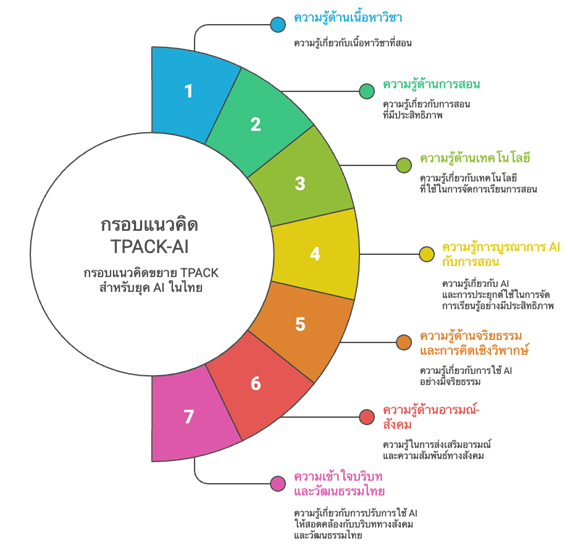
การสอน เนื้อหา จริยธรรม และอารมณ์-สังคม บทความนำเสนอกรอบแนวคิด TPACK-AI ที่ขยายจาก TPACK ดั้งเดิมเป็น 7 มิติ และเสนอแนวทางการพัฒนาทักษะครู 4 ระดับ ได้แก่ ระดับบุคคล สถานศึกษา นโยบาย และสถาบันผลิตครู เพื่อให้ครูไทยสามารถบูรณาการปัญญาประดิษฐ์ในการเรียนการสอนได้อย่างมีประสิทธิภาพและยั่งยืน
Downloads
Article Details

อนุญาตภายใต้เงื่อนไข Creative Commons Attribution-NonCommercial-NoDerivatives 4.0 International License.
The authors are solely responsible for the ideas and recommendations presented in articles published in the LEAD Journal RU. If any inaccuracies occur, the authors accept full responsibility.
Moreover, the Editorial Board, Editorial Team, and Committee of the LEAD Journal RU are committed to maintaining the integrity of the principles reflected in the authors' contributions.
Consequently, Ramkhamhaeng University, the Editorial Board, Editorial Team, and Editors shall not be held liable for any outcomes arising from the authors' presentation of their ideas and recommendations within the LEAD Journal RU.
เอกสารอ้างอิง
Asim, S., Kim, H. and Aedo, C. (2024). Teachers are Leading an AI Revolution in Korean Classrooms. World Bank Blogs. Retrieved from https://blogs.worldbank.org/en/education/teachers-are-leading-an-ai-revolution-in-korean-classrooms?utm_source=chatgpt.com
Battelle for Kids. (2019). Partnership for 21st Century Learning, A Network of Battelle for Kids, Framework for 21st Century Learning Definitions. Battelle for Kids. Retrieved from https://static.battelleforkids.org/documents/p21/P21_Framework_DefinitionsBFK.pdf
Bootchuy, T. and Bootchuy, P. (2021). Blended Learning Design in Communicative English Language Teaching for Learners in Higher Education in the Digital Age. ECT Education and Communication Technology Journal, 16(20), 31–48. [In Thai]. https://so01.tci-thaijo.org/index.php/ectstou/article/view/244977/167227
Celik, I., Dindar, M., … and Järvelä, S. (2022). The Promises and Challenges of Artificial Intelligence for Teachers: A Systematic Review of Research. TechTrends, 66(2022), 616–630. https://doi.org/10.1007/s11528-022-00715-y
Chakamanont, S. and Thabmali, P. (2025). Guidelines for Enhancing Thai Teachers' Artificial Intelligence Literacy in the Digital Age. Journal of Education and Innovation, 27(1), 186–201. [In Thai]. https://doi.org/10.71185/jeiejournals.v27i1.275674
Crompton, H. and Burke, D. (2023). Artificial Intelligence in Higher Education: The State of the Field. International Journal of Educational Technology in Higher Education, 20(2023), 1–22. https://doi.org/10.1186/s41239-023-00392-8
Darvishi, A., Khosravi, H., … and Gašević, D. (2022). Incorporating AI and Learning Analytics to Build Trustworthy Peer Assessment Systems. British Journal of Educational Technology, 53(2022), 844–875. https://doi.org/10.1111/bjet.13233
Dweck, C. S. (2017). Mindset: Changing the Way You Think to Fulfill Your Potential. Robinson, an Imprint of Constable & Robinson Ltd. Retrieved from https://icrrd.com/public/media/01-11-2020-205951Mindset%20by%20Carol%20S.%20Dweck.pdf
Gates, B. (2023). The Age of AI has Begun. Retrieved from https://www.gatesnotes.com/The-Age-of-AI-has-begun
Gumlanghan, T. (2025). The Use of AI and Big Data in Educational Leadership Decision-Making: Possibilities and Challenges. Ratchasimaparithat, 1(2), 11–21. [In Thai]. https://so09.tci-thaijo.org/index.php/RSMP/article/view/7158/4482
Hwang, G. J., Xie, H., … and Gašević, D. (2020). Vision, Challenges, Roles, and Research Issues of Artificial Intelligence in Education. Computers and Education: Artificial Intelligence, 1(2020), 1–5. https://doi.org/10.1016/j.caeai.2020.100001
ISTE, International Society for Technology in Education. (2017). ISTE Standards for Educators. Retrieved from https://cms-live-media.iste.org/ISTE_STANDARDS_2024_v02.pdf
Kumar, A., Sharma, P., … and Singh, V. (2024). Educational Inequality and Its Impact on Social and Economic Opportunities in Rural India. International Journal of Humanities, Management and Social Science, 7(2), 87–96.
https://doi.org/10.36079/lamintang.ij-humass-0702.697
Kasneci, E., Sessler, K., ...and Kasneci, G. (2023). ChatGPT for Good? On Opportunities and Challenges of Large Language Models for Education. Learning and Individual Differences, 103(2023), 1-8. https://doi.org/10.1016/j.lindif.2023.102274
Long, D. and Magerko, B. (2020). What is AI literacy? Competencies and Design Considerations. Proceedings of the 2020 CHI Conference on Human Factors in Computing Systems, 1–16. https://www.sci-hub.ee/10.1145/3313831.3376727
Luckin, R., Cukurova, M., …and du Boulay, B. (2022). Empowering Educators to be AI-ready. Computers and Education: Artificial Intelligence, 3(2002), 1–11. https://doi.org/10.1016/j.caeai.2022.100076
Ministry of Education. (2023). Five-year Action Plan (2023-2027) of the Office of the Permanent Secretary,
Ministry of Education. Bangkok: Office of the Permanent Secretary, Ministry of Education. [In Thai]. https://www.moe.go.th/wp-content/uploads/2022/04/รวมเล่มแผนปฏิบัติราชการ-5-ปี-สป-66-70-PDF.pdf
Ministry of Education, Singapore. (2024). Artificial Intelligence in Education. Retrieved from https://www.moe.gov.sg/education-in-sg/educational-technology-journey/edtech-masterplan/artificial-intelligence-in-education
Ministry of Education, Singapore. (2024). Singapore Teachers Embrace Digital Technologies and Benefit from Strong Professional Development, according to the OECD TALIS 2024 Study. Retrieved from https://www.moe.gov.sg/news/press-releases/20251007-singapore-teachers-embrace-digital-technologies-and-benefit-from-strong-professional-development-oecd-talis-2024-study?utm_source=chatgpt.com
Mishra, P. and Koehler, M. J. (2006). Technological Pedagogical Content Knowledge: A Framework for Teacher Knowledge. Teachers College Record, 108(6), 1017–1054. https://one2oneheights.pbworks.com/f/MISHRA_PUNYA.pdf
Ng, D. T. K., Leung, J. K. L., … and Qiao, M. S. (2021). Conceptualizing AI literacy: An Exploratory Review. Computers and Education: Artificial Intelligence, 2(2021), 1–15. https://doi.org/10.1016/j.caeai.2021.100041
Office of the Education Council. (2024). How to Create a Learning Ecosystem for Education in the New World. Bangkok: S.B.K. Printing Co., Ltd. [In Thai]. https://backoffice.onec.go.th/uploads/Book/2077-file.pdf
Phonyiam, P. and Prasertsang, P. (2024). Guidelines For Learning Management: The 5E of Inquiry-based Learning Combined with High-Level Questions Technique. Kalasin University Journal of Humanities Social Sciences and Innovation, 3(1), 68–85. [In Thai]. https://so02.tci-thaijo.org/index.php/hsi_01/article/view/258076/179262
Russell, S. J., & Norvig, P. (2021). Artificial Intelligence: A Modern Approach (4th ed.). Pearson. http://lib.ysu.am/disciplines_bk/efdd4d1d4c2087fe1cbe03d9ced67f34.pdf
Schmidt, D. A., Baran, E., …and Shin, T. S. (2009). Technological Pedagogical Content Knowledge (TPACK): The Development and Validation of an Assessment Instrument for Preservice Teachers. JRTE, 42(2), 123–149. https://files.eric.ed.gov/fulltext/EJ868626.pdf
Siengsanan, W. (2025). Future Teachers and AI: Coexistence, Adaptation, and Technology Integration for Enhanced Learning Quality. Ratchasimaparithat, 1(2), 22–34. [In Thai]. https://so09.tci-thaijo.org/index.php/RSMP/article/view/7196/4483
Soraphum, T. and Ratanaphan, J. (2025). TPACK: A Conceptual Framework for Modern Teachers. Journal of Educational Technology and Communications, Faculty of Education, Mahasarakham University, 8(27), 7–18. [In Thai]. https://so02.tci-thaijo.org/index.php/etcedumsujournal/issue/view/18081/5360
Teachers' Council of Thailand. (2019). Teachers' Council of Thailand Regulation on Professional Standards (No. 4) (2019). Bangkok: Studio. [In Thai]. https://news.ksp.or.th/opendata/rules/rule_standard4-2562.pdf
Teepakakorn, K. (2025). Thai Teachers’ Adaptation in the Era of Generative AI: Educational Opportunities and Challenges in 2025. Ratchasimaparithat, 1(2), 1–10. [In Thai]. https://so09.tci-thaijo.org/index.php/RSMP/article/view/7157/4481
UNESCO. (2018). UNESCO ICT Competency Framework for Teachers (Version 3). Retrieved from https://unesdoc.unesco.org/ark:/48223/pf0000265721
UNESCO. (2023). Guidance for Generative AI in Education and Research. Retrieved from https://unesdoc.unesco.org/ark:/48223/pf0000386693
Wang, S., Bao, J, … and Zhang, D. (2024). The Impact of Online Learning Engagement on College Students' Academic Performance: The Serial Mediating Effect of Inquiry Learning and Reflective Learning. Innovations in Education and Teaching International, 61(6), 1416–1430. https://doi.org/10.1080/14703297.2023.2236085
