Effects of a Project-Based Learning Innovation Integrating Active Learning and Instructional Technology on Operating System and Network Installation and Configuration Learning Outcomes of Students with Different Educational Backgrounds
Article Sidebar
Main Article Content
Abstract
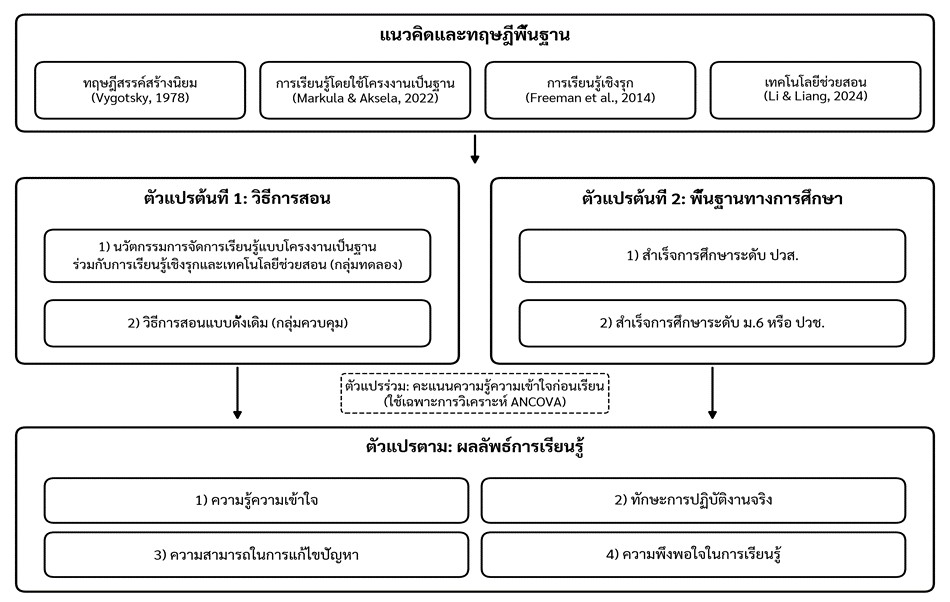
This quasi-experimental study aimed to 1) compare knowledge and understanding, practical skills, problem-solving ability, and learning satisfaction in operating system and network installation and configuration between students taught with a project-based learning innovation integrating active learning and instructional technology and those taught with conventional instruction, and 2) examine the interaction between teaching method and educational background. The purposive sample comprised 75 first-year information technology students (50 higher vocational certificate and 25 upper secondary or vocational certificate graduates), assigned to an experimental group (n = 38) and a control group (n = 37) by matching on educational background and pretest scores. The experiment lasted 15 weeks. Instruments included lesson plans, a knowledge test, a practical skill rubric, a problem-situation test, a satisfaction questionnaire, a semi-structured interview, and an observation form; the reliability of the measurement instruments ranged from .82 to .89. Data were analyzed using mean, standard deviation, ANCOVA for knowledge and understanding with pretest scores as the covariate, and two-way ANOVA for practical skills, problem-solving ability, and satisfaction. The results showed that 1) after controlling for pretest scores, the experimental group had a significantly higher adjusted knowledge mean (81.80) than the control group (72.95) at the .05 level; 2) the experimental group scored significantly higher in practical skills (85.52), problem-solving ability (80.34), and satisfaction (4.35) than the control group (71.99, 69.14, and 3.60, respectively) at the .05 level; and 3) no significant interaction between teaching method and educational background was found, suggesting that the innovation benefited both groups of students in the same direction, although the small subgroup sizes limit this conclusion.
Keywords: project-based learning, active learning, instructional technology, operating system and network, educational background, academic administration
Downloads
Article Details

This work is licensed under a Creative Commons Attribution-NonCommercial-NoDerivatives 4.0 International License.
แนวคิดและข้อเสนอแนะที่นำเสนอในบทความของวารสารการบริหารและความเป็นผู้นำทางการศึกษา มหาวิทยาลัยรามคำแหง เป็นแนวคิดที่มาจากผู้เขียน หากมีความผิดพลาดใด ๆ ผู้เขียนเป็นผู้รับผิดชอบแต่เพียงผู้เดียว
ทั้งนี้ บรรณาธิการ กองบรรณาธิการ และคณะกรรมการหน่วยจัดทำวารสารฯ จะไม่ก้าวก่ายความมั่นคงในหลักการตามความคิดของผู้เขียน
ดังนั้น บรรณาธิการ กองบรรณาธิการ คณะกรรมการหน่วยจัดทำวารสาร และมหาวิทยาลัย จะไม่รับผิดชอบใด ๆ จากผลที่เกิดขึ้นจากการนำเสนอแนวคิด และข้อเสนอแนะของผู้แต่งที่เผยแพร่ในวารสารฯ
References
Best, J. W. (1977). Research in education (3rd ed.). Prentice Hall.
Bittermann, A., McNamara, D., Simonsmeier, B. A., & Schneider, M. (2023). The landscape of research on prior knowledge and learning: A bibliometric analysis. Educational Psychology Review, 35, Article 58. https://doi.org/10.1007/s10648-023-09775-9
Blanca, M. J., Alarcón, R., Arnau, J., Bono, R., & Bendayan, R. (2017). Non-normal data: Is ANOVA still a valid option? Psicothema, 29(4), 552–557. https://doi.org/10.7334/psicothema2016.383
Bonwell, C. C., & Eison, J. A. (1991). Active learning: Creating excitement in the classroom (ASHE-ERIC Higher Education Report No. 1). George Washington University, School of Education and Human Development.
Braun, V., & Clarke, V. (2006). Using thematic analysis in psychology. Qualitative Research in Psychology, 3(2), 77–101. https://doi.org/10.1191/1478088706qp063oa
Cohen, J. (1988). Statistical power analysis for the behavioral sciences (2nd ed.). Lawrence Erlbaum Associates.
Cronbach, L. J. (1951). Coefficient alpha and the internal structure of tests. Psychometrika, 16(3), 297–334. https://doi.org/10.1007/BF02310555
Faul, F., Erdfelder, E., Lang, A.-G., & Buchner, A. (2007). G*Power 3: A flexible statistical power analysis program for the social, behavioral, and biomedical sciences. Behavior Research Methods, 39(2), 175–191. https://doi.org/10.3758/BF03193146
Field, A. (2018). Discovering statistics using IBM SPSS Statistics (5th ed.). SAGE.
Freeman, S., Eddy, S. L., McDonough, M., Smith, M. K., Okoroafor, N., Jordt, H., & Wenderoth, M. P. (2014). Active learning increases student performance in science, engineering, and mathematics. Proceedings of the National Academy of Sciences, 111(23), 8410–8415. https://doi.org/10.1073/pnas.1319030111
Hake, R. R. (1998). Interactive-engagement versus traditional methods: A six-thousand-student survey of mechanics test data for introductory physics courses. American Journal of Physics, 66(1), 64–74. https://doi.org/10.1119/1.18809
Huang, F. L. (2020). MANOVA: A procedure whose time has passed? Gifted Child Quarterly, 64(1), 56–60. https://doi.org/10.1177/0016986219887200
Koo, T. K., & Li, M. Y. (2016). A guideline of selecting and reporting intraclass correlation coefficients for reliability research. Journal of Chiropractic Medicine, 15(2), 155–163. https://doi.org/10.1016/j.jcm.2016.02.012
Kuder, G. F., & Richardson, M. W. (1937). The theory of the estimation of test reliability. Psychometrika, 2(3), 151–160. https://doi.org/10.1007/BF02288391
Lavado-Anguera, S., Velasco-Quintana, P.-J., & Terrón-López, M.-J. (2024). Project-based learning (PBL) as an experiential pedagogical methodology in engineering education: A review of the literature. Education Sciences, 14(6), 617. https://doi.org/10.3390/educsci14060617
Lertyosbordin, C., Maneewan, S., Yampinij, S., & Thamwipat, K. (2019). Scoring rubric of problem-solving on computing science learning. International Education Studies, 12(8), 26–32. https://doi.org/10.5539/ies.v12n8p26
Li, J., & Liang, W. (2024). Effectiveness of virtual laboratory in engineering education: A meta-analysis. PLOS ONE, 19(12), e0316269. https://doi.org/10.1371/journal.pone.0316269
Llanos, J., Bucheli, V. A., & Restrepo-Calle, F. (2023). Early prediction of student performance in CS1 programming courses. PeerJ Computer Science, 9, e1655. https://doi.org/10.7717/peerj-cs.1655
Markula, A., & Aksela, M. (2022). The key characteristics of project-based learning: How teachers implement projects in K–12 science education. Disciplinary and Interdisciplinary Science Education Research, 4, Article 2. https://doi.org/10.1186/s43031-021-00042-x
Mertler, C. A. (2001). Designing scoring rubrics for your classroom. Practical Assessment, Research & Evaluation, 7(25), 1–10. https://doi.org/10.7275/gcy8-0w24
Ministry of Higher Education, Science, Research and Innovation. (2022). Ministerial regulation on higher education qualification standards B.E. 2565. Royal Thai Government Gazette, 139(20 Kor), 28–31. [in Thai]
Office of the Education Council. (2024). Education statistics of Thailand: Academic year 2023. Ministry of Education. [in Thai]
Price, P. C., Jhangiani, R., Chiang, I.-C. A., Leighton, D. C., & Cuttler, C. (2017). Research methods in psychology (3rd American ed.). Washington State University. https://wsu.pressbooks.pub/carriecuttler/
Promwong, C. (2013). Developmental testing of media and instructional package. Silpakorn Educational Research Journal, 5(1), 7–20. [in Thai]
Rovinelli, R. J., & Hambleton, R. K. (1977). On the use of content specialists in the assessment of criterion-referenced test item validity. Dutch Journal of Educational Research, 2, 49–60.
Saud, A. S., Adhikari, B., & Piya, S. (2025). Evaluating the effectiveness of Cisco Packet Tracer for teaching networking concepts at the undergraduate level. Perspectives on Higher Education, 15(1), 123–136. https://doi.org/10.3126/phe.v15i01.80876
Seels, B. B., & Richey, R. C. (1994). Instructional technology: The definition and domains of the field. Association for Educational Communications and Technology.
Sweller, J., van Merriënboer, J. J. G., & Paas, F. (2019). Cognitive architecture and instructional design: 20 years later. Educational Psychology Review, 31(2), 261–292. https://doi.org/10.1007/s10648-019-09465-5
Tabachnick, B. G., & Fidell, L. S. (2019). Using multivariate statistics (7th ed.). Pearson.
Theobald, E. J., Hill, M. J., Tran, E., Agrawal, S., Arroyo, E. N., Behling, S., Chambwe, N., Cintrón, D. L., Cooper, J. D., Dunster, G., Grummer, J. A., Hennessey, K., Hsiao, J., Iranon, N., Jones, L., II, Jordt, H., Keller, M., Lacey, M. E., Littlefield, C. E., ... Freeman, S. (2020). Active learning narrows achievement gaps for underrepresented students in undergraduate science, technology, engineering, and math. Proceedings of the National Academy of Sciences, 117(12), 6476–6483. https://doi.org/10.1073/pnas.1916903117
Thianthai, C., & Sutamchai, K. (2022). Skills that matter: Qualitative study focusing on the transfer of training through the experience of Thai vocational students. Frontiers in Education, 7, 897808. https://doi.org/10.3389/feduc.2022.897808
van de Pol, J., Volman, M., & Beishuizen, J. (2010). Scaffolding in teacher–student interaction: A decade of research. Educational Psychology Review, 22(3), 271–296. https://doi.org/10.1007/s10648-010-9127-6
Vygotsky, L. S. (1978). Mind in society: The development of higher psychological processes. Harvard University Press.
Wang, X., Huang, R. T., Sommer, M., Pei, B., Shidfar, P., Rehman, M. S., Ritzhaupt, A. D., & Martin, F. (2024). The efficacy of artificial intelligence-enabled adaptive learning systems from 2010 to 2022 on learner outcomes: A meta-analysis. Journal of Educational Computing Research, 62(6), 1348–1383. https://doi.org/10.1177/07356331241240459
Weerasombat, T., & Pumipatyothin, P. (2025). Employers' priority on work skills and the skill gaps: A case of Thailand. Cogent Education, 12(1), 2441656. https://doi.org/10.1080/2331186X.2024.2441656
World Bank. (2025). Thailand economic monitor: Digital pathways for growth. World Bank.
World Economic Forum. (2025). The future of jobs report 2025. World Economic Forum. https://www.weforum.org/publications/the-future-of-jobs-report-2025/
Xu, E., Wang, W., & Wang, Q. (2023). The effectiveness of collaborative problem solving in promoting students' critical thinking: A meta-analysis based on empirical literature. Humanities and Social Sciences Communications, 10, Article 16. https://doi.org/10.1057/s41599-023-01508-1
Zhang, L., & Ma, Y. (2023). A study of the impact of project-based learning on student learning effects: A meta-analysis study. Frontiers in Psychology, 14, 1202728. https://doi.org/10.3389/fpsyg.2023.1202728