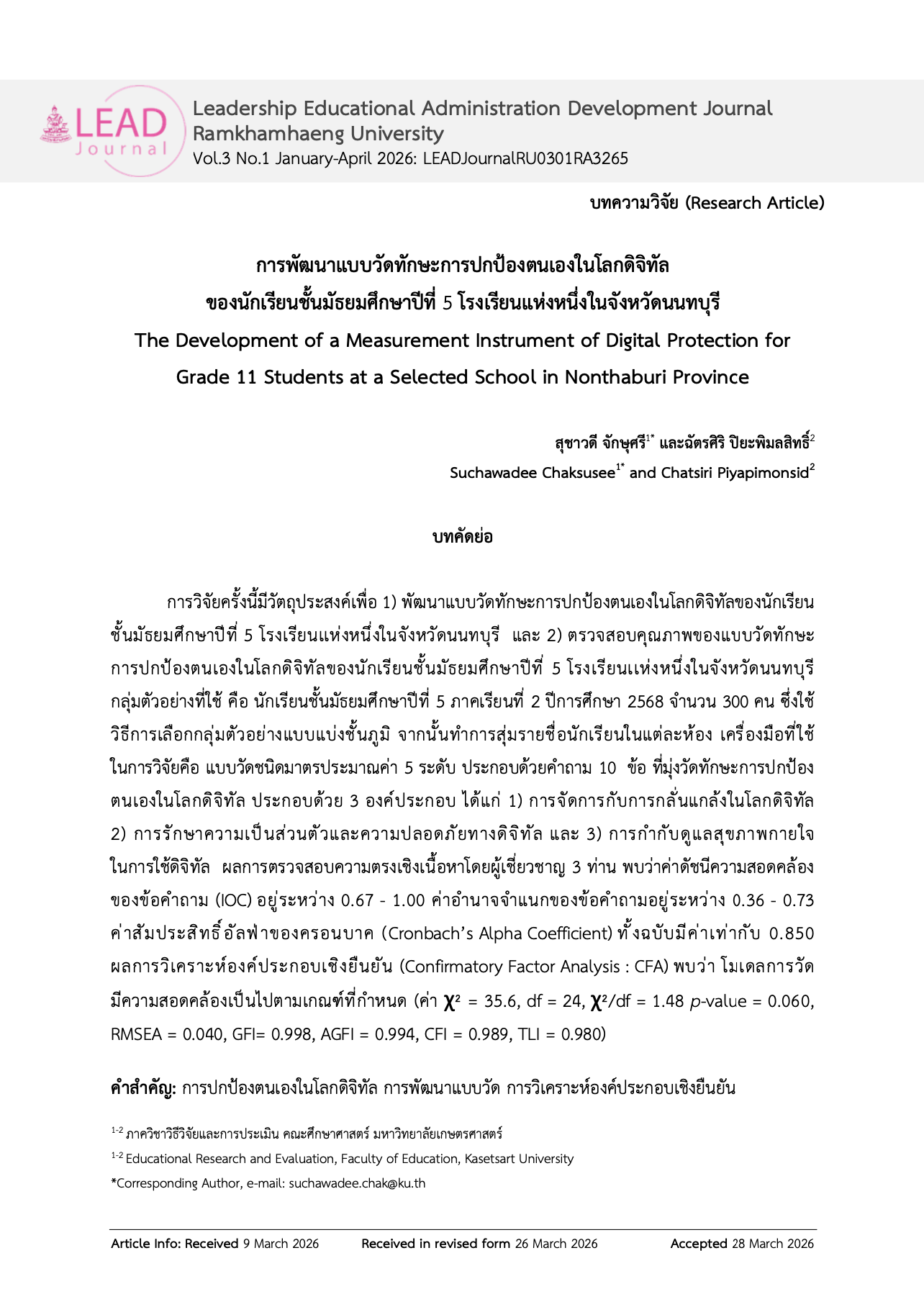
The Development of a Measurement Instrument of Digital Protection for Grade 11 Students at a Selected School in Nonthaburi Province.
Article Sidebar
Main Article Content
Abstract
The objectives of this research were to 1) develop a digital protection skills scale for Grade 11 students at a selected school in Nonthaburi Province, and 2) evaluate the quality of the developed scale for Grade 11 students at a selected school in Nonthaburi Province.
The sample consisted of 300 Grade 11 students enrolled in the second semester of the 2025 academic year, selected through stratified random sampling followed by simple random sampling within each classroom. The research instrument was a 5-point Likert scale comprising 10 items. The scale measures digital self-protection skills across three components: 1) cyberbullying management, 2) privacy and security management, and 3) digital health and wellness. Content validity, assessed by three experts, yielded an Item-Objective Congruence (IOC) index ranging from .66 to 1.00, with item discrimination power ranging from 0.36 to 0.73. The overall Cronbach’s alpha coefficient of the scale was 0.850. The results of a confirmatory factor analysis (CFA) show that the model fit indices meet the specified criteria (χ² = 35.6, df = 24, χ²/df = 1.48, p-value = 0.060, RMSEA = 0.040, GFI = 0.998, AGFI = 0.994, CFI = 0.989, TLI = 0.980).
Downloads
Article Details

This work is licensed under a Creative Commons Attribution-NonCommercial-NoDerivatives 4.0 International License.
แนวคิดและข้อเสนอแนะที่นำเสนอในบทความของวารสารการบริหารและความเป็นผู้นำทางการศึกษา มหาวิทยาลัยรามคำแหง เป็นแนวคิดที่มาจากผู้เขียน หากมีความผิดพลาดใด ๆ ผู้เขียนเป็นผู้รับผิดชอบแต่เพียงผู้เดียว
ทั้งนี้ บรรณาธิการ กองบรรณาธิการ และคณะกรรมการหน่วยจัดทำวารสารฯ จะไม่ก้าวก่ายความมั่นคงในหลักการตามความคิดของผู้เขียน
ดังนั้น บรรณาธิการ กองบรรณาธิการ คณะกรรมการหน่วยจัดทำวารสาร และมหาวิทยาลัย จะไม่รับผิดชอบใด ๆ จากผลที่เกิดขึ้นจากการนำเสนอแนวคิด และข้อเสนอแนะของผู้แต่งที่เผยแพร่ในวารสารฯ
References
Boonthanom, B. (2023). Instructional Guidelines for Enhancing Digital Citizenship of Secondary Students. (Master’s Thesis, Chulalongkorn University). [In Thai].
Chainwong, P. and Skulphan, S. (2020). Being Cyberbullied and Suicide Risk Among Youths. The Journal of Psychiatric Nursing and Mental Health, 34(3), 133–151. [In Thai].
Charoenwanichkun, P. (2021). The Appropriateness of Reflective and Formative Measurement Models of Students’ Digital Citizenship: Bayesian Statistical Analysis. (Master’s Thesis, Chulalongkorn University). [In Thai].
Domkerngsak, T. and Savagsuriyawong, G. (2024). Using Legal Measures as a Preventative Measure to Lessen Cyberbullying Behavior. Siam Communication Review, 23(1), 119–140. [In Thai].
DQ Institute. (2019). Digital Intelligence, DQ Global Standards Report 2019: Common Framework for Digital Literacy, Skills and Readiness. DQ Institute.
DeVellis, R. F. (2016). Scale Development: Theory and Applications (4th ed.). Sage Publications.
Hair, J. F., Black, W. C., Babin, B. J., and Anderson, R. E. (2019). Multivariate Data Analysis (8th ed.). Cengage Learning.
Hinduja, S., & Patchin, J. W. (2015). Bullying Beyond the Schoolyard: Preventing and Responding to Cyberbullying. Thousand Oaks: Corwin Press.
Insombat. (2011). Consideration Tips in Selecting Test Items with Discrimination Power. Nakhon Sawan Rajabhat University Graduate Studies Journal, 6(1), 1–12. [In Thai].
Janup, P. (2017). Behavior and Aftermath of Social Media Usage by Senior High School Students in Phitsanulok. (Master's Thesis, Naresuan University). [In Thai].
Kapur, R. (2019). Advantages of Technology. Delhi: University of Delhi.
Ministry of Education. (2008). Basic Education Core Curriculum B.E. 2551 (A.D., 2008). Bangkok: The Agricultural Co-operative Federation of Thailand. [In Thai].
Ministry of Education. (2026). Cyberbullying. Bangkok: Ministry of Education. [In Thai].
National Statistical Office, Ministry of Digital Economy and Society. (2025). The 2024 Household Survey on the Use of Information and Communication Technology (Quarter 4). National Statistical Office, Ministry of Digital Economy and Society. [In Thai].
Office of the Basic Education Commission. (2021). 3P Anti-Bullying Safety Measures. Bangkok: Office of the Basic Education Commission. [In Thai].
Schumacker, R. E. and Lomax, R. G. (2016). A Beginner's Guide to Structural Equation Modeling (4th ed.). New York: Routledge.
Suksawang, P. (2020). Structural Equation Modeling. Chonburi: A.P.Blueprint. [In Thai].
