APARIHANIYADHAMMA 7: THE SEVEN PRINCIPLES OF NON-DECLINE AND THE BUILDING OF GOOD GOVERNANCE IN CONTEMPORARY ORGANIZATIONS
Keywords:
Aparihaniyadhamma, Good Governance, Organizations, Buddhist ManagementAbstract
This article aims to 1) examine the meaning and origins of the seven Aparihaniyadhamma as found in the Tipiṭaka, 2) analyze the principles of good governance and challenges facing contemporary organizations, and 3) propose guidelines for applying the seven Aparihaniyadhamma to establish good governance in modern organizations. The study employs documentary research methodology.
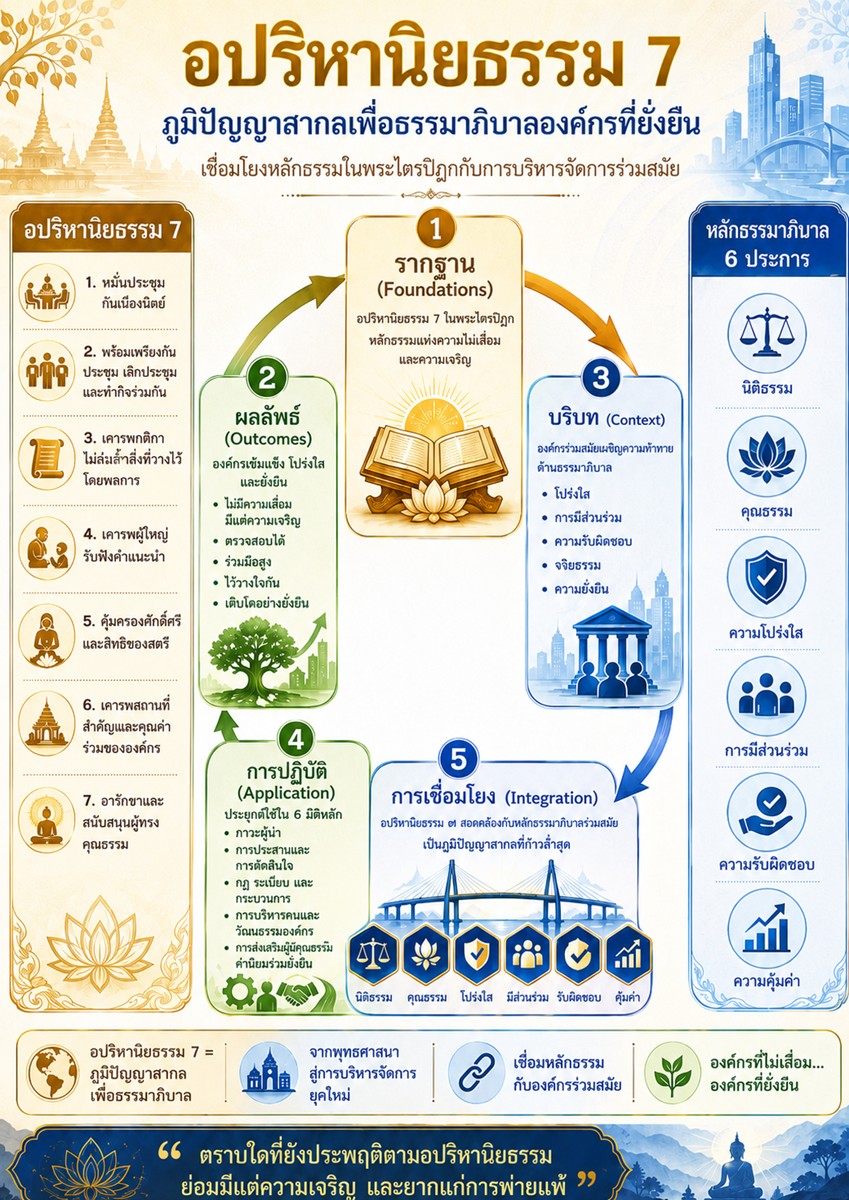
The findings reveal that the seven Aparihaniyadhamma were taught by the Buddha to the Vajjians in the Mahāparinibbāna Sutta as principles leading to non-decline and prosperity. They consist of: 1) holding regular assemblies, 2) assembling and conducting business in harmony, 3) not enacting new decrees nor abolishing existing ones, 4) honoring elders, 5) not abusing women, 6) respecting shrines, and 7) supporting righteous persons.
Good governance in contemporary organizations is founded on key principles including transparency, accountability, participation, rule of law, equity, and effectiveness. However, modern organizations face numerous challenges such as globalization and intensified competition, rapid technological advancement, cultural diversity, and global uncertainty.
The analysis reveals that the seven Aparihaniyadhamma align with contemporary good governance principles in every dimension. This article proposes five main areas of application: creating a culture of meetings and participation, establishing stable and fair systems of rules, creating mentoring systems and transmitting wisdom, promoting equity and diversity, and fostering social and cultural responsibility.
The key conclusion is that the seven Aparihaniyadhamma are not merely outdated religious teachings but represent universal wisdom encompassing all essential principles of good governance. Applying them in contemporary organizations bridges traditional wisdom with modern management concepts, leading to stronger, more transparent, and sustainable organizations.
References
ขมานันท์ ขบวนฉลาด. (2564). การประยุกต์ใช้หลักอปริหานิยธรรมเพื่อการบริหารจัดการขององค์การบริหารส่วนตำบลประทัดบุ อำเภอปราสาท จังหวัดสุรินทร์. วารสารมหาจุฬาคชสาร, 12(1), 133–142.
พนม คงกลิ่น. (2567). อปริหานิยธรรม 7 หลักความสามัคคี. วารสารนวังคสัตถุสาสน์ปริทรรศน์, 2(2), 110–121.
พระพรหมคุณาภรณ์ (ป.อ. ปยุตฺโต). (2551). พุทธธรรม ฉบับปรับปรุงและขยายความ (พิมพ์ครั้งที่ 11). โรงพิมพ์มหาจุฬาลงกรณราชวิทยาลัย.
พระมหาธนวัฒน์ ปริยตฺติเมธี. (2568). ธรรมาภิบาลเชิงพุทธ : แนวทางการสร้างธรรมรัฐในสังคมไทยร่วมสมัย. วารสารบัณฑิตศึกษามหาจุฬาลงกรณราชวิทยาลัย, 12(1), 1–15.
พระมหายุทธพิชัย สิริชโย, & ธิติวุฒิ หมั่นมี. (2561). การบริหารงานตามหลักอปริหานิยธรรม. วารสารสมาคมศิษย์เก่ามหาวิทยาลัยมหาจุฬาลงกรณราชวิทยาลัย, 7(2), 139–150.
มหาจุฬาลงกรณราชวิทยาลัย. (2539). พระไตรปิฎกภาษาไทย ฉบับมหาจุฬาลงกรณราชวิทยาลัย (45 เล่ม). โรงพิมพ์มหาจุฬาลงกรณราชวิทยาลัย.
สำนักงานคณะกรรมการพัฒนาระบบราชการ. (2551). คู่มือแนวทางและวิธีการพัฒนาระบบราชการ. สำนักงานคณะกรรมการพัฒนาระบบราชการ.
สินีนาถ ฉลาดล้น, สุกิจ ชัยมุสิก, มานะ วงศ์จิตรบุญตา, ปัณฑิพาณ์ ธาราภิบาล, & ฐานิกา บุษมงคล. (2562). การศึกษาวิเคราะห์หลักธรรมาภิบาลในพระพุทธศาสนา. Veridian E-Journal, Silpakorn University, 12(4), 900–914.
Bernal, G., & Domenech Rodríguez, M. M. (Eds.). (2012). Cultural adaptations: Tools for evidence-based practice with diverse populations. American Psychological Association.
Buddhistdoor Global. (2020, August 28). The seven essential dharmas: Principles of unity and good governance. https://www.buddhistdoor.net/features/the-seven-essential-dharmas-principles-of-unity-and-good-governance/
Congress of Local and Regional Authorities. (2025). 12 principles of good democratic governance. Council of Europe. https://www.coe.int
Floridi, L., Cowls, J., Beltrametti, M., Chatila, R., Chazerand, P., Dignum, V., ... & Vayena, E. (2018). AI4People—An ethical framework for a good AI society: Opportunities, risks, principles, and recommendations. Minds and Machines, 28(4), 689–707.
Jorm, A. F. (2012). Mental health literacy: Empowering the community to take action for better mental health. American Psychologist, 67(3), 231–243.
Kelley, D. L. (2017). Just relationships: Living out social justice as mentor, family, friend, and lover. Routledge.
Steinberg, L. (2016). Adolescence (11th ed.). McGraw-Hill Education.
United Nations Department of Economic and Social Affairs. (2025). World economic situation and prospects 2025. United Nations.
United Nations Development Programme. (1997). Governance for sustainable human development. UNDP.
United Nations Economic and Social Commission for Asia and the Pacific. (2025). What is good governance?. UNESCAP.
United Nations Educational, Scientific and Cultural Organization. (2005). Convention on the protection and promotion of the diversity of cultural expressions. UNESCO.
United Nations. (2015). Transforming our world: The 2030 Agenda for Sustainable Development. United Nations.
World Bank. (1992). Governance and development. World Bank.
World Economic Forum. (2024). Global risks report 2024. WEF.
World Economic Forum. (2025). 3 opportunities to strengthen good governance worldwide. https://www.weforum.org
Downloads
Published
How to Cite
Issue
Section
License
Copyright (c) 2026 Pāli–Theravāda Review Journal (PTRJ)

This work is licensed under a Creative Commons Attribution-NonCommercial-NoDerivatives 4.0 International License.
This article is published under a Creative Commons Attribution-NonCommercial-NoDerivatives 4.0 International License (CC BY-NC-ND 4.0), which allows others to share the article with proper attribution to the authors and prohibits commercial use or modification. For any other reuse or republication, permission from the journal and the authors is required.