

Peer Review Process
The Pāli–Theravāda Review Journal (PTRJ) employs a double-blind peer review system, in which neither the authors nor the reviewers are aware of each other’s names or institutional affiliations. This process ensures that manuscript evaluation is conducted in an objective, transparent, and academically ethical manner.
The manuscript review process consists of the following steps:
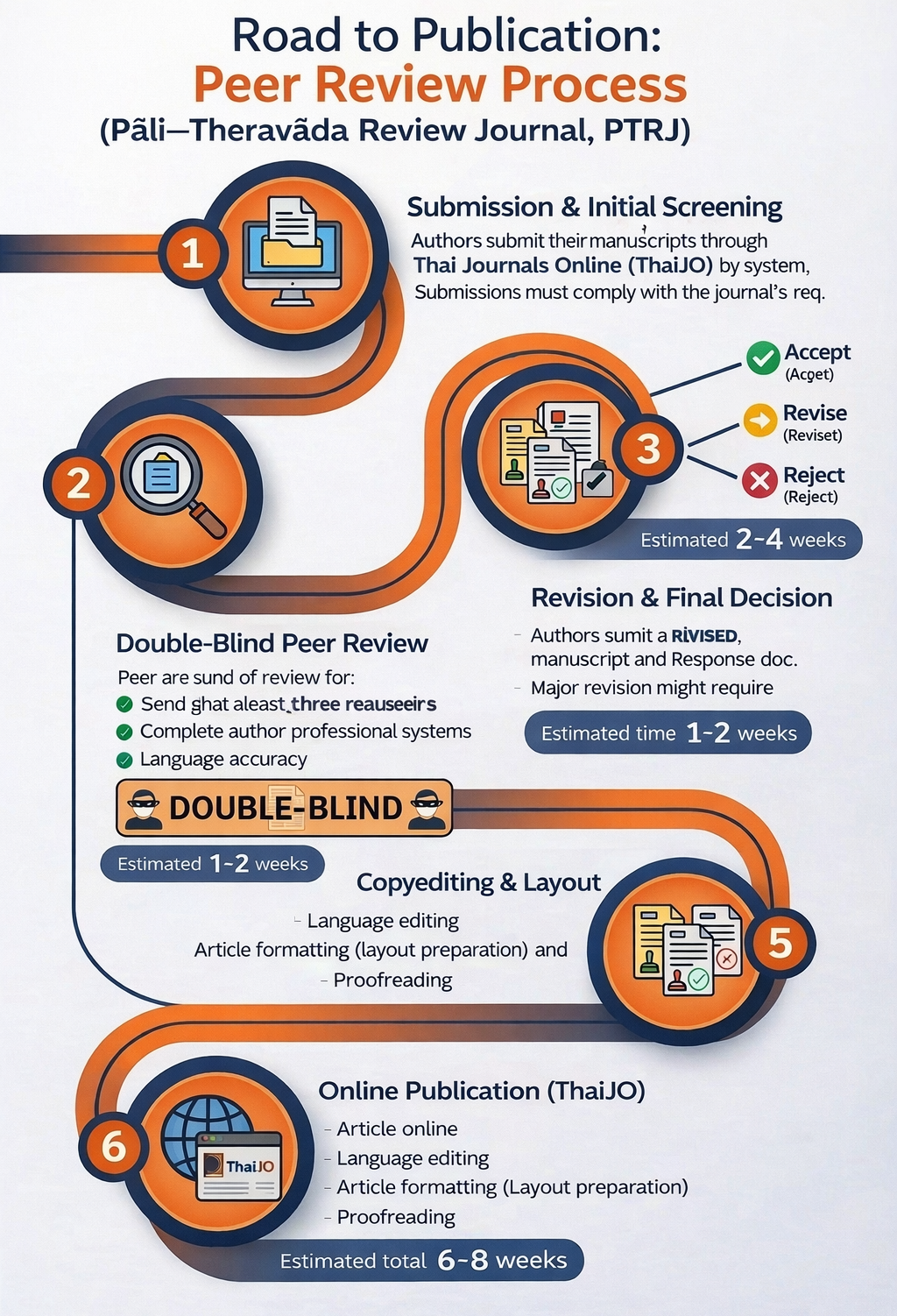
1. MANUSCRIPT SUBMISSION
Authors submit their manuscripts through the Thai Journals Online (ThaiJO) system. Submissions must comply with the journal’s requirements as follows:
- Use the journal’s official template
- Provide complete author information
- Include an Abstract and Keywords
- Follow the APA 7th edition referencing style
- Attach the manuscript file in anonymous format (Manuscript – Anonymous)
----------------------------------------------------------------------------------------------------------------------------------
2. INITIAL EDITORIAL SCREENING
The editorial team conducts an initial screening of the manuscript to ensure that it meets the journal’s basic requirements. The screening includes:
- Consistency with the journal scope
- Completeness of the article structure
- Compliance with the referencing format
- Language accuracy and clarity
- Plagiarism detection
Plagiarism detection tools used:
- Turnitin
- CopyCatch
- iThenticate
Acceptance criteria:
- The similarity index must not exceed 20–25%
If the manuscript does not meet the criteria, it may be:
- Rejected, or
- Returned to the author for revision before entering the peer review process
Estimated time: 3–7 days
----------------------------------------------------------------------------------------------------------------------------------
3. PEER REVIEW
Qualified reviewers are selected to evaluate the manuscript. Each manuscript will be reviewed by at least three reviewers who are experts in the relevant field.
Reviewer qualifications:
- Expertise in the relevant academic discipline
- No conflict of interest with the authors
- Not affiliated with the same institution as the authors
Review system used:
The journal employs a double-blind peer review system, in which:
- Reviewers do not know the identity of the authors
- Authors do not know the identity of the reviewers
Article Processing Charges (APC):
- Thai-language articles: 4,000 Baht
- English-language articles: 5,000 Baht
Estimated time: 2–4 weeks
----------------------------------------------------------------------------------------------------------------------------------
4. MANUSCRIPT REVISION
After receiving the reviewers’ comments, the authors must revise the manuscript accordingly.
Authors are required to:
- Revise the manuscript based on reviewers’ comments
- Prepare a Response to Reviewers document
- Submit the following files:
- Revised Manuscript
- Response to Reviewers
In cases of major revision, the revised manuscript may be sent back to the reviewers for a second round of evaluation.
Estimated time: 1–2 weeks
----------------------------------------------------------------------------------------------------------------------------------
5. EDITORIAL DECISION
The Editor-in-Chief makes the final decision based on:
- Reviewers’ reports
- Overall quality of the manuscript
Possible editorial decisions include:
- Accept for publication
- Accept with minor revisions
- Major revision and resubmission for further review
- Reject
The decision of the editorial board is final.
----------------------------------------------------------------------------------------------------------------------------------
6. COPYEDITING AND PUBLICATION
Accepted manuscripts proceed to the final production stage, which includes:
- Language editing
- Article formatting (layout preparation)
- Proofreading
After these processes are completed, the article will be published in the Thai Journals Online (ThaiJO) system according to the journal’s publication schedule.
Estimated time: 1–2 weeks