AN ANALYTICAL STUDY OF THE PRINCIPLE OF YONISOMANASIKĀRA IN THE TIPIṬAKA AND THE RESOLUTION OF MODERN FAMILY CONFLICTS
Keywords:
Yonisomanasikāra, Tipiṭaka, Family Conflict, Buddhist PsychologyAbstract
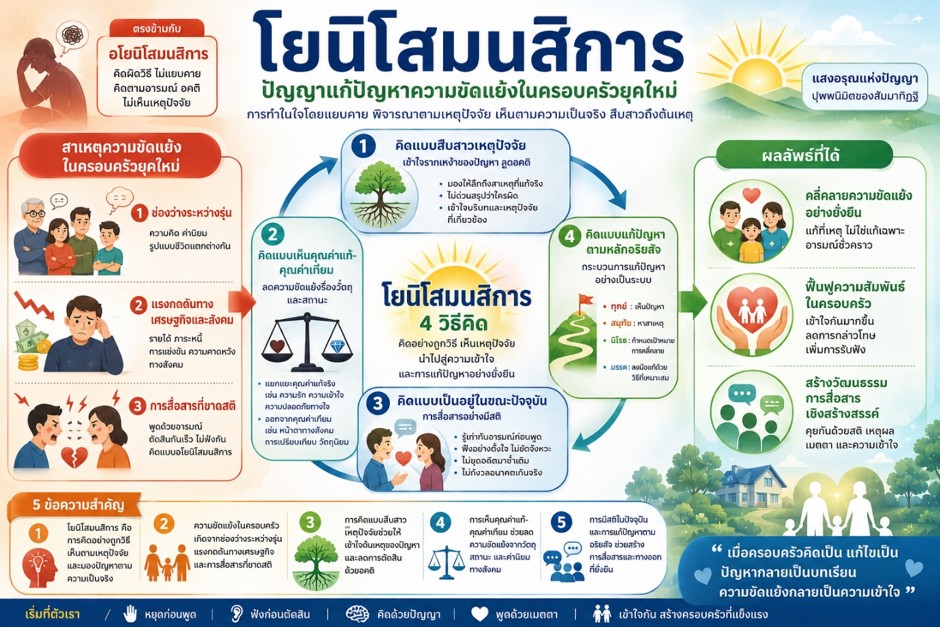
This article aims to: 1) examine the meaning, origin, and structure of yonisomanasikāra as found in the Tipiṭaka and commentaries; 2) analyze the characteristics and causes of conflict in modern families; and 3) propose ways to apply yonisomanasikāra to resolve and prevent family conflict. This study employs documentary research by examining the Tipiṭaka, commentaries, and related academic literature, and then analyzing and synthesizing the findings into practical guidelines for contemporary family contexts.
The findings reveal that yonisomanasikāra refers to wise attention, or the proper contemplation of things in accordance with reality, by tracing causes and conditions and understanding problems in a holistic manner. This principle is an important internal factor for the arising of right view and the development of wisdom. In contrast, ayonisomanasikāra refers to unwise attention, which leads to misunderstanding, attachment, and conflict. Conflict in modern families is mainly caused by generational gaps, differences in values, digital divides, economic and social pressures, and unmindful communication. These factors can turn minor misunderstandings into serious conflict, especially when family members make hasty judgments, cling to their own viewpoints, or view problems in a fragmented way. This article proposes four applications of yonisomanasikāra for family conflict management: 1) analytical thinking based on causes and conditions, which helps family members understand the roots of problems and reduce blaming; 2) thinking in terms of true and false values, which reduces conflict arising from unnecessary social values and expectations; 3) present-moment awareness, which promotes mindful communication; and 4) problem-solving based on the Four Noble Truths, which provides a systematic process for addressing problems. These approaches help reduce bias, restore mutual understanding, and foster more supportive family relationships.
References
กรมกิจการสตรีและสถาบันครอบครัว. (2566). แผนปฏิบัติการด้านครอบครัว พ.ศ. 2566 - 2570.
คิดใหม่การเมืองเรื่อง 'รุ่น' กรณีศึกษาความขัดแย้งในครอบครัวไทย. (2566). 101 PUB.
https://101pub.org/rethinking-politics-of-generation-full-report/
จุไรพร ใจจง, & ณัฏฐิณี ศิริวัฒนานนท์. (2566). แนวทางการแก้ไขปัญหาความขัดแย้งในครอบครัวโดยใช้หลักพุทธธรรม. วารสารสันติศึกษาปริทรรศน์ มจร, 11(6), 1–14.
ฐิตินันทน์ ผิวนิล, & ปลายฟ้า นามไพร. (2569). กลวิธีและบทบาทของเยาวชนกับการจัดการปัญหาดิจิทัลในครอบครัว: การวิเคราะห์เอกสารบันทึกสะท้อนความคิด. วารสารสหวิทยาการนวัตกรรมปริทรรศน์, 9(1), 241–255.
ณัฐพงค์ แย้มเจริญ, กรกช แสนจิตร, & สุเทพ เดชะชีพ. (2566). การใช้พื้นที่บนโซเซียลมีเดียของผู้ปกครองและเยาวชนไทยในครอบครัวไทยยุคดิจิทัล. วารสารนิเทศสยามปริทัศน์, 22(2), 99–112.
พระเจริญพงษ์ วิชัย, สายน้ำผึ้ง รัตนงาม, & วันไชย์ กิ่งแก้ว. (2566). โยนิโสมนสิการในฐานะเป็นเครื่องมือจัดการความขัดแย้งภายในของมนุษย์. วารสารบัณฑิตแสงโคมคำ, 8(2), 423–441.
พระเจริญพงษ์ วิชัย, สายน้ำผึ้ง รัตนงาม, & วันไชย์ กิ่งแก้ว. (2566). โยนิโสมนสิการในฐานะเป็นเครื่องมือจัดการความขัดแย้งภายในของมนุษย์. วารสารบัณฑิตแสงโคมคำ, 8(2), 423–441.
พระธรรมปิฎก (ป.อ. ปยุตฺโต). (2541). การพัฒนาที่ยั่งยืน. กรุงเทพมหานคร: มูลนิธิพุทธธรรม.
พระพรหมคุณาภรณ์ (ป.อ. ปยุตฺโต). (2546). พุทธธรรม ฉบับปรับขยาย. กรุงเทพมหานคร: สำนักพิมพ์ผลิธัมม์.
พระพรหมคุณาภรณ์ (ป.อ. ปยุตฺโต). (2559). พุทธธรรม ฉบับปรับปรุงและขยายความ (พิมพ์ครั้งที่ 13). บริษัท สหธรรมิก จํากัด.
มหาจุฬาลงกรณราชวิทยาลัย. (2539). พระไตรปิฎกภาษาไทย ฉบับมหาจุฬาลงกรณราชวิทยาลัย. กรุงเทพมหานคร: โรงพิมพ์มหาจุฬาลงกรณราชวิทยาลัย.
ศิริกัญญา แก้วทอง, & สมศักดิ์ สินธุระเวชญ์. (2566). การจัดการความขัดแย้งในครอบครัวตามแนวทางพุทธธรรม. วารสาร
มหาวิทยาลัยมหาจุฬาลงกรณราชวิทยาลัย, 10(6), 39–52.
Phramaha Phanuvich Panuwityo. (2025). The transformation of Thai families in the context of globalization. Asian Journal of Humanities and Social Sciences, 8(2), 1–15.
Downloads
Published
How to Cite
Issue
Section
License
Copyright (c) 2026 Pāli–Theravāda Review Journal (PTRJ)

This work is licensed under a Creative Commons Attribution-NonCommercial-NoDerivatives 4.0 International License.
This article is published under a Creative Commons Attribution-NonCommercial-NoDerivatives 4.0 International License (CC BY-NC-ND 4.0), which allows others to share the article with proper attribution to the authors and prohibits commercial use or modification. For any other reuse or republication, permission from the journal and the authors is required.