The Role of Leadership in Bridging the Generational Gap among School Personnel
Article Sidebar
Main Article Content
Abstract
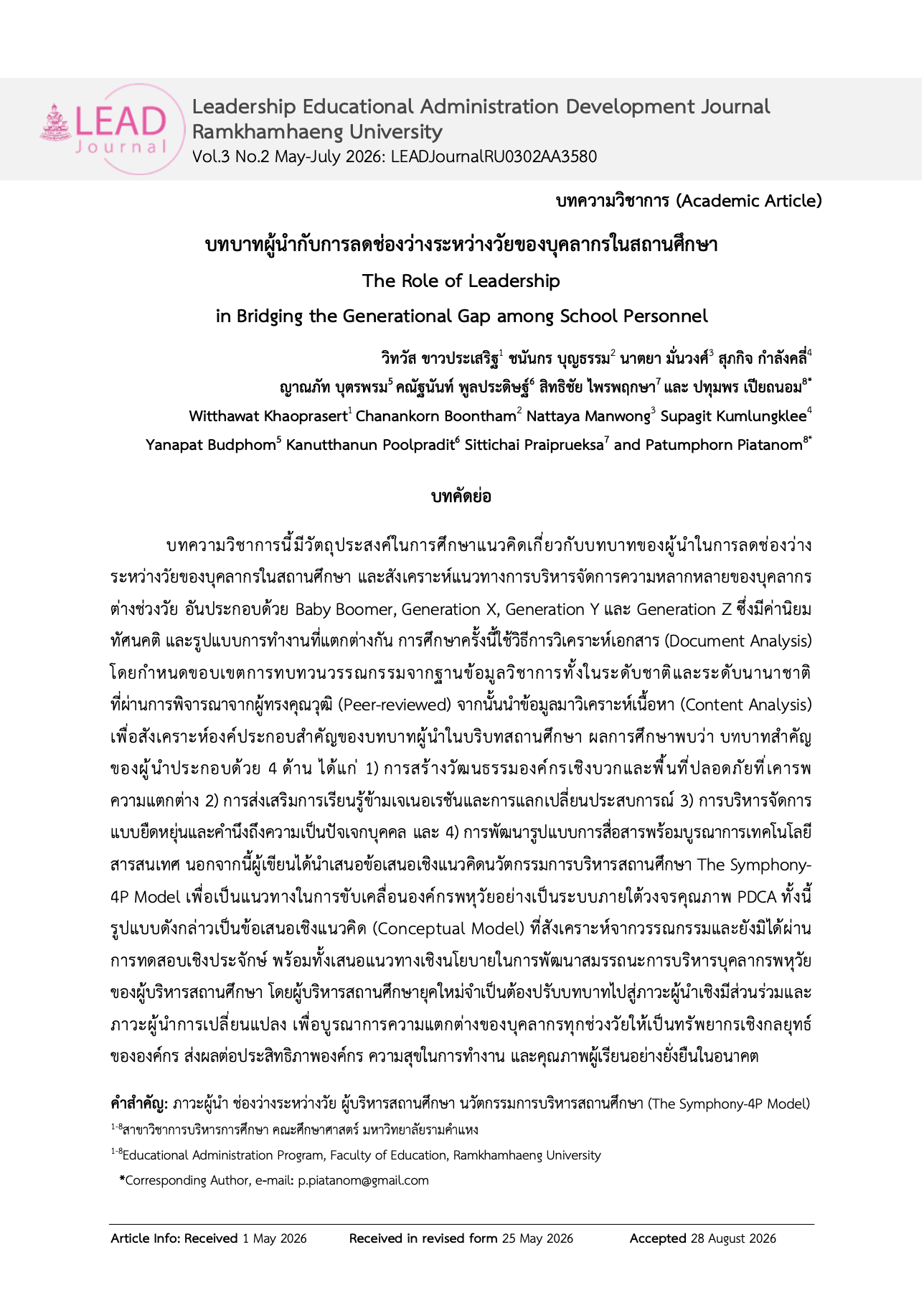
The purposes of the research article were to examine leadership's role in bridging the generational gap among school personnel and to synthesize management approaches to generational diversity in educational institutions. School personnel currently comprise multiple generations, including Baby Boomers, Generation X, Generation Y, and Generation Z, each with distinct values, attitudes, and working styles. This study employed document analysis by reviewing literature from national and international peer-reviewed academic databases. Subsequently, content analysis was used to synthesize the essential leadership roles in reducing generational differences within schools. The findings revealed that the significant roles of leaders consisted of four major aspects: 1) creating a positive organizational culture and safe spaces that respect diversity, 2) promoting intergenerational learning and knowledge exchange, 3) applying flexible management while recognizing individual differences, and 4) developing communication systems integrated with information technology. In addition, the study proposed an innovative school management framework, titled The Symphony-4P Model, as a systematic guideline for leading multigenerational organizations within the PDCA quality cycle. Modern school administrators need to transform their roles from traditional, authority-based management to participative and transformational leadership, integrating generational differences into collective strengths for school development. Such an approach contributes to organizational effectiveness, workplace well-being, and the sustainable improvement of student quality over time.
Downloads
Article Details

This work is licensed under a Creative Commons Attribution-NonCommercial-NoDerivatives 4.0 International License.
แนวคิดและข้อเสนอแนะที่นำเสนอในบทความของวารสารการบริหารและความเป็นผู้นำทางการศึกษา มหาวิทยาลัยรามคำแหง เป็นแนวคิดที่มาจากผู้เขียน หากมีความผิดพลาดใด ๆ ผู้เขียนเป็นผู้รับผิดชอบแต่เพียงผู้เดียว
ทั้งนี้ บรรณาธิการ กองบรรณาธิการ และคณะกรรมการหน่วยจัดทำวารสารฯ จะไม่ก้าวก่ายความมั่นคงในหลักการตามความคิดของผู้เขียน
ดังนั้น บรรณาธิการ กองบรรณาธิการ คณะกรรมการหน่วยจัดทำวารสาร และมหาวิทยาลัย จะไม่รับผิดชอบใด ๆ จากผลที่เกิดขึ้นจากการนำเสนอแนวคิด และข้อเสนอแนะของผู้แต่งที่เผยแพร่ในวารสารฯ
References
Bass, B. M. (1985). Leadership and performance beyond expectations. Free Press.
Burns, J. M. (1978). Leadership. Harper & Row.
Chaisri, P. (2024). The role of educational administrators in the new era. Journal of Mani Chettha Ram Wat Chommani, 7(3), 1099–1100. [In Thai].
Chaisupphaisan, C. (2024). A four-generation society in the workplace. The Secretariat of the Senate. [In Thai].
Chrislip, D. D., & Larson, C. E. (1994). Collaborative leadership: How citizens and civic leaders can make a difference. Jossey-Bass.
Cox, T. (1994). Cultural diversity in organizations: Theory, research, and practice. Berrett-Koehler.
Deloitte. (2023). 2023 Gen Z and Millennial survey. Deloitte Insights.
Deming, W. E. (1986). Out of the crisis. MIT Center for Advanced Engineering Study.
Denning, S. (2018). The age of agile: How smart companies are transforming the way work gets done. AMACOM.
Division of Social Policy Development and Innovation. (2026). Gen Z challenges: The future to watch in the transition to the new world of work. Social Warning Report, Fiscal Year 2026, Quarter 2 (January–March 2026). [In Thai].
Edmondson, A. C. (1999). Psychological safety and learning behavior in work teams. Administrative Science Quarterly, 44(2), 350–383. https://doi.org/10.2307/2666999
Edmondson, A. C. (2023). The fearless organization: Creating psychological safety in the workplace for learning, innovation, and growth (Updated ed.). Wiley.
Fastlearn10x. (2025, March 4). How to manage multigenerational people for peak performance – Gap of generation. https://pftg10x.com/gap-of-generation/ [In Thai].
Hatsakanrat, T. (2024). Leadership “P.A.S.T Gen Gap” overcoming generational problems in the team with 4 leadership styles. Future Trends. [In Thai].
Klaichang, A., Buasuwan, P., & Suebnusorn Klamjamlaeng, W. (2025). Relationship of agile leadership of education administrators with the teamwork of teachers in Generation X and Generation Y, under the Bangkok Secondary Education Service Area Office 2, United Wachiraburapha Campus. Interdisciplinary Academic and Research Journal, 5(4). [In Thai].
Koedsuk, P. (2022). The relationship between agile leadership and teachers work efficacy in Surin School under the Secondary Educational Service Area Office Surin. SWU Educational Administration Journal, Srinakharinwirot University, 19(37), 51–62. [In Thai].
Logutarawong, K. (2021). Generation gap management to develop human resources in organization. Panyapiwat Journal, 3(2), 132–143. [In Thai].
Lupavuthiti, P. (2024). Human resource development and the generation gap problem in public sector organizations (Independent study, Master of Economics, Business Economics Program). Thammasat University. [In Thai].
McKinsey & Company. (2024). The state of organizations 2024: Ten shifts transforming organizations. McKinsey Global Institute.
Ministry of Education. (2024). Education policy of the Ministry of Education. Royal Thai Government Gazette, 141(Special Issue 309 Ng), 11. (November 13, 2024). [In Thai].
Ministry of Education. (2024). Education policy and reform plan 2025–2026. [In Thai].
Na Ranong, N. (2023). Working of civil servants under generation gap problem: Case study of the Bureau of Policy and Planning Office of the Permanent Secretary, Ministry of Interior (Independent study, Master of Education). Ramkhamhaeng University. [In Thai].
Ninlakaphet, S., Saeng-ngern, S., & Laplay, C. (2025). Transformational leadership of basic educational institution administrators under Surin Primary Educational Service Area Office 3. Journal of Arts Management, 9(2), 164–183. [In Thai].
Nisadon, P. (2024). Conflict management in educational institutions by educational institution administrators under the Office of Basic Education, Lopburi (Independent study, Master of Education). Thepsatri Rajabhat University. [In Thai].
Nopparat, N. (2020). Generation gap (Differences in understanding across generations). https://acrosswork.co.th/2018/10/generation-gap
Northouse, P. G. (2018). Leadership: Theory and practice (8th ed.). Sage Publications.
Northouse, P. G. (2022). Leadership: Theory and practice (9th ed.). Sage Publications.
OECD. (2023). Teachers and school leaders as lifelong learners. OECD Publishing.
Robbins, S. P., & Judge, T. A. (2022). Organizational behavior (19th ed.). Pearson.
Salangam, S. (2023). Working patterns of teachers across different generations affecting teamwork efficiency in Ratchawipha Consortium under the Secondary Educational Service Area Office Bangkok 2 (Independent study, Master of Education).
Kasetsart University. [In Thai].
Taisrikhot, P., Preechamunee, P., Wannha, A., & Teeranun, W. (2020). Managing the age gap for organizational human resource. Journal of MCU Loei Review, 1(3). [In Thai].
Taweewat, N. (2022). Attitudes of employees toward working with different generation of employee in ABC Hotel (Independent study, Master of Business Administration). Burapha University. [In Thai].
Taweewat, S. (2022). Concepts of diversity management in modern organizations. [In Thai].
Thainoi, A. (2023). 21st century leadership of school administrators under Kalasin Primary Educational Service Area Office 2 (Master's thesis). Mahamakut Buddhist University. [In Thai].
UNESCO. (2024). Global education monitoring report: Technology in education. UNESCO Publishing.
Wariyapipat, N. (2016). The role of HRM: Generation gap management in organization. RMUTP Research Journal Humanities and Social Sciences, 1(2), 73–88. [In Thai].
