Enhancing the Learning Achievement of Foreign Words in the Thai Language for Grade 6 Students through a Gamification Approach Integrated with a Board Game
Article Sidebar
Main Article Content
Abstract
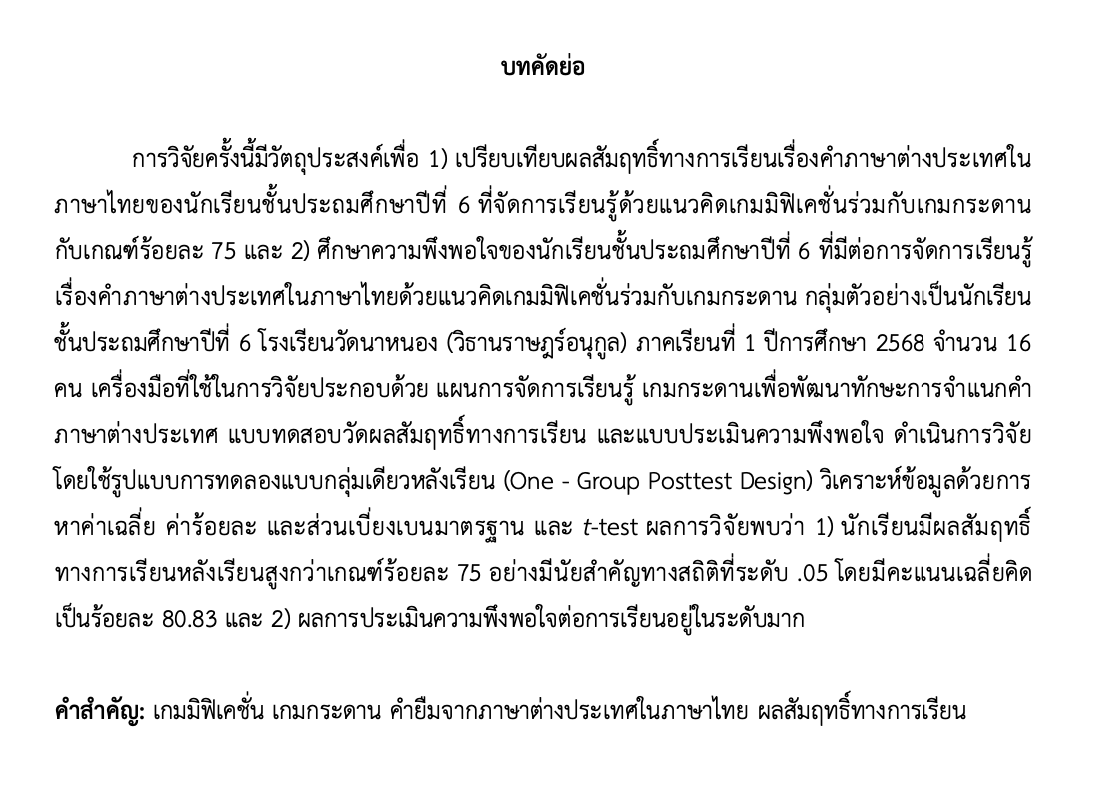
The objectives of this research were to: 1) compare learning achievement of foreign words in the Thai language for grade 6 students through a gamification approach integrated with a board game with the criterion level of 75 percent, and 2) examine students’ satisfaction with learning achievement of foreign words in the Thai language for grade 6 students through a gamification approach integrated with a board game. The sample comprised 16 Grade 6 students from Wat Nanong School (Withanrat Anukul) during Semester 1 of the 2025 academic year. The research instruments included lesson plans, a board game designed to enhance skills in classifying foreign loanwords, a learning achievement test, and a satisfaction questionnaire. The study employed a one-group posttest-only design (One-Group Posttest Design). Data analysis was performed using means, percentages, standard deviations, and t-tests. The results indicated that the students’ posttest achievement scores were significantly higher than the 75 percent criterion at the .05 level, with an average score of 80.83 percent. Additionally, students’ overall satisfaction with the learning activities was assessed as high.
Downloads
Article Details

This work is licensed under a Creative Commons Attribution-NonCommercial-NoDerivatives 4.0 International License.
แนวคิดและข้อเสนอแนะที่นำเสนอในบทความของวารสารการบริหารและความเป็นผู้นำทางการศึกษา มหาวิทยาลัยรามคำแหง เป็นแนวคิดที่มาจากผู้เขียน หากมีความผิดพลาดใด ๆ ผู้เขียนเป็นผู้รับผิดชอบแต่เพียงผู้เดียว
ทั้งนี้ บรรณาธิการ กองบรรณาธิการ และคณะกรรมการหน่วยจัดทำวารสารฯ จะไม่ก้าวก่ายความมั่นคงในหลักการตามความคิดของผู้เขียน
ดังนั้น บรรณาธิการ กองบรรณาธิการ คณะกรรมการหน่วยจัดทำวารสาร และมหาวิทยาลัย จะไม่รับผิดชอบใด ๆ จากผลที่เกิดขึ้นจากการนำเสนอแนวคิด และข้อเสนอแนะของผู้แต่งที่เผยแพร่ในวารสารฯ
References
Boonsuaykhwan, S. (2022). Development of Thai Literature Learning Achievement and Learning Happiness of Grade 9 Students through Gamification and Feedback. (Master’s Thesis, Silpakorn University). [In Thai].
Buaphan, P. (2021). Effects of Board Game Activities on Enhancing English Speaking Skills of Grade 7 Students. (Master of Independent Study, Silpakorn University). [In Thai].
Chongmuenwai, B., Kongsima, K., …, Suikraduang, A. (2018). (2019). Gamification for Learning. Journal of Project in Computer Science and Information Technology, 4(2), 34–43. [In Thai]
Duangrattanekchai, S. (2019). Game-based Learning: An Alternative for Modern Science Education. IPST Magazine, 47(216), 25–30. [In Thai].
Kapp, K. M. (2013). The Gamification of Learning and Instruction Fieldbook: Ideas into Practice. John Wiley & Sons.
Kleabpanichkul, K. (1999). Thai Language Usage. Odean Store. [In Thai].
Laolertworakul, A. (2012). Thai Language Norms. Thai Language Institute, Bureau of Academic Affairs and Educational Standards, Office of the Basic Education Commission, Ministry of Education. [In Thai].
Mapa, M. (2016). Foreign Languages in Thai. Faculty of Humanities and Social Sciences, Udon Thani Rajabhat University. [In Thai].
Ministry of Education. (2008). The Basic Education Core Curriculum B.E. 2551 (2008). Kurusapa Ladprao Printing House. [In Thai].
Maulana, R. A. (2019). The Use of Board Game for Improving Students’ English-speaking Ability. (Master's Thesis, The State Institute for Islamic Studies of Bengkulu).
Mungsri, N. (2023). Effects of Learning Management Integrating Murdoch’s Integrated Approach (MIA) with Gamification to Enhance English Reading Comprehension Ability of Grade 7 Students. (Master of Independent Study, Silpakorn University). [In Thai].
Na Nongkhai, J. and Phataranigone, S. (2024). The Development of Learning Management Plans in the Topic of Loanwords in Thai Language with the Conceptual Learning Management in Conjuntion with Game Based Learning for Mattayomsuksa 3 Students, Pathumthep Wittayakarn School, Nongkhai Province. Journal of Humanities and Social Sciences Songkhla Rajabhat University, 7(1), 101–124. [In Thai].
Na Songkhla. (2018). Digital Learning Design. Chulalongkorn University Press. [In Thai].
Niljinda, N. (1996). Foreign Languages in Thai. Department of Thai Language, Faculty of Humanities and Social Sciences, Sakon Nakhon Rajabhat Institute. [In Thai].
Nimnuan, S., and Pakapol, P. (2025). The Development of Learning Outcomes in Thai Language Subject on Words Derived from Foreign Languages for 9th-Grades Students Using Inquiry-Based Learning Combined with Online Games. Journal of Social Science Panyapat, 7(2), 313–322. [In Thai].
Orbe, A., Rojí, E., …, and Cuadrado, J. (2018). Urban Planning Board Game: A Cooperative Serious Game. Academic Conferences International Limited.
Srijantha, S., Sinthanapanya, A., …, and Phupakdee, P. (2019). Creating and Using Games for Learning through Active Learning: Creating a New Classroom with Happiness. EDUCA. Retrieved from https://www.educathai.com/events/2019/44. [In Thai].
Suya, S. (2022). Effects of Learning Activities Via Web Applications Based on Gamification Concepts on Learning Engagement of Grade 6 Students with Different Academic Achievement Levels. (Master’s Thesis, Silpakorn University). [In Thai].
