TPACK-AI Framework: Guidelines for Developing Thai Teacher Skills in the Artificial Intelligence Era
Article Sidebar
Main Article Content
Abstract
The arrival of artificial intelligence significantly influences the education system, especially the role of teachers who must adapt to work effectively with technology. Teacher skill development, therefore, is not just about learning how to use tools but involves a comprehensive growth covering knowledge, pedagogy, and technology. This article aims to
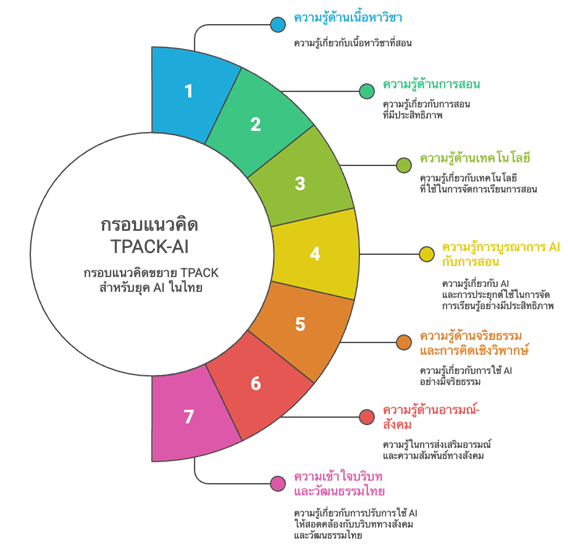
1) analyze the roles and limitations of artificial intelligence in teaching and learning within the Thai context; 2) identify essential skills for Thai teachers in the age of artificial intelligence; and 3) introduce the TPACK-AI framework and guidelines for systematically developing Thai teacher skills. The findings show that AI serves three primary roles: as a teacher assistant, a learning enhancement tool, and a knowledge source. However, there are limitations related to data accuracy, ethics, and disparities within the Thai context. Teachers need to develop skills in five areas: Technology, Pedagogy, Content, Ethics, and Socio-emotional skills. The article introduces the TPACK-AI framework, which expands the original TPACK into seven dimensions. It offers guidelines for teacher skill development at four levels: individual, school, policy, and teacher education institutions. This aims to help Thai teachers effectively and sustainably integrate artificial intelligence into instruction.
Downloads
Article Details

This work is licensed under a Creative Commons Attribution-NonCommercial-NoDerivatives 4.0 International License.
แนวคิดและข้อเสนอแนะที่นำเสนอในบทความของวารสารการบริหารและความเป็นผู้นำทางการศึกษา มหาวิทยาลัยรามคำแหง เป็นแนวคิดที่มาจากผู้เขียน หากมีความผิดพลาดใด ๆ ผู้เขียนเป็นผู้รับผิดชอบแต่เพียงผู้เดียว
ทั้งนี้ บรรณาธิการ กองบรรณาธิการ และคณะกรรมการหน่วยจัดทำวารสารฯ จะไม่ก้าวก่ายความมั่นคงในหลักการตามความคิดของผู้เขียน
ดังนั้น บรรณาธิการ กองบรรณาธิการ คณะกรรมการหน่วยจัดทำวารสาร และมหาวิทยาลัย จะไม่รับผิดชอบใด ๆ จากผลที่เกิดขึ้นจากการนำเสนอแนวคิด และข้อเสนอแนะของผู้แต่งที่เผยแพร่ในวารสารฯ
References
Asim, S., Kim, H. and Aedo, C. (2024). Teachers are Leading an AI Revolution in Korean Classrooms. World Bank Blogs. Retrieved from https://blogs.worldbank.org/en/education/teachers-are-leading-an-ai-revolution-in-korean-classrooms?utm_source=chatgpt.com
Battelle for Kids. (2019). Partnership for 21st Century Learning, A Network of Battelle for Kids, Framework for 21st Century Learning Definitions. Battelle for Kids. Retrieved from https://static.battelleforkids.org/documents/p21/P21_Framework_DefinitionsBFK.pdf
Bootchuy, T. and Bootchuy, P. (2021). Blended Learning Design in Communicative English Language Teaching for Learners in Higher Education in the Digital Age. ECT Education and Communication Technology Journal, 16(20), 31–48. [In Thai]. https://so01.tci-thaijo.org/index.php/ectstou/article/view/244977/167227
Celik, I., Dindar, M., … and Järvelä, S. (2022). The Promises and Challenges of Artificial Intelligence for Teachers: A Systematic Review of Research. TechTrends, 66(2022), 616–630. https://doi.org/10.1007/s11528-022-00715-y
Chakamanont, S. and Thabmali, P. (2025). Guidelines for Enhancing Thai Teachers' Artificial Intelligence Literacy in the Digital Age. Journal of Education and Innovation, 27(1), 186–201. [In Thai]. https://doi.org/10.71185/jeiejournals.v27i1.275674
Crompton, H. and Burke, D. (2023). Artificial Intelligence in Higher Education: The State of the Field. International Journal of Educational Technology in Higher Education, 20(2023), 1–22. https://doi.org/10.1186/s41239-023-00392-8
Darvishi, A., Khosravi, H., … and Gašević, D. (2022). Incorporating AI and Learning Analytics to Build Trustworthy Peer Assessment Systems. British Journal of Educational Technology, 53(2022), 844–875. https://doi.org/10.1111/bjet.13233
Dweck, C. S. (2017). Mindset: Changing the Way You Think to Fulfill Your Potential. Robinson, an Imprint of Constable & Robinson Ltd. Retrieved from https://icrrd.com/public/media/01-11-2020-205951Mindset%20by%20Carol%20S.%20Dweck.pdf
Gates, B. (2023). The Age of AI has Begun. Retrieved from https://www.gatesnotes.com/The-Age-of-AI-has-begun
Gumlanghan, T. (2025). The Use of AI and Big Data in Educational Leadership Decision-Making: Possibilities and Challenges. Ratchasimaparithat, 1(2), 11–21. [In Thai]. https://so09.tci-thaijo.org/index.php/RSMP/article/view/7158/4482
Hwang, G. J., Xie, H., … and Gašević, D. (2020). Vision, Challenges, Roles, and Research Issues of Artificial Intelligence in Education. Computers and Education: Artificial Intelligence, 1(2020), 1–5. https://doi.org/10.1016/j.caeai.2020.100001
ISTE, International Society for Technology in Education. (2017). ISTE Standards for Educators. Retrieved from https://cms-live-media.iste.org/ISTE_STANDARDS_2024_v02.pdf
Kumar, A., Sharma, P., … and Singh, V. (2024). Educational Inequality and Its Impact on Social and Economic Opportunities in Rural India. International Journal of Humanities, Management and Social Science, 7(2), 87–96.
https://doi.org/10.36079/lamintang.ij-humass-0702.697
Kasneci, E., Sessler, K., ...and Kasneci, G. (2023). ChatGPT for Good? On Opportunities and Challenges of Large Language Models for Education. Learning and Individual Differences, 103(2023), 1-8. https://doi.org/10.1016/j.lindif.2023.102274
Long, D. and Magerko, B. (2020). What is AI literacy? Competencies and Design Considerations. Proceedings of the 2020 CHI Conference on Human Factors in Computing Systems, 1–16. https://www.sci-hub.ee/10.1145/3313831.3376727
Luckin, R., Cukurova, M., …and du Boulay, B. (2022). Empowering Educators to be AI-ready. Computers and Education: Artificial Intelligence, 3(2002), 1–11. https://doi.org/10.1016/j.caeai.2022.100076
Ministry of Education. (2023). Five-year Action Plan (2023-2027) of the Office of the Permanent Secretary,
Ministry of Education. Bangkok: Office of the Permanent Secretary, Ministry of Education. [In Thai]. https://www.moe.go.th/wp-content/uploads/2022/04/รวมเล่มแผนปฏิบัติราชการ-5-ปี-สป-66-70-PDF.pdf
Ministry of Education, Singapore. (2024). Artificial Intelligence in Education. Retrieved from https://www.moe.gov.sg/education-in-sg/educational-technology-journey/edtech-masterplan/artificial-intelligence-in-education
Ministry of Education, Singapore. (2024). Singapore Teachers Embrace Digital Technologies and Benefit from Strong Professional Development, according to the OECD TALIS 2024 Study. Retrieved from https://www.moe.gov.sg/news/press-releases/20251007-singapore-teachers-embrace-digital-technologies-and-benefit-from-strong-professional-development-oecd-talis-2024-study?utm_source=chatgpt.com
Mishra, P. and Koehler, M. J. (2006). Technological Pedagogical Content Knowledge: A Framework for Teacher Knowledge. Teachers College Record, 108(6), 1017–1054. https://one2oneheights.pbworks.com/f/MISHRA_PUNYA.pdf
Ng, D. T. K., Leung, J. K. L., … and Qiao, M. S. (2021). Conceptualizing AI literacy: An Exploratory Review. Computers and Education: Artificial Intelligence, 2(2021), 1–15. https://doi.org/10.1016/j.caeai.2021.100041
Office of the Education Council. (2024). How to Create a Learning Ecosystem for Education in the New World. Bangkok: S.B.K. Printing Co., Ltd. [In Thai]. https://backoffice.onec.go.th/uploads/Book/2077-file.pdf
Phonyiam, P. and Prasertsang, P. (2024). Guidelines For Learning Management: The 5E of Inquiry-based Learning Combined with High-Level Questions Technique. Kalasin University Journal of Humanities Social Sciences and Innovation, 3(1), 68–85. [In Thai]. https://so02.tci-thaijo.org/index.php/hsi_01/article/view/258076/179262
Russell, S. J., & Norvig, P. (2021). Artificial Intelligence: A Modern Approach (4th ed.). Pearson. http://lib.ysu.am/disciplines_bk/efdd4d1d4c2087fe1cbe03d9ced67f34.pdf
Schmidt, D. A., Baran, E., …and Shin, T. S. (2009). Technological Pedagogical Content Knowledge (TPACK): The Development and Validation of an Assessment Instrument for Preservice Teachers. JRTE, 42(2), 123–149. https://files.eric.ed.gov/fulltext/EJ868626.pdf
Siengsanan, W. (2025). Future Teachers and AI: Coexistence, Adaptation, and Technology Integration for Enhanced Learning Quality. Ratchasimaparithat, 1(2), 22–34. [In Thai]. https://so09.tci-thaijo.org/index.php/RSMP/article/view/7196/4483
Soraphum, T. and Ratanaphan, J. (2025). TPACK: A Conceptual Framework for Modern Teachers. Journal of Educational Technology and Communications, Faculty of Education, Mahasarakham University, 8(27), 7–18. [In Thai]. https://so02.tci-thaijo.org/index.php/etcedumsujournal/issue/view/18081/5360
Teachers' Council of Thailand. (2019). Teachers' Council of Thailand Regulation on Professional Standards (No. 4) (2019). Bangkok: Studio. [In Thai]. https://news.ksp.or.th/opendata/rules/rule_standard4-2562.pdf
Teepakakorn, K. (2025). Thai Teachers’ Adaptation in the Era of Generative AI: Educational Opportunities and Challenges in 2025. Ratchasimaparithat, 1(2), 1–10. [In Thai]. https://so09.tci-thaijo.org/index.php/RSMP/article/view/7157/4481
UNESCO. (2018). UNESCO ICT Competency Framework for Teachers (Version 3). Retrieved from https://unesdoc.unesco.org/ark:/48223/pf0000265721
UNESCO. (2023). Guidance for Generative AI in Education and Research. Retrieved from https://unesdoc.unesco.org/ark:/48223/pf0000386693
Wang, S., Bao, J, … and Zhang, D. (2024). The Impact of Online Learning Engagement on College Students' Academic Performance: The Serial Mediating Effect of Inquiry Learning and Reflective Learning. Innovations in Education and Teaching International, 61(6), 1416–1430. https://doi.org/10.1080/14703297.2023.2236085
