ผลของนวัตกรรมการจัดการเรียนรู้แบบโครงงานเป็นฐานร่วมกับการเรียนรู้เชิงรุกและเทคโนโลยีช่วยสอนต่อผลลัพธ์การเรียนรู้ด้านการติดตั้งและปรับแต่งระบบปฏิบัติการและเครือข่ายของนักศึกษาที่มีพื้นฐานทางการศึกษาแตกต่างกัน
Article Sidebar
Main Article Content
บทคัดย่อ
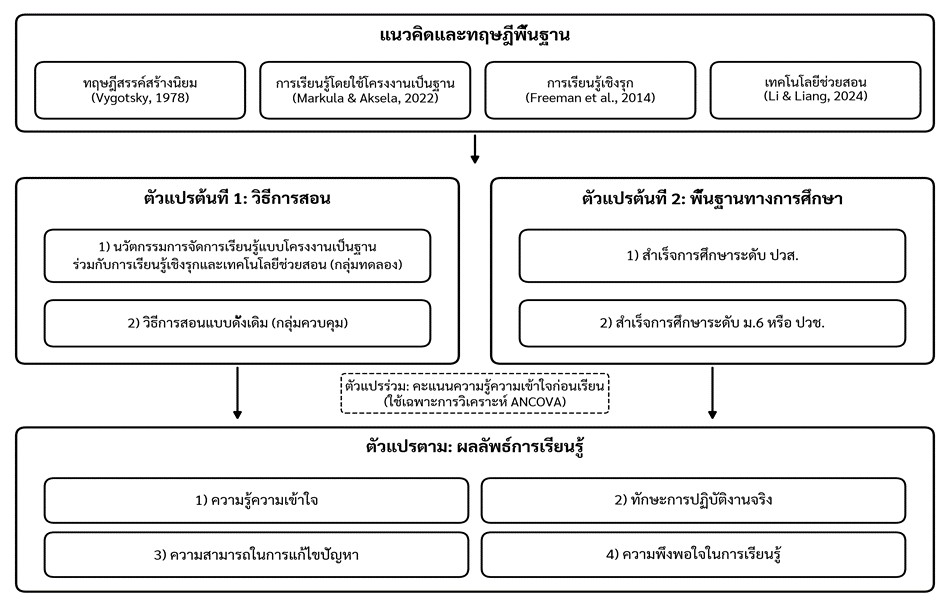
การวิจัยกึ่งทดลองนี้มีวัตถุประสงค์เพื่อ 1) เปรียบเทียบความรู้ความเข้าใจ ทักษะการปฏิบัติงานจริง ความสามารถในการแก้ไขปัญหา และความพึงพอใจในการเรียนรู้ด้านการติดตั้งและปรับแต่งระบบปฏิบัติการและเครือข่าย ระหว่างนักศึกษาที่เรียนด้วยนวัตกรรมการจัดการเรียนรู้แบบโครงงานเป็นฐานร่วมกับการเรียนรู้เชิงรุกและเทคโนโลยีช่วยสอนกับนักศึกษาที่เรียนด้วยวิธีการสอนแบบดั้งเดิม และ 2) ศึกษาปฏิสัมพันธ์ระหว่างวิธีการสอนกับพื้นฐานทางการศึกษาของผู้เรียน กลุ่มตัวอย่างเป็นนักศึกษาสาขาเทคโนโลยีสารสนเทศชั้นปีที่ 1 จำนวน 75 คน ได้มาโดยการเลือกแบบเจาะจง (สำเร็จการศึกษาระดับ ปวส. 50 คน และระดับ ม.6/ปวช.
25 คน) จัดเข้ากลุ่มทดลอง 38 คน และกลุ่มควบคุม 37 คนโดยการจับคู่ตามพื้นฐานทางการศึกษา และคะแนนก่อนเรียน ทดลอง 15 สัปดาห์ เครื่องมือวิจัย ได้แก่ แผนการจัดการเรียนรู้ของทั้งสองกลุ่ม แบบทดสอบความรู้ความเข้าใจ แบบประเมินทักษะการปฏิบัติงานจริง แบบทดสอบสถานการณ์ปัญหา แบบสอบถาม
ความพึงพอใจ แบบสัมภาษณ์กึ่งโครงสร้าง และแบบบันทึกการสังเกตพฤติกรรม เครื่องมือวัดมีค่าความเชื่อมั่น .82–.89 วิเคราะห์ข้อมูลด้วยค่าเฉลี่ย ส่วนเบี่ยงเบนมาตรฐาน การวิเคราะห์ความแปรปรวนร่วม (ANCOVA) สำหรับความรู้ความเข้าใจโดยใช้คะแนนก่อนเรียนเป็นตัวแปรร่วม และการวิเคราะห์ความแปรปรวน
แบบสองทาง (Two-way ANOVA) สำหรับทักษะการปฏิบัติงานจริง ความสามารถในการแก้ไขปัญหา และความพึงพอใจในการเรียนรู้ ผลการวิจัยพบว่า 1) เมื่อควบคุมคะแนนก่อนเรียน กลุ่มทดลองมีค่าเฉลี่ยปรับของคะแนนความรู้
ความเข้าใจ (81.80) สูงกว่ากลุ่มควบคุม (72.95) อย่างมีนัยสำคัญทางสถิติที่ระดับ .05 2) กลุ่มทดลองมีทักษะการปฏิบัติงานจริง (85.52) ความสามารถในการแก้ไขปัญหา (80.34) และความพึงพอใจในการเรียนรู้ (4.35) สูงกว่ากลุ่มควบคุม (71.99, 69.14 และ 3.60 ตามลำดับ) อย่างมีนัยสำคัญทางสถิติที่ระดับ .05 และ
3) ไม่พบปฏิสัมพันธ์ระหว่างวิธีการสอนกับพื้นฐานทางการศึกษาในทั้งสามผลลัพธ์ ซึ่งอาจแสดงว่านวัตกรรมให้ผลในทิศทางเดียวกันกับผู้เรียนทั้งสองพื้นฐาน แต่ด้วยขนาดกลุ่มย่อยที่เล็ก ข้อสรุปเรื่องปฏิสัมพันธ์จึงยังมีข้อจำกัด
คำสำคัญ: การเรียนรู้โดยใช้โครงงานเป็นฐาน การเรียนรู้เชิงรุก เทคโนโลยีช่วยสอน ระบบปฏิบัติการและเครือข่าย พื้นฐานทางการศึกษา การบริหารงานวิชาการ
Downloads
Article Details

อนุญาตภายใต้เงื่อนไข Creative Commons Attribution-NonCommercial-NoDerivatives 4.0 International License.
The authors are solely responsible for the ideas and recommendations presented in articles published in the LEAD Journal RU. If any inaccuracies occur, the authors accept full responsibility.
Moreover, the Editorial Board, Editorial Team, and Committee of the LEAD Journal RU are committed to maintaining the integrity of the principles reflected in the authors' contributions.
Consequently, Ramkhamhaeng University, the Editorial Board, Editorial Team, and Editors shall not be held liable for any outcomes arising from the authors' presentation of their ideas and recommendations within the LEAD Journal RU.
เอกสารอ้างอิง
Best, J. W. (1977). Research in education (3rd ed.). Prentice Hall.
Bittermann, A., McNamara, D., Simonsmeier, B. A., & Schneider, M. (2023). The landscape of research on prior knowledge and learning: A bibliometric analysis. Educational Psychology Review, 35, Article 58. https://doi.org/10.1007/s10648-023-09775-9
Blanca, M. J., Alarcón, R., Arnau, J., Bono, R., & Bendayan, R. (2017). Non-normal data: Is ANOVA still a valid option? Psicothema, 29(4), 552–557. https://doi.org/10.7334/psicothema2016.383
Bonwell, C. C., & Eison, J. A. (1991). Active learning: Creating excitement in the classroom (ASHE-ERIC Higher Education Report No. 1). George Washington University, School of Education and Human Development.
Braun, V., & Clarke, V. (2006). Using thematic analysis in psychology. Qualitative Research in Psychology, 3(2), 77–101. https://doi.org/10.1191/1478088706qp063oa
Cohen, J. (1988). Statistical power analysis for the behavioral sciences (2nd ed.). Lawrence Erlbaum Associates.
Cronbach, L. J. (1951). Coefficient alpha and the internal structure of tests. Psychometrika, 16(3), 297–334. https://doi.org/10.1007/BF02310555
Faul, F., Erdfelder, E., Lang, A.-G., & Buchner, A. (2007). G*Power 3: A flexible statistical power analysis program for the social, behavioral, and biomedical sciences. Behavior Research Methods, 39(2), 175–191. https://doi.org/10.3758/BF03193146
Field, A. (2018). Discovering statistics using IBM SPSS Statistics (5th ed.). SAGE.
Freeman, S., Eddy, S. L., McDonough, M., Smith, M. K., Okoroafor, N., Jordt, H., & Wenderoth, M. P. (2014). Active learning increases student performance in science, engineering, and mathematics. Proceedings of the National Academy of Sciences, 111(23), 8410–8415. https://doi.org/10.1073/pnas.1319030111
Hake, R. R. (1998). Interactive-engagement versus traditional methods: A six-thousand-student survey of mechanics test data for introductory physics courses. American Journal of Physics, 66(1), 64–74. https://doi.org/10.1119/1.18809
Huang, F. L. (2020). MANOVA: A procedure whose time has passed? Gifted Child Quarterly, 64(1), 56–60. https://doi.org/10.1177/0016986219887200
Koo, T. K., & Li, M. Y. (2016). A guideline of selecting and reporting intraclass correlation coefficients for reliability research. Journal of Chiropractic Medicine, 15(2), 155–163. https://doi.org/10.1016/j.jcm.2016.02.012
Kuder, G. F., & Richardson, M. W. (1937). The theory of the estimation of test reliability. Psychometrika, 2(3), 151–160. https://doi.org/10.1007/BF02288391
Lavado-Anguera, S., Velasco-Quintana, P.-J., & Terrón-López, M.-J. (2024). Project-based learning (PBL) as an experiential pedagogical methodology in engineering education: A review of the literature. Education Sciences, 14(6), 617. https://doi.org/10.3390/educsci14060617
Lertyosbordin, C., Maneewan, S., Yampinij, S., & Thamwipat, K. (2019). Scoring rubric of problem-solving on computing science learning. International Education Studies, 12(8), 26–32. https://doi.org/10.5539/ies.v12n8p26
Li, J., & Liang, W. (2024). Effectiveness of virtual laboratory in engineering education: A meta-analysis. PLOS ONE, 19(12), e0316269. https://doi.org/10.1371/journal.pone.0316269
Llanos, J., Bucheli, V. A., & Restrepo-Calle, F. (2023). Early prediction of student performance in CS1 programming courses. PeerJ Computer Science, 9, e1655. https://doi.org/10.7717/peerj-cs.1655
Markula, A., & Aksela, M. (2022). The key characteristics of project-based learning: How teachers implement projects in K–12 science education. Disciplinary and Interdisciplinary Science Education Research, 4, Article 2. https://doi.org/10.1186/s43031-021-00042-x
Mertler, C. A. (2001). Designing scoring rubrics for your classroom. Practical Assessment, Research & Evaluation, 7(25), 1–10. https://doi.org/10.7275/gcy8-0w24
Ministry of Higher Education, Science, Research and Innovation. (2022). Ministerial regulation on higher education qualification standards B.E. 2565. Royal Thai Government Gazette, 139(20 Kor), 28–31. [in Thai]
Office of the Education Council. (2024). Education statistics of Thailand: Academic year 2023. Ministry of Education. [in Thai]
Price, P. C., Jhangiani, R., Chiang, I.-C. A., Leighton, D. C., & Cuttler, C. (2017). Research methods in psychology (3rd American ed.). Washington State University. https://wsu.pressbooks.pub/carriecuttler/
Promwong, C. (2013). Developmental testing of media and instructional package. Silpakorn Educational Research Journal, 5(1), 7–20. [in Thai]
Rovinelli, R. J., & Hambleton, R. K. (1977). On the use of content specialists in the assessment of criterion-referenced test item validity. Dutch Journal of Educational Research, 2, 49–60.
Saud, A. S., Adhikari, B., & Piya, S. (2025). Evaluating the effectiveness of Cisco Packet Tracer for teaching networking concepts at the undergraduate level. Perspectives on Higher Education, 15(1), 123–136. https://doi.org/10.3126/phe.v15i01.80876
Seels, B. B., & Richey, R. C. (1994). Instructional technology: The definition and domains of the field. Association for Educational Communications and Technology.
Sweller, J., van Merriënboer, J. J. G., & Paas, F. (2019). Cognitive architecture and instructional design: 20 years later. Educational Psychology Review, 31(2), 261–292. https://doi.org/10.1007/s10648-019-09465-5
Tabachnick, B. G., & Fidell, L. S. (2019). Using multivariate statistics (7th ed.). Pearson.
Theobald, E. J., Hill, M. J., Tran, E., Agrawal, S., Arroyo, E. N., Behling, S., Chambwe, N., Cintrón, D. L., Cooper, J. D., Dunster, G., Grummer, J. A., Hennessey, K., Hsiao, J., Iranon, N., Jones, L., II, Jordt, H., Keller, M., Lacey, M. E., Littlefield, C. E., ... Freeman, S. (2020). Active learning narrows achievement gaps for underrepresented students in undergraduate science, technology, engineering, and math. Proceedings of the National Academy of Sciences, 117(12), 6476–6483. https://doi.org/10.1073/pnas.1916903117
Thianthai, C., & Sutamchai, K. (2022). Skills that matter: Qualitative study focusing on the transfer of training through the experience of Thai vocational students. Frontiers in Education, 7, 897808. https://doi.org/10.3389/feduc.2022.897808
van de Pol, J., Volman, M., & Beishuizen, J. (2010). Scaffolding in teacher–student interaction: A decade of research. Educational Psychology Review, 22(3), 271–296. https://doi.org/10.1007/s10648-010-9127-6
Vygotsky, L. S. (1978). Mind in society: The development of higher psychological processes. Harvard University Press.
Wang, X., Huang, R. T., Sommer, M., Pei, B., Shidfar, P., Rehman, M. S., Ritzhaupt, A. D., & Martin, F. (2024). The efficacy of artificial intelligence-enabled adaptive learning systems from 2010 to 2022 on learner outcomes: A meta-analysis. Journal of Educational Computing Research, 62(6), 1348–1383. https://doi.org/10.1177/07356331241240459
Weerasombat, T., & Pumipatyothin, P. (2025). Employers' priority on work skills and the skill gaps: A case of Thailand. Cogent Education, 12(1), 2441656. https://doi.org/10.1080/2331186X.2024.2441656
World Bank. (2025). Thailand economic monitor: Digital pathways for growth. World Bank.
World Economic Forum. (2025). The future of jobs report 2025. World Economic Forum. https://www.weforum.org/publications/the-future-of-jobs-report-2025/
Xu, E., Wang, W., & Wang, Q. (2023). The effectiveness of collaborative problem solving in promoting students' critical thinking: A meta-analysis based on empirical literature. Humanities and Social Sciences Communications, 10, Article 16. https://doi.org/10.1057/s41599-023-01508-1
Zhang, L., & Ma, Y. (2023). A study of the impact of project-based learning on student learning effects: A meta-analysis study. Frontiers in Psychology, 14, 1202728. https://doi.org/10.3389/fpsyg.2023.1202728
