การพัฒนาแบบวัดภาวะผู้นำเชิงบารมี สำหรับนิสิตปริญญาตรี คณะวิศวกรรมศาสตร์
Article Sidebar
Main Article Content
บทคัดย่อ
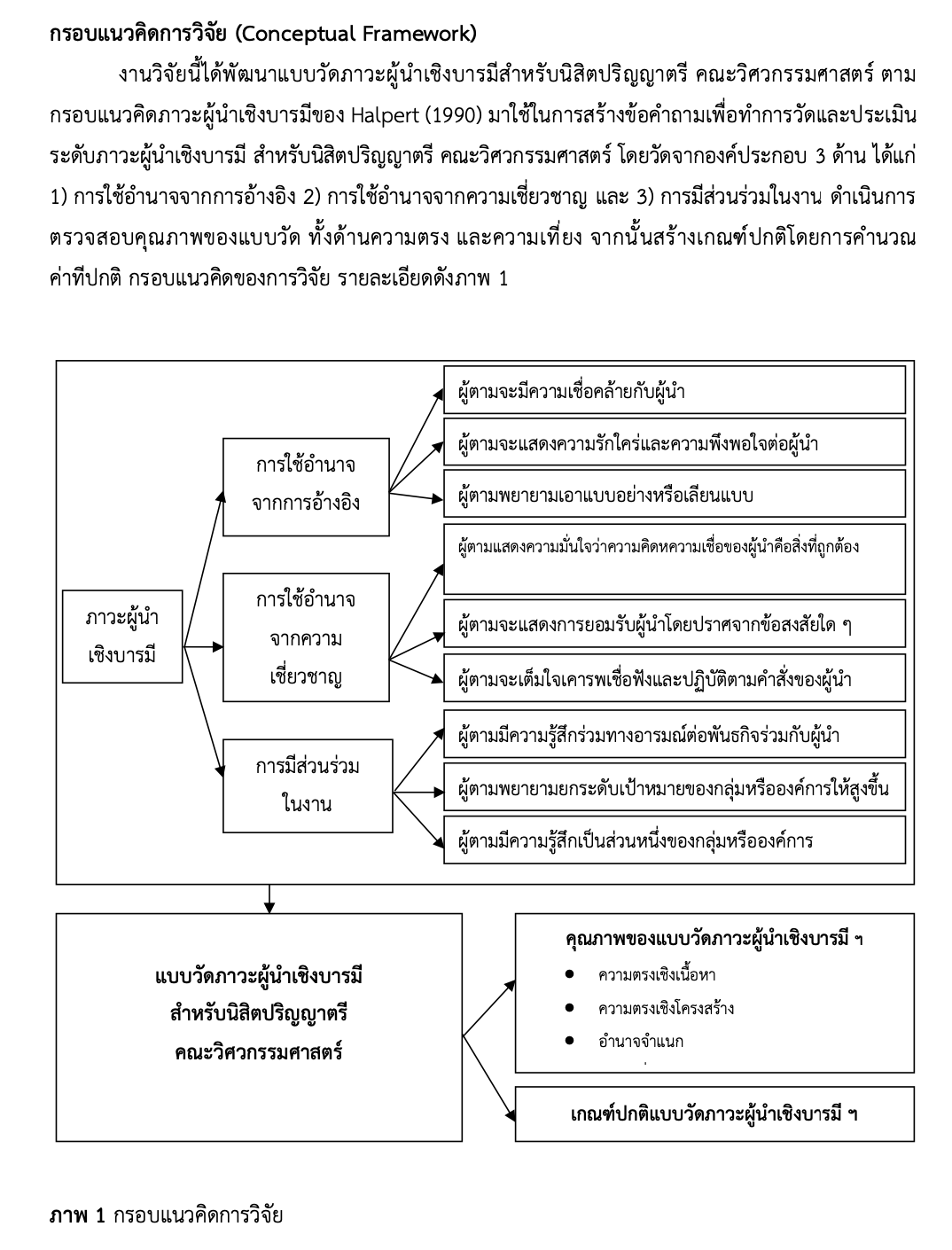
การวิจัยนี้มีวัตถุประสงค์เพื่อ 1) สร้างและตรวจสอบคุณภาพของแบบวัดภาวะผู้นำเชิงบารมี สำหรับนิสิตปริญญาตรี คณะวิศวกรรมศาสตร์ และ 2) สร้างเกณฑ์ปกติของแบบวัดภาวะผู้นำเชิงบารมี สำหรับนิสิตปริญญาตรี คณะวิศวกรรมศาสตร์ กลุ่มตัวอย่างคือนิสิตชั้นปีที่ 4 คณะวิศวกรรมศาสตร์ จากมหาวิทยาลัยในกำกับของรัฐแห่งหนึ่งในเขตกรุงเทพมหานคร จำนวน 254 คน ได้มาจากการสุ่มแบบหลายขั้นตอน วิเคราะห์ข้อมูลด้วยสถิติพื้นฐาน การตรวจสอบความตรงเชิงเนื้อหา ค่าอำนาจจำแนก ความเที่ยง ความตรงเชิงโครงสร้างด้วยการวิเคราะห์องค์ประกอบเชิงยืนยัน ผลการวิจัยพบว่า 1) แบบวัดภาวะผู้นำเชิงบารมี สำหรับนิสิตปริญญาตรี มีจำนวน 9 ข้อ 3 องค์ประกอบ ได้แก่ 1) การใช้อำนาจจากการอ้างอิง จำนวน 3 ข้อ 2) การใช้อำนาจจากความเชี่ยวชาญ จำนวน 3 ข้อ และ 3) การมีส่วนร่วมในงาน จำนวน 3 ข้อ ลักษณะแบบวัดเป็นมาตราส่วนประมาณค่า 5 ระดับ แบบวัดมีความตรงเชิงเนื้อหาโดยมีค่าความสอดคล้อง (IOC) ระหว่าง 0.67 – 1.00 ค่าอำนาจจําแนกอยู่ระหว่าง 0.70 - 0.84 มีความตรงเชิงโครงสร้างจากการวิเคราะห์องค์ประกอบเชิงยืนยันอันดับที่สอง (χ2/df = 1.59, RMSEA = .048, RMR = .020, CFI = .992, GFI = .998, AGFI = .996) และมีค่าความเที่ยงทั้งฉบับเท่ากับ 0.94 และ 2) เกณฑ์ปกติแบ่งเป็น 5 ระดับ ดังนี้ คะแนนตั้งแต่ T66 ขึ้นไป T55 – T65, T45 – T54, T35 – T44 และเท่ากับหรือต่ำกว่า T34 หมายถึง นิสิตมีระดับภาวะผู้นำเชิงบารมี
อยู่ในระดับสูงมาก สูง ปานกลาง ต่ำ และต่ำมาก โดยคะแนนทีปกติของภาวะผู้นำเชิงบารมี สำหรับนิสิตปริญญาตรี มีค่าตั้งแต่ T28 ถึง T66
Downloads
Article Details

อนุญาตภายใต้เงื่อนไข Creative Commons Attribution-NonCommercial-NoDerivatives 4.0 International License.
The authors are solely responsible for the ideas and recommendations presented in articles published in the LEAD Journal RU. If any inaccuracies occur, the authors accept full responsibility.
Moreover, the Editorial Board, Editorial Team, and Committee of the LEAD Journal RU are committed to maintaining the integrity of the principles reflected in the authors' contributions.
Consequently, Ramkhamhaeng University, the Editorial Board, Editorial Team, and Editors shall not be held liable for any outcomes arising from the authors' presentation of their ideas and recommendations within the LEAD Journal RU.
เอกสารอ้างอิง
Avolio, B. J. (2011). Full range leadership development. Thousand Oaks: Sage.
Bass, B. M. (1985). Leadership and performance beyond expectations. New York: The Free Press.
Byrne, B. M. (1994). Structural equation modeling with EQS and EQS/Windows.
Thousand Oaks, CA: Sage Publications.
Chawan, P. (1977). The Construction of Standardized tests for Matthayomsueksa 3.
The Printing House of The Thacher’ Council. [in Thai]
Conger, J.A. & Kanungo, R.N. (1998). Charismatic leadership in organizations.
Thousand Oaks, CA: Sage Publications.
Hair, J., Black, W., Babin, B., & Anderson, E. (2010). Multivariate data analysis (7th ed.).
London: Pearson Education Limited.
House J. Robert. (1976). A 1976 Theory of Charismatic Leadership. The Southern
Illinois University Fourth Biennial Leadership Symposium. Carbondale, Illinois:
Southern Illinois University.
Jane, A. Halpert. (1990). The Dimensionality of Charisma. Journal of Business and
Psychology, 4(4), 399-410.
Kanjanawasee, S. (2001). Classical Test Theory.Chulalongkorn University Printing House.
[in Thai]
Kanjanawasee, S. (2013). Classical Test Theory.Chulalongkorn University Printing House.
[in Thai]
Khumsung, J. (2023). Buddhist psychological leadership competencies for promoting
Thai engineers’ happiness at work [in Thai]. Journal of Applied Buddhist
Psychology for Society, 9(1), 251-264. [in Thai].
Leekitwattana, P. (2016). Research methods in education (11th ed.). Mean Service
Supply. [in Thai]
Nunnally, J. C., and Bernstein, I. H. (1994). Psychometric theory (3rd ed). New York:
Mc Graw-Hill.
Paseefol, C. (2011). Construction and development of educational measurement and
evaluation tools (2nd ed.). Chulalongkorn University Press. [in Thai]
Panpinit, S. (2011). Social science research techniques (2nd ed.). Wittayaphat. [in Thai].
Phairatkul, C. (1977). Manual for constructing standardized achievement tests for
Grade 9 students. The Printing House of The Thacher’ Council. [in Thai].
Phuttiyatanee, S. (2019). Education Measurement.Prasan Printing. [in Thai]
Suwannajaroen, J., & et al. (2017). Instructional models for promoting 21st century skills
of nursing students [in Thai]. Nursing Journal, 44(4), 177-188. [in Thai].
Weber. (1947). The Theory of Social and Economic Organization. A.M. Henderson
and T. Parsons (trans). New York: Free Press.
Yukl Gary. (2014). Charismatic and Transformational Leadership. Leadership in
Organizational. 138. Tamil Nadu, India: HT Media Ltd.
