
BUDDHIST INTEGRATION FOR STRENGTHENING POLITICAL CONSCIOUSNESS AMONG CITIZENS IN NAKHON RATCHASIMA TOWN MUNICIPALITY
Keywords:
Buddhist Integration, Raising Awareness, Politics, CitizensAbstract
The objectives of this research article were: 1) to study the level of political consciousness enhancement among the citizens of Nakhon Ratchasima City Municipality; 2) to compare citizens' opinions regarding this enhancement based on personal factors; and 3) to propose a Buddhist integration approach to enhance political consciousness among the citizens of Nakhon Ratchasima City Municipality. A mixed-methods research design was employed. Quantitative data were collected from a sample of 379 individuals using a questionnaire with an overall reliability coefficient of 0.939; data analysis involved frequencies, percentages, means, standard deviations, and F-tests. Qualitative data were collected from nine key informants through interviews and analyzed using descriptive content analysis.
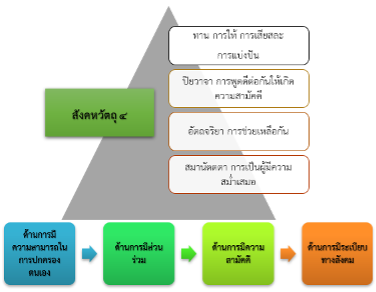
The research findings revealed that: 1. The overall level of political consciousness enhancement among the citizens of Nakhon Ratchasima City Municipality was moderate (x̄ = 3.47, S.D. = 0.56). 2. Comparisons of opinions regarding the enhancement of political consciousness based on personal factors showed no significant differences; thus, the research hypothesis was rejected. 3. A Buddhist integration approach to enhance political consciousness among the citizens of Nakhon Ratchasima City Municipality was proposed based on the *Sangahavatthu 4* (Virtues for Group Solidarity) principles, specifically *Dana* (giving, sacrifice, and sharing): the municipality allocates budgets to organize activities that promote political knowledge among the citizens. ...to participate in politics; 2) *Piyavaca* (Pleasant Speech): Speaking kindly to foster unity—the municipality communicates policies and political information using clear, friendly language; 3) *Atthacariya* (Beneficial Conduct): Helping one another—the municipality facilitates the participation of the elderly and persons with disabilities in the electoral process; 4) *Samanattata* (Impartiality/Consistency): Being consistent—the municipality organizes activities to promote political participation annually and consistently disseminates political information through various channels.
References
จิตรกร ละออศรี. (2564). การสร้างจิตสำนึกทางการเมืองในระบอบประชาธิปไตยของเยาวชนในเทศบาลเมืองอโยธยา จังหวัดพระนครศรีอยุธยา. สารนิพนธ์รัฐศาสตรมหาบัณฑิต สาขาวิชารัฐศาสตร์. บัณฑิตวิทยาลัย: มหาวิทยาลัยมหาจุฬาลงกรณราชวิทยาลัย.
เชวงศักดิ์ เอี่ยมสำอางค์. (2566). การส่งเสริมจิตสำนึกทางการเมืองแบบประชาธิปไตยของเยาวชนในสังกัดสำนักงานเขตพื้นที่การศึกษามัธยมศึกษาชลบุรี ระยอง. ดุษฎีนิพนธ์ปรัชญาดุษฎีบัณฑิต สาขาวิชารัฐศาสตร์. บัณฑิตวิทยาลัย: มหาวิทยาลัยมหาจุฬาลงกรณราชวิทยาลัย.
เชษฐา ทรัพย์เย็น. (2560). การปกครองตนเองผ่านกระบวนการมีส่วนร่วมและการมีจิตสำนึกประชาธิปไตยของประชาสังคม. วารสาร มจร. สังคมศาสตร์ปริทรรศน์, 6(1), 153-159.
ญาณิศา กุเวรไตรย์. (2566). บทบาทของสตีในการมีส่วนร่วมทางการเมืองในอำเภอสีคิ้ว จังหวัดนครราชสีมา. วิทยานิพนธ์รัฐศาสตรมหาบัณฑิต สาขาวิชารัฐศาสตร์. บัณฑิตวิทยาลัย: มหาวิทยาลัยมหาจุฬาลงกรณราชวิทยาลัย.
เทศบาลนครนครราชสีมา. (11 มกราคม 2568). ข้อมูลชุมชนเทศบาลนครนครราชสีมา พ.ศ.2568. สืบค้น จาก https://www.koratcity.go.th/organiz-strupersonnel?dpm=3
พระชิศนุพงศ์ วชิรญาโณ (อพรรัมย์). (2567). การส่งเสริมภาวะผู้นำตามหลักพุทธธรรมสำหรับนักการเมืองท้องถิ่นในอำเภอคง จังหวัดนครราชสีมา. วิทยานิพนธ์รัฐศาสตรมหาบัณฑิต สาขาวิชารัฐศาสตร์. บัณฑิตวิทยาลัย: มหาวิทยาลัยมหาจุฬาลงกรณราชวิทยาลัย.
พระปัญญา สุจิตฺโต (สีงาม). (2564). การบูรณาการหลักพุทธธรรมเพื่อส่งเสริมจิตสำนึกการมีส่วนร่วมทางการเมืองของประชาชนในอำเภอเมืองระยอง จังหวัดระยอง. สารนิพนธ์รัฐศาสตรมหาบัณฑิต สาขาวิชารัฐศาสตร์. บัณฑิตวิทยาลัย: มหาวิทยาลัยมหาจุฬาลงกรณราชวิทยาลัย.
พระมหาสมบัติ ธนปญฺโญ (ฉลองนิติติ์กุล). (2566). การประยุกต์หลักพุทธธรรมเพื่อส่งเสริมจิตสำนึกทางการเมืองของเด็กและเยาวชนในจังหวัดสมุทรปราการ. ดุษฎีนิพนธ์ปรัชญาดุษฎีบัณฑิต สาขาวิชารัฐศาสตร์. บัณฑิตวิทยาลัย: มหาวิทยาลัยมหาจุฬาลงกรณราชวิทยาลัย.
พัชรี สิโรรส. (2555). จิตสำนึกพลเมืองกับการพัฒนาประชาธิปไตยไทย. กรุงเทพมหานคร: สำนักพิมพ์จุฬาลงกรณ์มหาวิทยาลัย.
ฤทัยรัตน์ สุพะนานัย. (2557). จิตสำนึกทางการเมืองของประชาชนในภาคตะวันออกเฉียงเหนือตอนกลาง. วิทยานิพนธ์ศิลปศาสตรมหาบัณฑิต สาขาวิชาพัฒนาสังคม. บัณฑิตวิทยาลัย: มหาวิทยาลัยขอนแก่น.
วรากรณ์ สามโกเศศ. (2546). วัฒนธรรมทางการเมืองกับการพัฒนาประชาธิปไตย. กรุงเทพมหานคร: สำนักพิมพ์มหาวิทยาลัยธรรมศาสตร์.
สมชาย ปรีชาศิลปะกุล. (2560). ประชาธิปไตยในบริบทไทย. เชียงใหม่: ศูนย์ศึกษาเพื่อความเป็นธรรมทางสังคม.
สุทธิโชติ รัตนแสงเสถียร. (2553). การสร้างจิตสำนึกทางการเมืองในระบอบประชาธิปไตย. กรุงเทพมหานคร: สำนักพิมพ์วิญญูชน.
องฺ.จตุกฺก. (ไทย) 21/32/256.
อภิชาต สถิตนิรามัย. (2556). ประชาธิปไตยแบบมีส่วนร่วม : แนวคิดและการพัฒนาในประเทศไทย. กรุงเทพมหานคร: สถาบันพระปกเกล้า.
Likert, R. (1967). The Method of Constructing and Attitude Scale. New York: Wiley & Son.
Taro Yamane. (1973). Statistics : An Introductory Analysis. Tokyo: Aoyama Gakuin University.
Downloads
Published
How to Cite
Issue
Section
License
Copyright (c) 2026 Journal Political Science MCU Korat

This work is licensed under a Creative Commons Attribution-NonCommercial-NoDerivatives 4.0 International License.
This article is published under a Creative Commons Attribution-NonCommercial-NoDerivatives 4.0 International License (CC BY-NC-ND 4.0), which allows others to share the article with proper attribution to the authors and prohibits commercial use or modification. For any other reuse or republication, permission from the journal and the authors is required.


