
Civil Society Networks and the Promotion of Local Good Governance
Keywords:
Civil Society Networks, Ocal Governance, DecentralizationAbstract
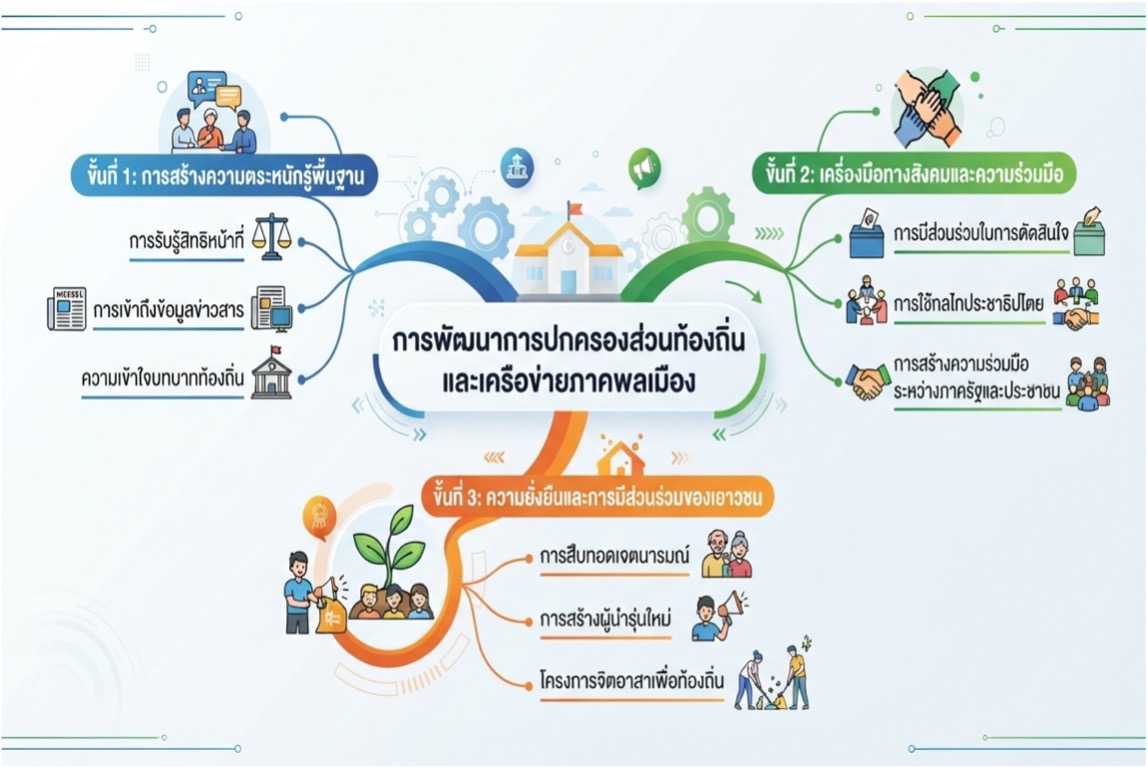
This study examines local operational guidelines, success factors, and area-specific obstacles to synthesize recommendations for developing grassroots democracy in Thai society. Shifts in the socio-economic context have transformed the state-citizen relationship from one-way directives to an inclusive model where all sectors collaborate on planning, implementation, and shared responsibility. However, local decentralization still faces constraints-such as entrenched power structures, patronage culture, and varying levels of public awareness-making the key challenge one of elevating participation into a genuine driver of change rather than a mere legal formality. The study reveals that civil society networks serve as vital social capital, bridging the gap between policy and practice. They play a crucial role in monitoring corruption, proposing policies, and fostering values of integrity aligned with the six principles of good governance. This process involves three key stages: first, building foundational awareness regarding rights, duties, and access to information to instill a sense of local ownership; second, utilizing social tools and collaborative platforms-such as community forums, social media, and state-citizen partnerships-to address issues effectively; and third, ensuring sustainability and youth engagement to secure long-term stability through the continuity of shared goals, the development of new-generation leaders, and volunteer initiatives. Ultimately, these civil society networks function as mechanisms for transparency and as schools of democracy that cultivate civic-mindedness and strengthen the community. and drive Thai society towards sustainable growth based on equality and justice.
References
โกวิทย์ พวงงาม. (2553). การจัดการตนเองของชุมชนและท้องถิ่น. กรุงเทพฯ: บพิธการพิมพ์.
ชำนาญ จันทร์เรือง. (2549). การกระจายอำนาจที่แท้จริงเป็นอย่างไร. กรุงเทพฯ: ประชาไทย.
ชำนาญ ชูเที่ยง และคณะ. (2556). การกระจายอำนาจสู่ท้องถิ่นภายใต้กระบวนทัศน์การปกครองท้องถิ่นสมัยใหม่. วารสารการบริหารและสังคมศาสตร์ปริทรรศน์, 6(4), 297-308.
ชูศักดิ์ เที่ยงตรง . (2520). การบริหารการปกครองท้องถิ่น. กรุงเทพฯ: โรงพิมพ์มหาวิทยาลัยธรรมศาสตร์.
ธีรยุทธ บุญมี. (2541). แนวคิดและวาทะกรรมว่าด้วยธรรมรัฐแห่งชาติ. ในการประชุมทางวิชาการเนื่องในวาระครบรอบ 50 ปีคณะรัฐศาสตร์. กรุงเทพฯ: จุฬาลงกรณ์มหาวิทยาลัย.
บวรศักดิ์ อุวรรณโณ. (2545). ธรรมาภิบาลในองค์กรอิสระ. นนทบุรี: สถาบันพระปกเกล้า.
พระราชญาณวิสิฐ. (2548). หลักธรรมาภิบาลและประมุขศิลป์. กรุงเทพฯ: สํานักพิมพ์ชัยมงคลพริ้นติ้ง.
วุฒิสาร ตันไชย. (2555). การสร้างความปรองดองแห่งชาติ. วารสารสถาบันพระปกเกล้า, 10(1), 5-28.
สัภยา ขาวหมื่นไวย์ และคณะ. (2569). วัฏจักรอำนาจการเมืองท้องถิ่นกับธรรมาภิบาลที่ถูกกัดกิน. วารสารสถาบันพระปกเกล้า, 24(1), 128-148.
อรทัย ก๊กผล. (2552). คู่คิด คู่มือการมีส่วนร่วมของประชาชน สําหรับนักบริหารท้องถิ่น. กรุงเทพฯ: จรัญสนิทวงศ์การพิมพ์.
Ekakul, T. (2008). perational Research. Ubon Ratchathani: Yongsawat Inter Group Co., Ltd.
Downloads
Published
How to Cite
Issue
Section
License
Copyright (c) 2026 Journal Political Science MCU Korat

This work is licensed under a Creative Commons Attribution-NonCommercial-NoDerivatives 4.0 International License.
This article is published under a Creative Commons Attribution-NonCommercial-NoDerivatives 4.0 International License (CC BY-NC-ND 4.0), which allows others to share the article with proper attribution to the authors and prohibits commercial use or modification. For any other reuse or republication, permission from the journal and the authors is required.


