
Buddhist-Oriented Organizational Management from Buddhist Principles to Practice in Modern Organizations
Keywords:
Organizational management, Buddhist principles, Modern organizationsAbstract
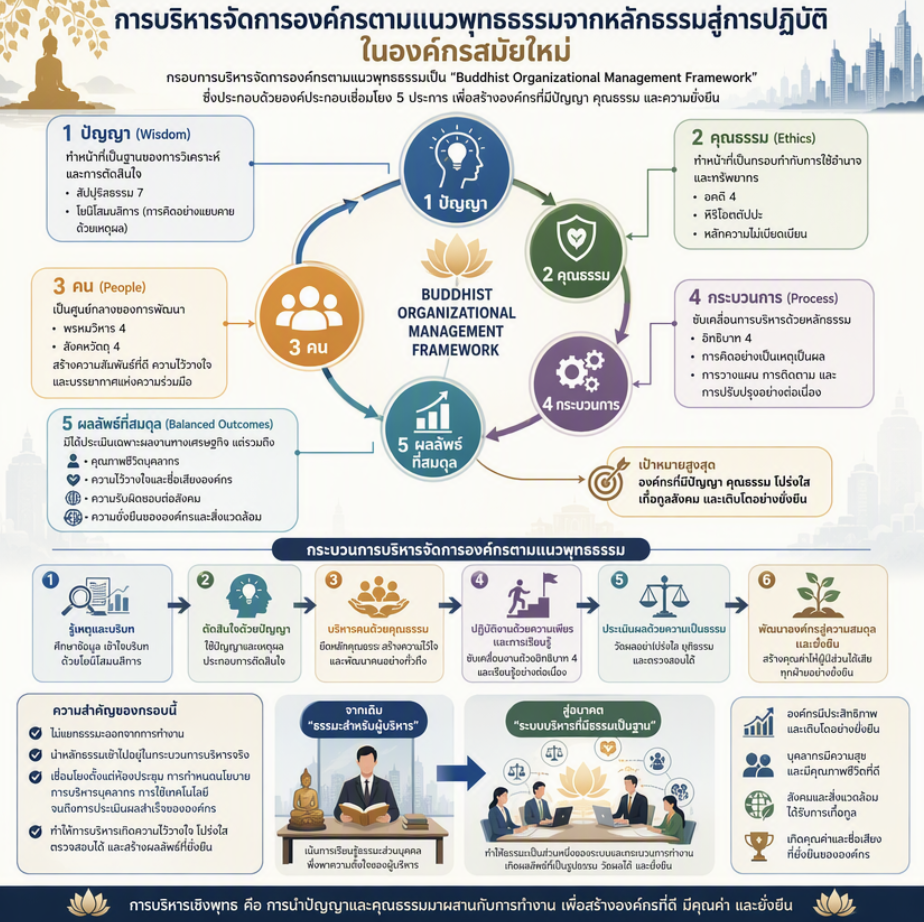
This academic article aims to study and synthesize the concept of organizational management based on Buddhist principles and to present guidelines for applying Buddhist principles from the principal level to practice in modern organizations. This is within the context of organizations facing increasingly complex economic, social, technological, labor structure, and stakeholder expectations changes. Therefore, organizational management cannot focus solely on efficiency, effectiveness, and economic returns, but must also prioritize morality, ethics, quality of life of personnel, social responsibility, and sustainability. The study is divided into five themes: 1) Concepts and foundations of organizational management based on Buddhist principles; 2) Integrating Buddhist principles with organizational management processes; 3) Leadership and human resource management based on Buddhist principles; 4) Applying Buddhist principles from principle to practice in organizations; and 5) Organizational management based on Buddhist principles in the context of modern organizations. The synthesis reveals that the Buddhist principles with significant potential for organizational management are the Seven Virtues of a Good Person (Saptapuriṣa-dhamma), the Four Bases of Success (Iddhipāda), the Four Sublime States of Mind (Brahmavihāra), the Four Principles of Social Harmony (Saṅgahavatthu), the Four Biases (Akaṭṭhāna), Hiri-Ottappa (shame and fear of wrongdoing), and Yonisomanasikara (wise reflection). These can be systematically integrated into planning, organizing, human resource management, directing, decision-making, controlling, and organizational development. Buddhist management is not about applying principles symbolically, but about creating a management system based on wisdom and virtue, with humans at its center, and aiming to strike a balance between efficiency, quality of life, responsibility, and sustainability. This is a key approach for developing modern organizations that can grow while creating value for individuals, organizations, and society.
References
กฤษณวรุณ ไชยนิจ. (2560). หลักพุทธธรรมในการบริหารรัฐกิจ. วารสารบัณฑิตศึกษามหาจุฬาขอนแก่นเกี่ยวกับวารสาร. 4(1). 110-119.
พระครูวินัยธรบุญธรรม และคณะ. (2569). ภาวะผู้นำเชิงพุทธกับการบริหารจัดการองค์กร. วารสารสหวิทยาการนวัตกรรมปริทรรศน์. 9(2). 327–341.
พระพรหมคุณาภรณ์ (ป.อ. ปยุตฺโต). (2559). พุทธธรรม ฉบับปรับขยาย (พิมพ์ครั้งที่ 45). สหธรรมิก.
ฝนธิป ศรีวรัญญู. (2568). แนวคิดการบริหารเชิงพุทธในสังคมร่วมสมัย: บทเรียนจากการเดินทางสู่สังเวชนียสถาน. วารสารสหวิทยาการนวัตกรรมปริทรรศน์. 8(5). 311–323.
มหาจุฬาลงกรณราชวิทยาลัย. (2539). พระไตรปิฎกภาษาไทย ฉบับมหาจุฬาลงกรณราชวิทยาลัย. โรงพิมพ์มหาจุฬาลงกรณราชวิทยาลัย.
ศิขริน ชื่นสมบุญ และคณะ. (2568). ภาวะผู้นำเชิงพุทธในองค์กรธุรกิจไทยสมัยใหม่. วารสารสถาบันวิจัยญาณสังวร. 16(2). 113-123.
สมคิด บางโม. (2562). องค์การและการจัดการ. กรุงเทพฯ: ซีเอ็ดยูเคชั่น.
สุรวุฒ ณ ระนอง. (2566). การประยุกต์หลักพุทธธรรมเพื่อพัฒนาภาวะผู้นำการเปลี่ยนแปลงในการบริหารองค์กร. วารสารสหวิทยาการนวัตกรรมปริทรรศน์. 6(1), 189-198.
อารุณ สิทธิวงศ์. (2562). เคล็ดลับพุทธวิธีภาวะของผู้นำกับการบริหารงานในพระพุทธศาสนา. วารสารสังคมศาสตร์วิชาการ, 12(1). 65-72.
Downloads
Published
How to Cite
Issue
Section
License
Copyright (c) 2026 Journal Political Science MCU Korat

This work is licensed under a Creative Commons Attribution-NonCommercial-NoDerivatives 4.0 International License.
This article is published under a Creative Commons Attribution-NonCommercial-NoDerivatives 4.0 International License (CC BY-NC-ND 4.0), which allows others to share the article with proper attribution to the authors and prohibits commercial use or modification. For any other reuse or republication, permission from the journal and the authors is required.


