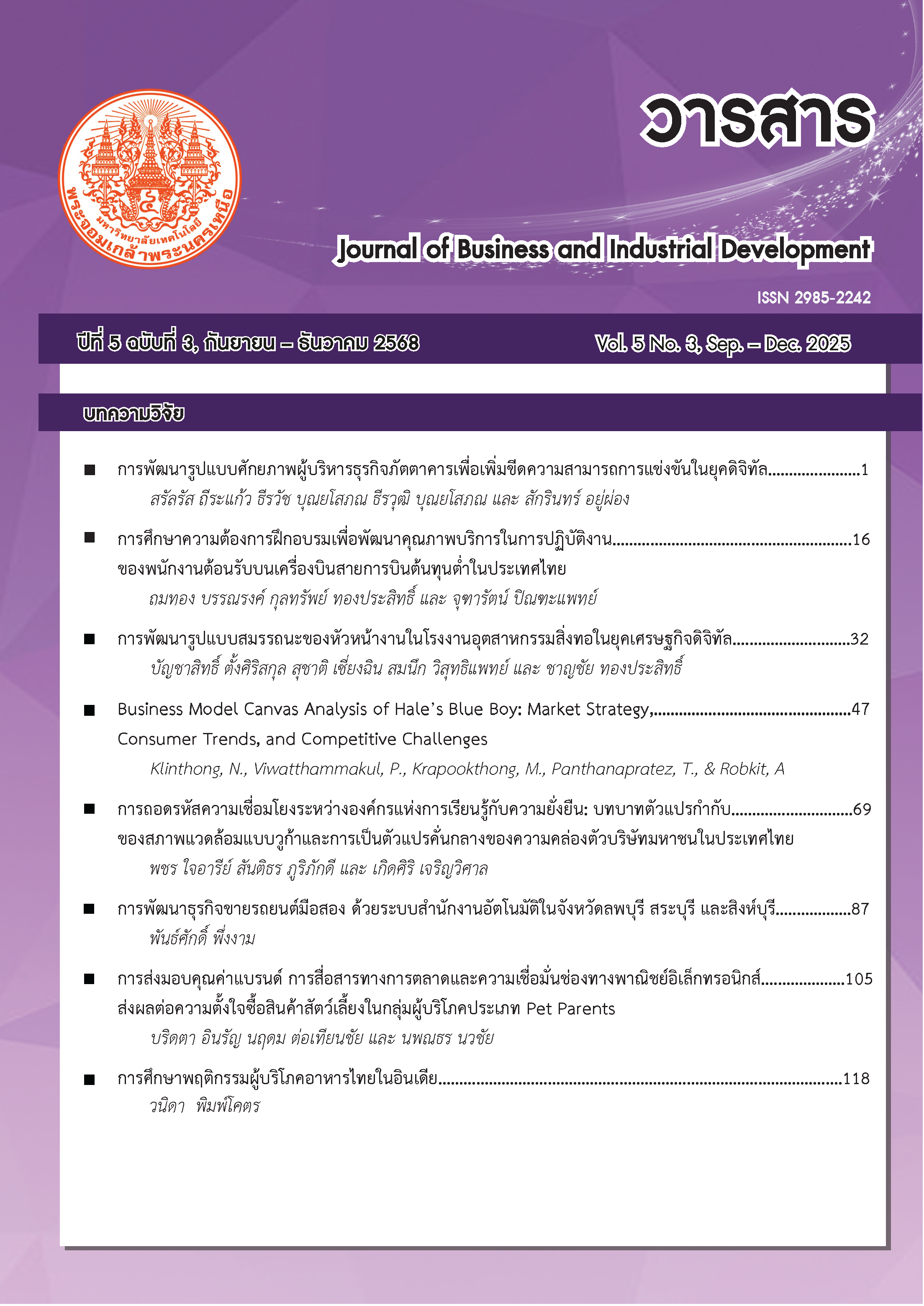
Development a Competency Model for Supervisors in the Textile Industry in the Digital Economy Era
Keywords:
Model, Competency, Supervisor, Digital Age, Textile IndustryAbstract
The purposes of this study were 1) to study the competency components of supervisors in the textile industry in the digital economy era, 2) to develop a competency model for supervisors in the textile industry in the digital economy era, and 3) to prepare a guideline for competency development of supervisors in textile factories in the digital economy era. This research was a mixed method including qualitative research and quantitative research. Qualitative research used in-depth interviews with 7 experts and focus group discussions with 15 people. These tools’ data were analyzed using content analysis. Quantitative research used a questionnaire for 300 people. Its data were analyzed using statistics, percentages, averages, standard deviations, and exploratory factor analysis (EFA). The results found that the competency model for supervisors in the textile industry in the digital economy era consisted of 3 areas and 17 elements. The first area was knowledge consisting of 5 elements: 1) knowledge of production management, 2) knowledge of digital technology in production, 3) knowledge of machine repair and maintenance, 4) knowledge of digital communication technology, and 5) knowledge of design and material selection. The second area, skills, consisted of 8 elements: 1) efficient resource utilization, 2) work system development, 3) technology application in human resource development, 4) production process improvement, 5) monitoring and evaluation, 6) workplace safety management, 7) problem-solving and decision-making, and 8) application of digital technology in production. The last area, personal characteristics included 4 components: 1) morality, ethics, and leadership, 2) good interpersonal relationships and communication, 3) teamwork, and 4) love and loyalty to the organization. For the competency model of supervisors in the textile industry in the digital economy era, all 15 experts agreed that it was appropriate. For the guideline for the competency model of supervisors in the textile industry in the digital economy era, 5 experts agreed that it was appropriate and could be applied.
References
Siribenjapruk, S. (2022). How Can Thai Textiles Continue to Be Sustainable? Focused and Quick (FAQ) Issue 195. Monetary Policy Committee, Bank of Thailand. (in Thai)
Aimkosakun, J. (2024, April 28). Textile Factories Have Labor Shortages. Textile Library. https://youtu.be/hVJH_xn2U90?si=hB_eO5XFxZidkd74 (in Thai)
Textile Industry Institute. (2022, June 2). Thai Textile and Clothing Industrial Situation. Thai Textile. https://www.thaitextile.org/th/insign/detail.3049.1.0.html (in Thai)
McClelland, D. C. (1975). A Competency Model for Human Resource Management Specialists to Be Used in the Delivery of the Human Resource Management Cycle. McBer.
Department of Industrial Works. (2024, January 30). Factory Data. https://userdb.diw.go.th/results1.asp (in Thai)
Yamane, T. (1973). Statistics: An Introductory Analysis. Harper & Row.
Mulphakdee, P. (n.d.). Competency Developing Process of Insulator in Oil & Gas Industry: Case Study LNG Module Friction in AAA Construction Company [Unpublished master’s thesis]. Burapha University. (in Thai)
Shounchupol, A. (2020). Management of Business Organization with Artificial Intelligence for Business Survival. Valaya Alongkorn Review, 10(3), 155–164. (in Thai)
Inrun, B., Wisuthiphat, S., Boonyasopon, T., & Boonyasopon, T. (2024). Developing Model of Digital Technion’s Competencies in Digital Industries. Journal of Technical Education Development, 36(129), 24–34. (in Thai)
Teinwan, R., Pinthapataya, S., & Boonyasopon, T. (2023). The Executive Development Model for the Entry into Director’s Position of the Trans-international Joint Venture Energy Industrial Company in the Age of Digitalization. The
Journal of King Mongkut's University of Technology North Bangkok, 33(3), 233. (in Thai)
Sukhumanunt, N. (2017). Artificial Intelligence Technology and Market Penetration by Personalization Tactics. Executive Journal, 37(2), 51–62. (in Thai)
Munkongtum, C., Piakson, P., & Phonvut, C. (2017). Factors Effect to the Success of the Management of Factory About Automotive Industry in the Eastern Seaboard. Journal of Kasetsart Educational Review, 32(2), 24–30. (in Thai)
Honghiranrueng, T., Chotiwong, C., & Attavinijtrakarn, P. (2019). Competency Development Model for Thai Commercial Bank’ Managers in Digital Economy. The Journal of Social Communication Innovation, 7(2), 122–135. (in Thai)
Kumar, I., Rawat, J., Mohd, N., & Husain, S. (2021). Opportunities of Artificial Intelligence and Machine Learning in the Food Industry. Journal of Food Quality, 2021, 1–10. https://doi.org/10.1155/2021/4535567
Trailapwiti, P., Watthanabut, B., & Chavasirikulto, N. (2020). Human Capital Development Approach in Driving the Organization to Success. Journal of Local Governance and Innovation, 4(3), 157–170. (in Thai)
Siripatcharanan, L., Chirinang, P., & Chaisakunkiat, U. (2023). Motivating Employees in the Organization for Modern Management. Journal of Administrative and Management Innovation, 11(1), 127–136. (in Thai)
Chenaphun, J., Attavinijtrakarn, P., Wisuttipaet, S., & Roopsing, T. (2023). The Development Model of Energy Manager’s Potential in Industrial Plants. The Journal of King Mongkut's University of Technology North Bangkok, 28(2), 461–468. (in Thai)
Downloads
Published
How to Cite
Issue
Section
License
Copyright (c) 2025 Journal of Business and Industrial Development

This work is licensed under a Creative Commons Attribution-NonCommercial-NoDerivatives 4.0 International License.



