
BUDDHIST TEACHINGS AND THE CRISIS OF POLITICAL FAITH
Keywords:
Buddhist Principles, Crisis of Political Faith, Political LegitimacyAbstract
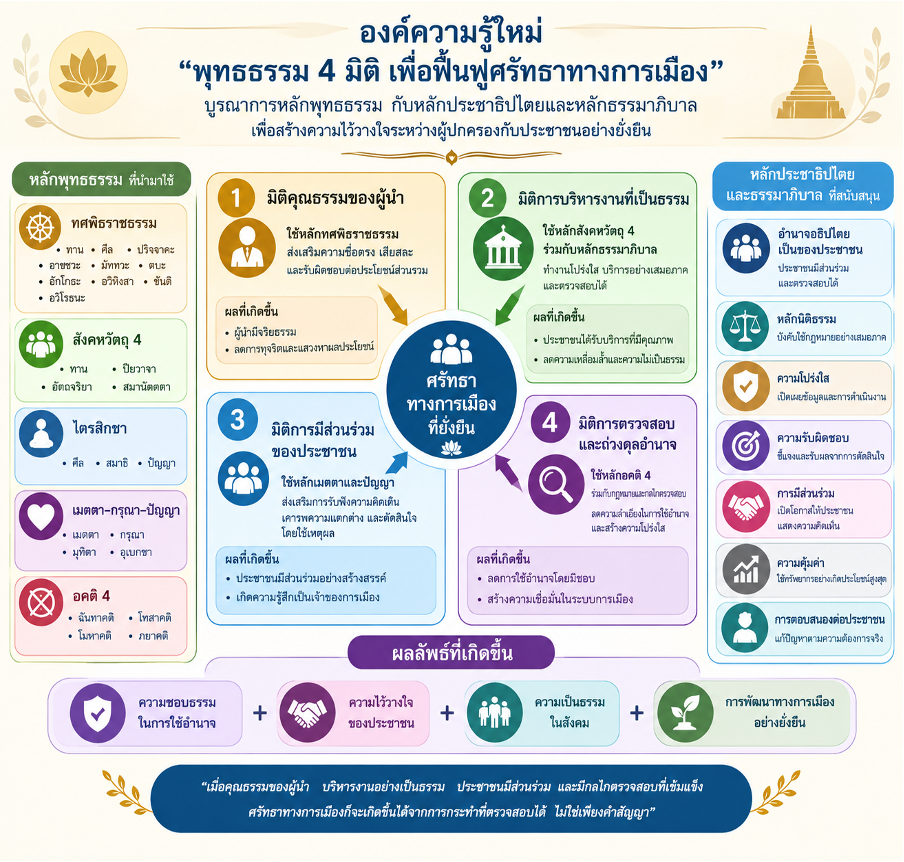
This academic article aims to examine the concept of a crisis of political legitimacy, analyze the role of Buddhist principles in fostering the legitimacy of state power, and propose ways to apply these principles to restore trust between those in power and the public. The study employs a documentary research approach and conceptual analysis, drawing upon Buddhist teachings, democratic principles, and the framework of good governance. A crisis of political legitimacy often stems from the irresponsible exercise of power, corruption, a lack of transparency, inequitable law enforcement, and limitations within the mechanisms designed to hold state power accountable-all of which erode public confidence in those who govern and in political institutions. Restoring political legitimacy requires both the cultivation of moral integrity among those in power and the improvement of public administration systems, alongside the promotion of civic participation. This study synthesizes a new framework—a four-dimensional model of Buddhist principles—to restore political legitimacy: the first dimension focuses on the moral integrity of leaders based on the Dasavidha-rajadhamma (the Ten Virtues of a Ruler); the second emphasizes equitable administration through the Sangahavatthu (the Four Bases of Social Harmony) integrated with good governance; the third promotes public participation grounded in metta (loving-kindness), karuna (compassion), and panna (wisdom); and the fourth addresses the oversight and balancing of power by applying the Akati (the Four Biases to be avoided) alongside formal legal accountability mechanisms. Integrating Buddhist principles with democracy and good governance serves as a vital approach to ensuring that state power is exercised with moral integrity, transparency, fairness, and accountability. which leads to strengthening political legitimacy, restoring public trust, and fostering the development of the democratic system
References
ไชย ณ พล. (2537). การปกครองของพระพุทธเจ้าระบอบธรรมาธิปไตย. กรุงเทพฯ: เคล็ดไทย.
ไชยวัฒน์ ค้ำชูและคณะ. (2545). ธรรมาภิบาล การบริหารการปกครองที่โปร่งใสด้วยจริยธรรม. กรุงเทพฯ: น้ำฝน.
ธเนศวร์ เจริญเมือง . (2540). 100 ปี การปกครองท้องถิ่นไทย พ.ศ. 2440-2540. กรุงเทพฯ: คบไฟ.
บวรศักดิ์ อุวรรณโณ และถวิลวดี บุรีกุล. (2548). ประชาธิปไตยแบบมีส่วนร่วม Participatory Democracy Democracy. กรุงเทพฯ: สถาบันพระปกเกล้า.
พรอัมรินทร์ พรหมเกิด. (2558). การปฏิรูปการเมืองไทยว่าด้วยการพัฒนาวัฒนธรรมทางการเมืองแบบประชาธิปไตย: สู่เส้นทางใหม่ที่ดีกว่า. รัฐสภาสาร, 3 (11), 9-34.
พระครูธรรมธรวรวุฒิ จิตฺตญาโณ (สุวรรณจู). (2566). วิกฤตศรัทธาของประชาชนที่มีต่อระบบการเมืองการปกครองไทยในปัจจุบัน. Interdisciplinary Academic and Research Journal, 3(6), 1–12.
พระราชวรมุนี ประยุทธ์ ปยุตฺโต. (2526). พระพุทธศาสนากับสังคมไทย. กรุงเทพฯ: สํานักพิมพ์มูลนิธิ.
ลิขิต ธีรเวคิน. (2552). วิวัฒนาการการเมืองการปกครองไทย. กรุงเทพฯ: สำนักพิมพ์มหาวิทยาลัย ธรรมศาสตร์.
สภาหอการค้าแห่งประเทศไทย. (2557). หลักการสากลของธรรมาภิบาล. กรุงเทพฯ: สภาหอการค้าแห่งประเทศไทย.
สมคิด สถิตย์ธรรม. (2558). หลักธรรมทางการเมือง. กรุงเทพฯ: สํานักพิมพ์รัฐศาสตร์.
สํานักวิจัย ซูเปอร์โพล. (2568). วิกฤตศรัทธาจมดิ่ง ‘ซูเปอร์โพล’ เผยการเมืองเข้าสู่ทางตัน. เข้าถึงได้จาก https://www.thaipost.net/politics-news/787401/.
อริย์ธัช แก้วเกาะสะบ้า. (2559). วัฒนธรรมทางการเมืองแบบประชาธิปไตย. กรุงเทพฯ: สำนักงานวิชาการสำนักงานเลขาธิการสภาผู้แทนราษฎร.
Downloads
Published
How to Cite
Issue
Section
License
Copyright (c) 2026 Journal Political Science MCU Korat

This work is licensed under a Creative Commons Attribution-NonCommercial-NoDerivatives 4.0 International License.
This article is published under a Creative Commons Attribution-NonCommercial-NoDerivatives 4.0 International License (CC BY-NC-ND 4.0), which allows others to share the article with proper attribution to the authors and prohibits commercial use or modification. For any other reuse or republication, permission from the journal and the authors is required.


