
DESIRABLE BUDDHIST CHARACTERISTICS OF LOCAL POLITICIANS ACCORDING TO PEOPLE’S ATTITUDE IN NAKHON RATCHASIMA CITY MUNICIPALITY
Keywords:
Characteristics, Local Politicians, AttitudesAbstract
The objectives of this research article are: 1) to examine the perceived characteristics of local politicians according to the public in the Nakhon Ratchasima Municipality; 2) to compare public perceptions regarding the characteristics of local politicians in the Nakhon Ratchasima Municipality, categorized by personal factors; and 3) to propose Buddhist-oriented characteristics for local politicians based on the perspectives of the public in the Nakhon Ratchasima Municipality. This study employs a mixed-methods research design. The quantitative component utilizes a questionnaire for data collection, which demonstrated an overall reliability coefficient of 0.865. The sample consists of 379 eligible voters aged 18 and older residing within the Nakhon Ratchasima Municipality, Mueang District, Nakhon Ratchasima Province. Data were analyzed using descriptive statistics—specifically frequency, percentage, mean, and standard deviation—while hypotheses were tested using t-tests and one-way analysis of variance (ANOVA). The qualitative component involves in-depth interviews with 9 key informants, with the data analyzed through descriptive content analysis.
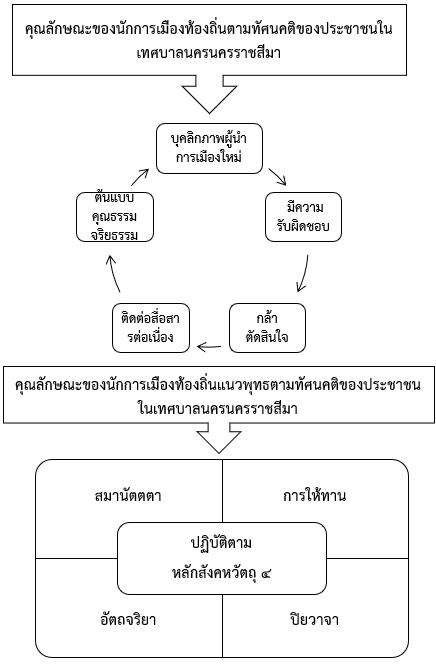
The research findings indicate that: 1) the perceived characteristics of local politicians, according to the public in the Nakhon Ratchasima Municipality, are rated at a high level overall (x̄ = 4.48); and 2) a comparison of the perceived characteristics of local politicians in the Nakhon Ratchasima Municipality, categorized by personal factors, reveals no significant differences. Thus, the research hypothesis was rejected. Regarding the desirable characteristics of local politicians from a Buddhist perspective—as perceived by the residents of Nakhon Ratchasima City Municipality—it was found that the application of the *Sangahavatthu 4* (the four bases of social solidarity) by local politicians influences their administration across five key areas: personality, responsibility, decision-making, communication, and ethics/morality. Specifically, the implementation of *dana* (generosity), *piyavaca* (kind speech), *atthacariya* (beneficial conduct), and *samanattata* (impartiality/consistency in behavior) has a significant positive impact on public attitudes and confidence. Residents prioritize ethics, morality, and responsibility above all else, followed by sincere communication and fair decision-making, all of which are essential for sustainable local development.
References
กาญจนา แก้วเทพ. (2561). การสื่อสารการเมืองท้องถิ่นในยุคดิจิทัล. กรุงเทพมหานคร: สำนักพิมพ์แห่งจุฬาลงกรณ์มหาวิทยาลัย.
เทศบาลนครนครราชสีมา. (11 มกราคม 2568). ข้อมูลชุมชนเทศบาลนครนครราชสีมา พ.ศ. 2568. สืบค้น จาก https://www.koratcity.go.th/organiz-strupersonnel?dpm=3
ธีระพล อ่อนดำ. (2559). ภาวะผู้นำเชิงประชาธิปไตยของนักการเมืองท้องถิ่น. กรุงเทพมหานคร: สำนักพิมพ์มหาวิทยาลัยธรรมศาสตร์.
ธีระพล อ่อนดำ. (2559). ภาวะผู้นำทางการเมืองท้องถิ่น. ขอนแก่น: มหาวิทยาลัยขอนแก่น.
ปิยวัฒน์ สีหวัฒน์. (2550). การกระจายอำนาจและการปกครองท้องถิ่น. นนทบุรี: โครงการจัดพิมพ์คบไฟ.
พระครูสุวรรณธรรมาภิมณฑ์ (สมชาย เจริญผา). (2564). การประยุกต์ใช้หลักสาราณียธรรมเพื่อส่งเสริมความสมานฉันท์ในการบริหารองค์กรปกครองส่วนท้องถิ่นอำเภอเมือง จังหวัดสุพรรณบุรี. วิทยานิพนธ์รัฐประศาสนศาสตรมหาบัณฑิต สาขาวิชารัฐประศาสนศาสตร์. บัณฑิตวิทยาลัย: มหาวิทยาลัยมหาจุฬาลงกรณราชวิทยาลัย.
พระธรรมปิฎก (ป. อ. ปยุตฺโต). (2559). พจนานุกรมพุทธศาสน์ ฉบับประมวลธรรม. กรุงเทพมหานคร: โรงพิมพ์มหาจุฬาลงกรณราชวิทยาลัย.
พระธีระพงษ์ ธีรงฺกุโร และคณะ. (2565). การบูรณาการหลักพุทธธรรมเพื่อการให้บริการประชาชน ของสำนักงานเขตบางพลัด กรุงเทพมหานคร. วารสาร มจร สังคมศาสตร์ปริทรรศน์, 11(4), 191-201.
พระใบฎีกาคณิน สุวณฺโณ (เร่งทอง) และคณะ. (2566). พฤติกรรมทางการเมืองของผู้นําท้องถิ่นที่มีความสัมพันธ์กับการตัดสินใจของประชาชนในการเลือกตั้งท้องถิ่นในอำเภอลานสัก จังหวัดอุทัยธานี. วารสารพุทธนวัตกรรมและการจัดการ, 6(2), 13 26.
พระใบฎีกาบุญส่ง ปุญฺญภาโค (พันธ์กุล). (2566). การประยุกต์หลักพุทธธรรมเพื่อส่งเสริมความปรองดองสมานฉันท์ของประชาชนเทศบาลตำบลหมูสี อำเภอปากช่อง จังหวัดนครราชสีมา. สารนิพนธ์รัฐศาสตรมหาบัณฑิต สาขาวิชารัฐศาสตร์. บัณฑิตวิทยาลัย: มหาวิทยาลัยมหาจุฬาลงกรณราชวิทยาลัย.
พระใบฎีกาสมคิด นาถสีโล และคณะ. (2564). บทบาทของพระสังฆาธิการในการช่วยเหลือเกื้อกูลประชาชน อำเภอวังทรายพูน จังหวัดพิจิตร. วารสาร มจร สังคมศาสตร์ปริทรรศน์, 10(1), 142-152.
พระประเสริฐ ปญฺญาวโร (เปลกระโทก). (2566). การพัฒนาชุมชนตามหลักธรรมาธิปไตยของนักการเมืองท้องถิ่นในอำเภอโชคชัย จังหวัดนครราชสีมา. วิทยานิพนธ์รัฐศาสตรมหาบัณฑิต สาขาวิชารัฐศาสตร์. มหาวิทยาลัยมหาจุฬาลงกรณราชวิทยาลัย: บัณฑิตวิทยาลัย.
พระปลัดเอกชัย จนฺทโชโต (คงชีวะ) และคณะ. (2567). การส่งเสริมภาวะผู้นำนักการเมืองท้องถิ่นตามหลักพุทธธรรมสำหรับนักการเมืองท้องถิ่นในอำเภอคง จังหวัดนครราชสีมา. วารสารพุทธสังคมวิทยาปริทรรศน์, 9(2), 81–92.
ศักดิ์สิทธิ์ เฉลิมพงศ์. (2560). จริยธรรมกับการบริหารงานภาครัฐ. นครราชสีมา: มหาวิทยาลัยราชภัฏนครราชสีมา.
สมคิด เลิศไพฑูรย์. (2544). การปกครองท้องถิ่นไทย. กรุงเทพมหานคร: สำนักพิมพ์นิติธรรม.
สุมาลี บุญเรือง. (2564). การพัฒนาการตื่นตัวทางการเมืองของประชาชนในระบอบประชาธิปไตยที่มีผลต่อการเลือกตั้งทั่วไป. ปรัชญาดุษฎีบัณฑิต สาขาวิชารัฐศาสตร์. บัณฑิตวิทยาลัย: มหาวิทยาลัยมหาจุฬาลงกรณราชวิทยาลัย.
Likert, R. (1967). The Method of Constructing and Attitude Scale. New York: Wiley & Son.
Taro Yamane. (1973). Statistics: An Introductory Analysis. Tokyo: Aoyama Gakuin University.
Downloads
Published
How to Cite
Issue
Section
License
Copyright (c) 2026 Journal Political Science MCU Korat

This work is licensed under a Creative Commons Attribution-NonCommercial-NoDerivatives 4.0 International License.
This article is published under a Creative Commons Attribution-NonCommercial-NoDerivatives 4.0 International License (CC BY-NC-ND 4.0), which allows others to share the article with proper attribution to the authors and prohibits commercial use or modification. For any other reuse or republication, permission from the journal and the authors is required.


