
APPLICATION OF THE PRINCIPLES OF PANICTAMA TO PROMOTE LEADERSHIP OF THE ADMINISTRATORS OF NAKHON RATCHASIMA CENTRAL PRISON
Keywords:
Leadership, Prison Administration, Principles of Moral ConductAbstract
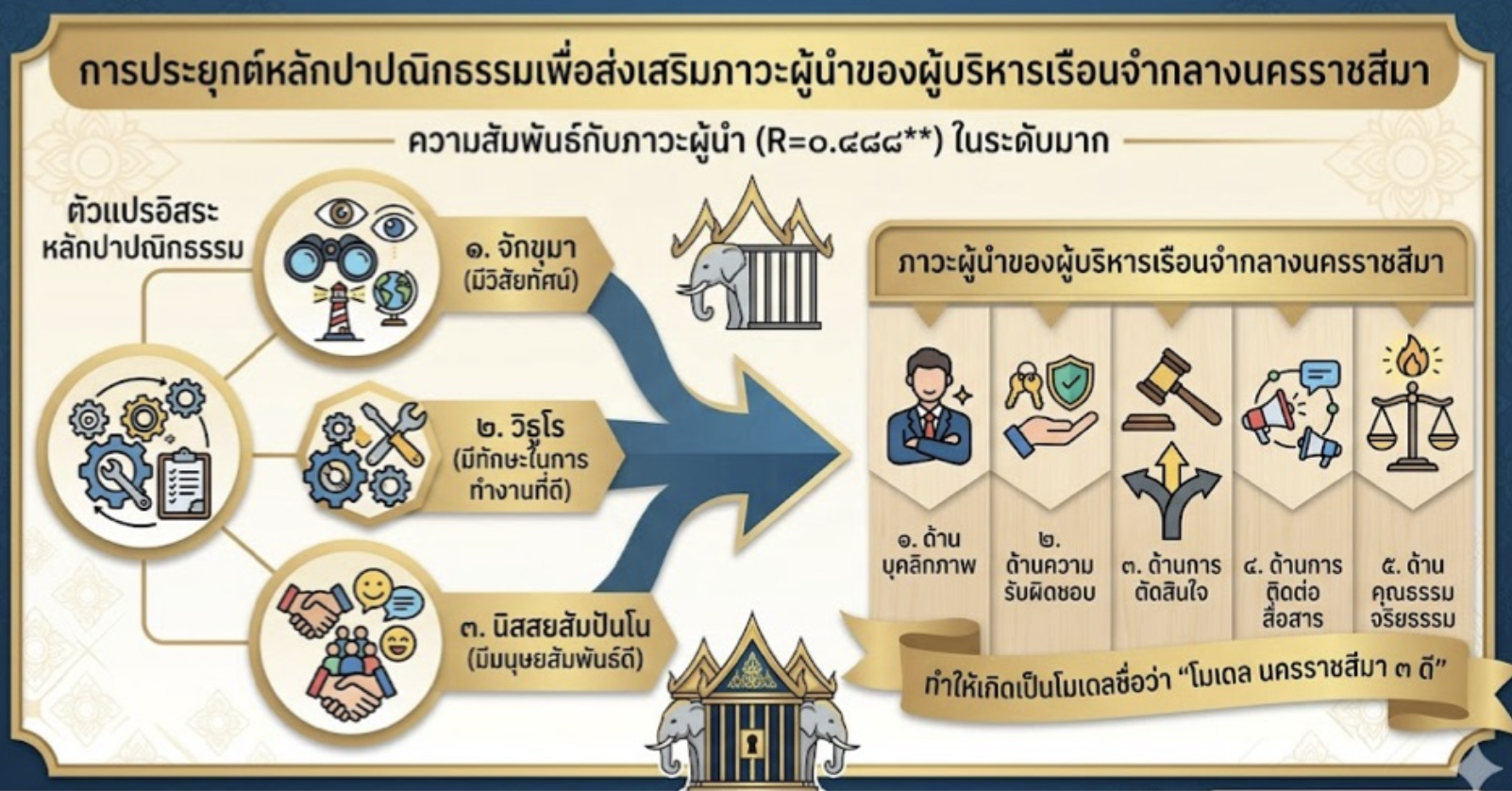
This research aims to 1) study the leadership level of administrators at Nakhon Ratchasima Central Prison, 2) examine the relationship between the principles of Papaniikadhamma and the leadership of administrators at Nakhon Ratchasima Central Prison, and 3) propose the application of Papaniikadhamma to promote the leadership of administrators at Nakhon Ratchasima Central Prison. This research employed a mixed-methods approach. Quantitative data was collected using a questionnaire with a reliability coefficient of 0.903 from a sample of 100 individuals. Statistical analyses included frequency, percentage, mean, standard deviation, and Pearson correlation coefficient. In-depth interviews were also conducted with 9 key informants. The research findings revealed that: 1. The overall leadership level of administrators at Nakhon Ratchasima Central Prison was found to be high ( = 3.99). 2. The overall relationship between the principles of Papaniikadhamma and the leadership of administrators at Nakhon Ratchasima Central Prison showed a positive correlation. The findings were at a high level (R=0.888**), statistically significant at the 0.01 level, thus accepting research hypothesis 3. The application of the principles of Papanikadhamma to promote leadership among administrators of Nakhon Ratchasima Central Prison revealed that: 1. Chakkuma possesses a vision focused on understanding overall management, with modern, up-to-date ideas and long-term strategic planning. 2. Vithuro has good work skills, emphasizing awareness and understanding of trends and modern techniques to develop actual work processes and proactively manage the organization towards excellence in all aspects. 3. Nissayasampanno has good interpersonal skills, having applied the science and art of management effectively to gain acceptance and trust from personnel within the organization and all stakeholders.
References
คมกริช สุขพัตร. (2566). ภาวะผู้นำทางการเมืองของคณะผู้บริหารเทศบาลเมืองปากช่องจังหวัดนครราชสีมา. วิทยานิพนธ์รัฐศาสตรมหาบัณฑิต สาขาวิชารัฐศาสตร์. บัณฑิตวิทยาลัย: มหาวิทยาลัยมหาจุฬาลงกรณราชวิทยาลัย.
ชูวงศ์ ฉายะบุตร. (2539). การปกครองท้องถิ่นไทย. กรุงเทพฯ: บริษัทพิฆเณศ พริ้นติ้ง เซ็นเตอร์ จำกัด.
พระปัญญา โชติธมฺโม (แก้วหาวงค์). (2561). ภาวะผู้นำตามหลักปาปณิกธรรมของผู้บริหารเทศบาลเมืองท่าเรือพระแท่น อำเภอท่ามะกา จังหวัดกาญจนบุรี. วิทยานิพนธ์รัฐศาสตรมหาบัณฑิต สาขาวิชารัฐศาสตร์,. บัณฑิตวิทยาลัย: มหาวิทยาลัยมหาจุฬาลงกรณราชวิทยาลัย.
พระปิติพงษ์ ธมฺมปาโล (แน่นนอก). (2566). คุณลักษณะผู้นำทางการเมืองตามแนวพระพุทธศาสนาของผู้บริหารเทศบาลตำบลเมืองคง อำเภอคง จังหวัดนครราชสีมา. สารนิพนธ์รัฐศาสตรมหาบัณฑิต สาขาวิชารัฐศาสตร์. บัณฑิตวิทยาลัย: มหาวิทยาลัยมหาจุฬาลงกรณราชวิทยาลัย.
พระสัภยา สุทฺธสีโล (ขาวหมื่นไวย์). (2567). การส่งเสริมภาวะผู้นำนักการเมืองท้องถิ่นตามหลักปาปณิกธรรมสำหรับนักการเมืองท้องถิ่นในเทศบาลตำบลเมืองคง จังหวัดนครราชสีมา. วิทยานิพนธ์รัฐศาสตรมหาบัณฑิต สาขารัฐศาสตร์. บัณฑิตวิทยาลัย: มหาวิทยาลัยมหาจุฬาลงกรณราชวิทยาลัย.
วันดี ขันแก้ว. (2566). การประยุกต์หลักพุทธธรรมเพื่อพัฒนาภาวะผู้นำเชิงสร้างสรรค์ของผู้บริหารท้องถิ่นในการพัฒนาชุมชนองค์การบริหารส่วนตำบลพลงตาเอี่ยม อำเภอวังจันทร์ จังหวัดระยอง. วิทยานิพนธ์รัฐศาสตรมหาบัณฑิต สาขาวิชารัฐศาสตร์. บัณฑิตวิทยาลัย: มหาวิทยาลัยมหาจุฬาลงกรณราชวิทยาลัย.
สัมฤทธิ์ กางเพ็ง และสรายุทธ กันหลง. (2553). ภาวะผู้นำใฝ่บริการในองค์การ : แนวคิด หลักการ ทฤษฎี และงานวิจัย. ขอนแก่น: โรงพิมพ์คลังนานาวิทยา หจก.
สุจิต กิ่งเกล้า. (2562). การบูรณาการหลักปาปณิกธรรมเพื่อส่งเสริมคุณลักษณะผู้นำที่พึงประสงค์ ของผู้บริหารสำนักงานประกันสังคมจังหวัดสมุทรสาคร. วารสารสหวิทยาการนวัตกรรมปริทรรศน์, 2(2), 34-43.
สุทธิ์ นุ่นสังข์. (2541). การศึกษาระดับความเครียดในกลุ่มผู้บริหารงานของกรมราชทัณฑ์. สารนิพนธ์หลักสูตรผู้บริหารกระบวนการยุติธรรมระดับสูง. บัณฑิตวิทยาลัย: วิทยาลัยการยุติธรรม.
Yamane, T. (1973). Statistics: An Introductory Analysis (3rd ed.). New York: Harper and Row.
Downloads
Published
How to Cite
Issue
Section
License
Copyright (c) 2026 วารสารรัฐศาสตร์ มจร โคราช

This work is licensed under a Creative Commons Attribution-NonCommercial-NoDerivatives 4.0 International License.
This article is published under a Creative Commons Attribution-NonCommercial-NoDerivatives 4.0 International License (CC BY-NC-ND 4.0), which allows others to share the article with proper attribution to the authors and prohibits commercial use or modification. For any other reuse or republication, permission from the journal and the authors is required.


