Announcements

Updates to Publication Policies Regarding AI Use and Author Contributions for ALPS Journals

2026-05-14

Following the participation of our Editor-in-Chief and Managing Editor in the "Publication Ethics" training organized by the Thai-Journal Citation Index Centre (TCI) on May 8, 2026, at the Eastin Grand Hotel Sathorn, Bangkok, the Association of Legal & Political Studies (ALPS) has conducted a comprehensive review of our editorial practices across all nine of our affiliated journals.

We are pleased to reaffirm that our current guidelines remain fully aligned with the standards set forth by TCI and other relevant regulatory bodies, including the Committee on Publication Ethics (COPE). These practices are clearly outlined on our websites and strictly adhered to throughout every stage of our editorial workflow.

However, to further elevate the operations of ALPS journals to align with the standards of world-leading publications and to proactively accommodate future enhancements to TCI criteria, the Association is introducing supplementary policies on manuscript preparation. Authors are now requested to provide specific statements in the Back Matter of their manuscripts concerning two key areas:

1. Declaration of AI Use

Declaring the use of AI tools supports transparency and trust among authors, readers, reviewers, editors, and contributors, while facilitating compliance with the terms of use of the relevant AI applications. Authors must document their use of AI, including the name of the AI tool, the purpose of its use, and the extent of their oversight.

  • For AI used in manuscript preparation: Authors should include a statement such as, "The authors declare that Artificial Intelligence (AI) tools were used in the preparation of this manuscript only for [e.g., language editing / grammar correction / improving readability]. The authors take full responsibility for the content, interpretation, and conclusions of this work."
  • For research methodologies: If AI was utilized directly within the research process (e.g., data collection or analysis), it must be declared and described in detail within the Methods section, if relevant.
  • Exceptions: Basic checks for grammar, spelling, and punctuation do not require a declaration.
  • If no AI was used: Authors must explicitly state, "The authors declare that no AI tools were used in the preparation of this manuscript."

2. Author Contributions

To ensure accountability and appropriately recognize individual efforts, authorship must include only those who have contributed substantially to the work. Each author is expected to meet all of the following criteria:

  • Made substantial contributions to the conception or design of the work; or the acquisition, analysis, or interpretation of data; or the creation of new software used in the work; or have drafted the work or substantively revised it; AND
  • Approved the submitted version (and any version substantially edited by journal staff that involves the author’s contribution to the study); AND
  • Agrees to be personally accountable for their own contributions and for ensuring that questions related to the accuracy or integrity of any part of the work, even ones in which the author was not personally involved, are appropriately investigated, resolved, and documented in the literature.

For research articles with multiple authors, a short paragraph specifying individual contributions must be provided in the Back Matter. We require the use of the Contributor Roles Taxonomy (CRediT) using the following format: "Conceptualization, X.X. and Y.Y.; Methodology, X.X.; Software, X.X.; Validation, X.X., Y.Y. and Z.Z.; Formal Analysis, X.X.; Investigation, X.X.; Resources, X.X.; Data Curation, X.X.; Writing – Original Draft Preparation, X.X.; Writing – Review & Editing, X.X.; Visualization, X.X.; Supervision, X.X.; Project Administration, X.X.; Funding Acquisition, Y.Y."

For detailed definitions of each role, please refer to the CRediT taxonomy website at: https://credit.niso.org/

Implementation Timeline

Authors are encouraged to voluntarily include these statements in their manuscript submissions, effective immediately. Please note that ALPS will make the inclusion of both the "Declaration of AI Use" and the "Author Contributions" statements a mandatory requirement for all manuscripts published starting from Issue 1 of the year 2027.


Associate Professor Dr. Thanaporn SRIYAKUL

President, Association of Legal & Political Studies (ALPS)

Read more about Updates to Publication Policies Regarding AI Use and Author Contributions for ALPS Journals

Current Issue

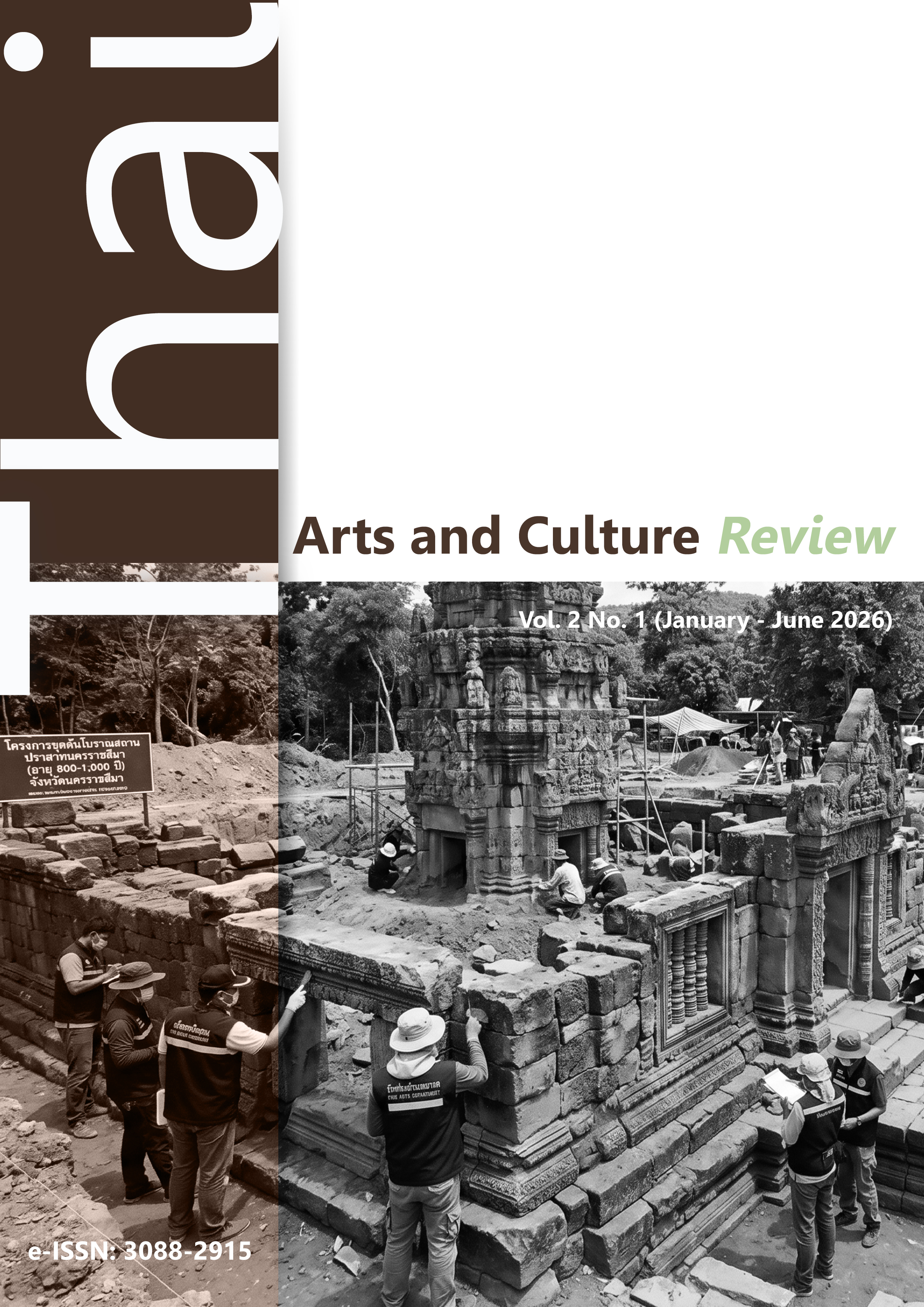
Vol. 1 No. 2 (2025): Thai Arts and Culture Review
					View Vol. 1 No. 2 (2025): Thai Arts and Culture Review

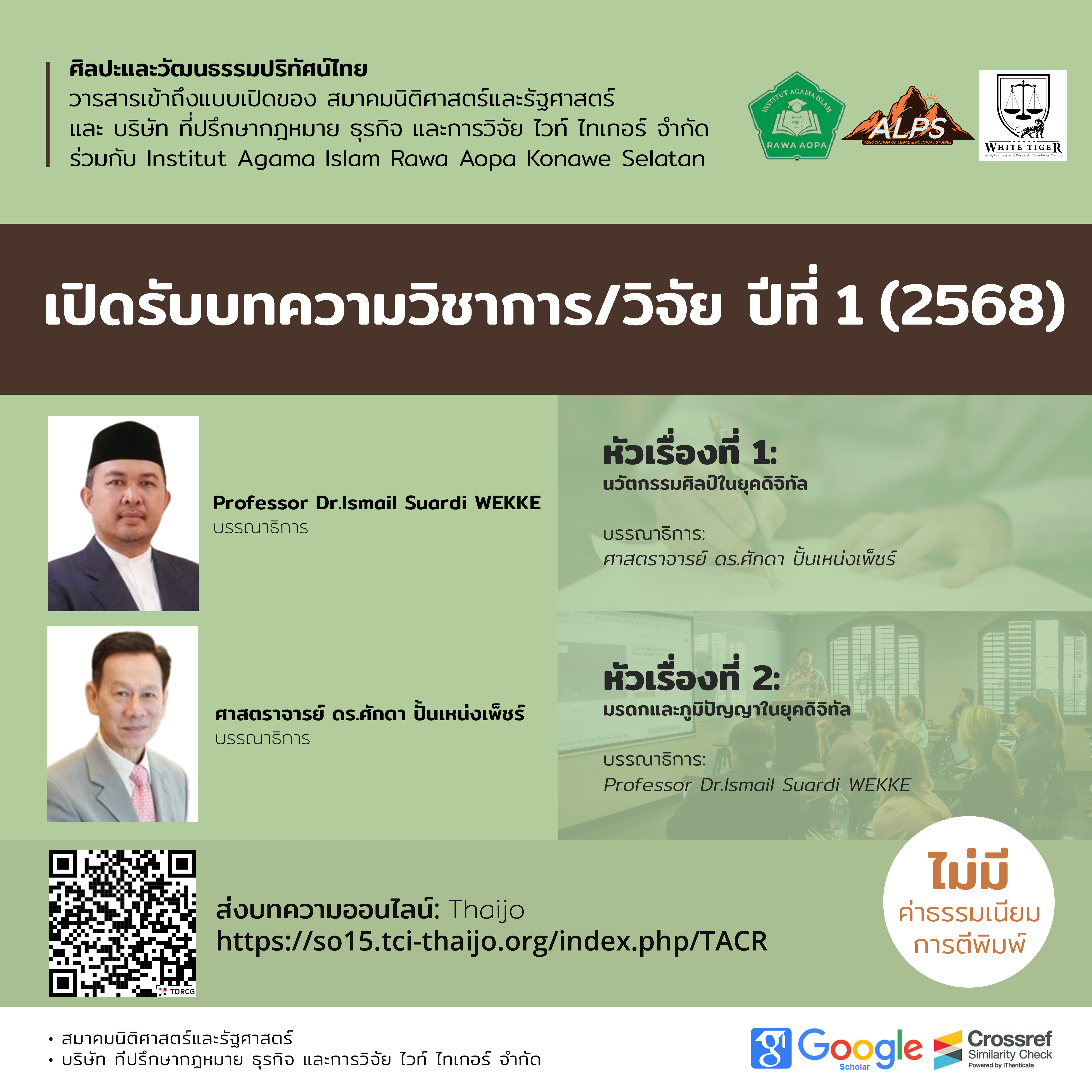
Thai Arts and Culture Review (TACR) is an open-access, peer-reviewed electronic journal published biannually in Thai and English. The journal is published by the Association of Legal & Political Studies (Thailand) and White Tiger Legal, Business and Research Consultants Co., Ltd. (Thailand), in collaboration with the Institut Agama Islam Rawa Aopa Konawe Selatan (Indonesia). It offers a scholarly platform for rigorous, interdisciplinary research on arts and culture in their broadest sense, emphasizing their regional and global interconnectedness. TACR welcomes submissions that explore all facets of arts and culture, providing a forum for innovative, critical, and comprehensive scholarly work. The journal particularly invites articles on visual arts—from studio art to architecture and performing arts—as well as cultural practices, theories, policies, and other elements integral to cultural identity, including philosophy, religion, and language. It encourages works that engage with contemporary and traditional issues, addressing their social impacts, policy implications, and cultural dynamics within Thailand and the wider region. All manuscripts are subjected to a transparent, open peer-review process involving at least three expert reviewers to ensure high academic standards. TACR aims to foster critical dialogue, contribute to the preservation and revitalization of Thailand’s rich cultural heritage, and promote a deeper understanding of arts and culture in a globalized world.

Published: 2026-01-11

Articles

View All Issues