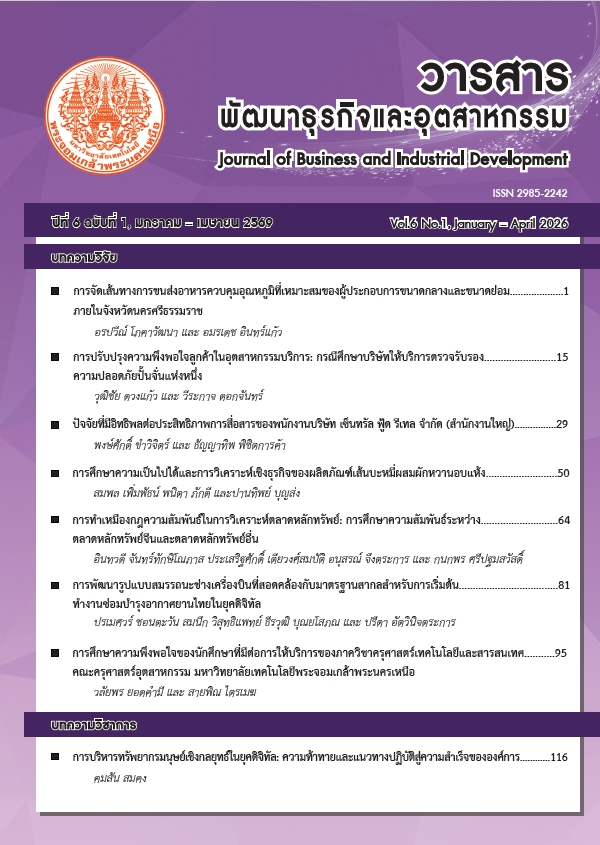
Association Rule Mining in Stock Market Analysis: Investigating the Relationship Between Chinese and Other Stock Markets
Keywords:
Association Rule Mining, Stock Market Analysis, Stock Market Relationship, Chinese Stock MarketAbstract
In the current Thai investment landscape, there are proposals for investing in index funds focusing on regional risk diversification, with the Chinese stock market being one of the options. However, there is a lack of empirical evidence regarding the relationship between returns from Chinese stock markets and other markets. THSI research examines the relationship between investment returns from Chinese stock markets and other global stock markets using association rule mining with the FP-Growth algorithm. The analysis uses data from investing.com spanning November 11, 2014, to November 11, 2019, analyzing daily percentage changes of 14 Chinese and global stock indices. The study compares short-, medium-, and long-term trends using Exponential Moving Averages (EMA) with n=10, 25, and 200 respectively, with minimum support of 0.1 and minimum confidence of 0.5. The research finds that in short and medium terms, the Chinese HSI index and Thai SET50 index show strong correlation when indices trend upward. However, no correlation was found in the long term. The conclusion suggests that investing in Chinese stocks under SSEC, SZI, and HSI indices may be more suitable for long-term risk diversification rather than short- and medium-term investment. While SSEC may be more appropriate than SZI, other factors such as returns, and maximum drawdown should also be considered.
References
Agrawal, R., Imielinski, T., & Swami, A. (1993). Mining association rules between sets of items in large databases. ACM SIGMOD Record, 22(2), 207–216. https://doi.org/10.1145/170036.170072
Asset Plus Fund Management. (n.d.). Asset Plus China (ASP-CHINA). https://www.assetfund.co.th/home/assetplus/upload_otherdocs/ASP-CHINA_presentation.pdf
Brown, R. G. (2004). Smoothing, forecasting and prediction of discrete time series. Courier Corporation.
Chootong, C. (2012). Trading signal generation using a combination of chart patterns and indicators [Master’s thesis]. National Institute of Development Administration. https://doi.org/10.14457/NIDA.the.2012.38 (in Thai).
Dai, L., Huang, C., Yu, C., & Gu, S. (2024). A novel discovery model for revealing substitution relationships from international stock markets: With association rule analysis. Heliyon, 10(20), e38774. https://doi.org/10.1016/j.heliyon.2024.e38774
Dwiputra, D., Widodo, A. M., Akbar, H., & Firmansyah, G. (2023). Evaluating the performance of association rules in Apriori and FP-growth algorithms: Market basket analysis to discover rules of item combinations. Journal of World Science, 2(8), 1229–1248.
Ghosh, S. K., Hossain, M. N., & Khatun, H. (2022). The hedging role of US and Chinese stock markets against economic and trade policy uncertainty: Lessons from recent turbulences. China Finance Review International, 13(3), 444–470.
Han, J., Pei, J., & Yin, Y. (2000). Mining frequent patterns without candidate generation. ACM SIGMOD Record, 29(2), 1–12. https://doi.org/10.1145/335191.335372
Hansun, S. (2013, November). A new approach of moving average method in time series analysis. In Proceedings of the 2013 Conference on New Media Studies (CoNMedia). (pp. 1–4). IEEE. https://doi.org/10.1109/CoNMedia.2013.6708545
Kartal, B., Sert, M. F., & Kutlu, M. (2022). Determination of the world stock indices' co-movements by association rule mining. Journal of Economics, Finance and Administrative Science, 27(54), 231–246.
Major indices. (n.d.). Investing.com. https://th.investing.com/indices/major-indices
Manager Online. (2020, January 24). Increase investment opportunities for Chinese New Year by diversifying investment risk in China, Hong Kong, Taiwan, Singapore. https://mgronline.com/stockmarket/detail/9630000007953 (in Thai).
Pacharawongsakda, E. (2014). Data analysis using basic data mining techniques (2nd ed.). Asia Digital Press. (in Thai).
Polasa, N. (2005). To sell product modeling and sales forecasting of life insurance using data mining techniques: A case study of a life insurance company [Master’s thesis]. Thammasat University. https://digital.library.tu.ac.th/tu_dc/frontend/Info/item/dc:91238 (in Thai).
Rungrattanaubol, J. (2023). Data mining techniques. Naresuan University Publishing House. (in Thai).
Shan, C., Tang, D. Y., Wang, S. Q., & Zhang, C. (2022). The diversification benefits and policy risks of accessing China’s stock market. Journal of Empirical Finance, 66, 155–175.
Shearer, C. (2000). The CRISP-DM model: The new blueprint for data mining. Journal of Data Warehousing, 5(4), 13–22.
Sophonpana, K., & Limantachai, R. (2022, April). Investing in foreign stock exchanges. Bank of Thailand. https://www.bot.or.th/th/our-roles/financial-markets/foreign-exchange-regulations/foreign-exchange-laws/retail-portfolio-investment-abroad/portfolio-investment-2021.html (in Thai).
Srithanpong, T. (n.d.). 5 good reasons why investors must have Chinese A-shares in the portfolio in 2021. SCB. https://www.scb.co.th/th/personal-banking/stories/grow-your-wealth/china-a-share.html (in Thai).
Srithanpong, T. (n.d.). China’s dual circulation: Parallel strategy, the new form of growth of China. SCB. https://www.scb.co.th/th/personal-banking/stories/business-maker/china_dual_circulation.
html (in Thai).
Srivastava, T., Mullick, I., & Bedi, J. (2024). Association mining based deep learning approach for financial time-series forecasting. Applied Soft Computing, 155, 111469. https://doi.org/10.1016/j.asoc.
111469
Thitipatlertdech, N. (2016). The effects of macroeconomic factors on return of portfolio [Master’s thesis]. Bangkok University. http://dspace.bu.ac.th/jspui/handle/123456789/2187 (in Thai).
Downloads
Published
How to Cite
Issue
Section
License
Copyright (c) 2026 Journal of Business and Industrial Development

This work is licensed under a Creative Commons Attribution-NonCommercial-NoDerivatives 4.0 International License.



