
Developing fine motor skills in kindergarten 1 students at Ban Khao Saraphi Border Patrol Police School through Nature-Based 3D Art
Article Sidebar
Main Article Content
Abstract
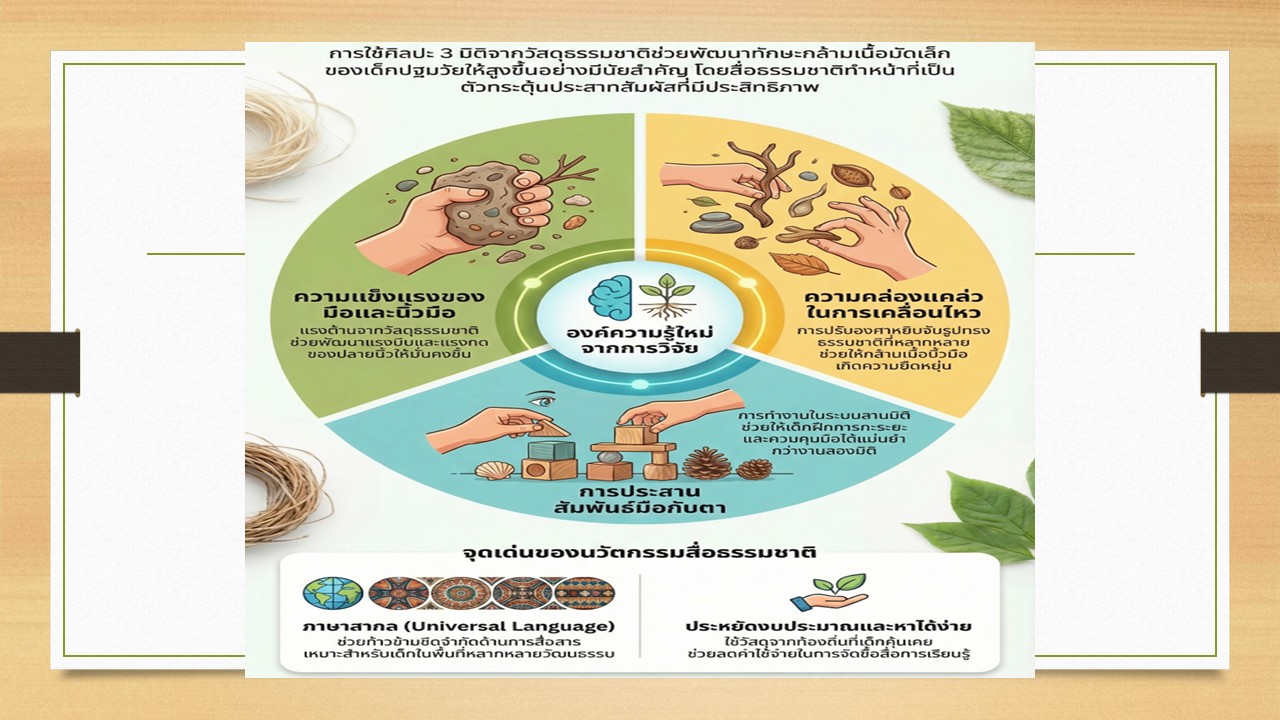
This research aimed to 1) Develop the fine motor skills of preschool children through the use of a set of Nature-Based 3D Art activities, and 2) To compare the fine motor skills of preschool children before and after providing experiences with a set of Nature-Based 3D Art activities. The target group for this research consisted of male and female students aged 3-5 years, studying in Kindergarten Year 1, Semester 1, Academic Year 2025, at the Border Patrol Police School, Ban Khao Saraphi, totaling 8 students, selected through purposive sampling. The research tools used included. 1) A set of 18 Nature-Based 3D Art activities made from natural materials. 2) Fine motor skills assessment form. Data were analyzed using the mean, Standard deviation, and the dependent-samples t-test. Research results: 1) The fine motor skills of kindergarten 1 students before the creative art activities were at a moderate level. After participating in creative art activities, Kindergarten 1 students demonstrated the highest level of fine motor skills. 2) A comparison of the fine motor skills of preschool children showed that after receiving the Nature-Based 3D Art activity set made from natural materials, students' fine motor skills were significantly higher than before the experiment, at a statistical significance level of 05. This is consistent with the hypothesis. This demonstrates how innovative natural media, in the form of Nature-Based 3D Art, can effectively stimulate hand and finger muscle function.
Keywords: Fine Motor Development, Three-Dimensional Art (3D Art), Natural Materials, Early Childhood Children
Article Details

This work is licensed under a Creative Commons Attribution-NonCommercial-NoDerivatives 4.0 International License.
This article is published under a Creative Commons Attribution-NonCommercial-NoDerivatives 4.0 International License (CC BY-NC-ND 4.0), which allows others to share the article with proper attribution to the authors and prohibits commercial use or modification. For any other reuse or republication, permission from the journal and the authors is required.References
กัลลาฮิว, ดี. แอล., และ ออซมัน, เจ. ซี. (2021). พัฒนาการทางการเคลื่อนไหว: ทารก เด็ก วัยรุ่น และผู้ใหญ่ (Understanding motor development: Infants, children, adolescents, adults). นิวยอร์ก: McGraw-Hill Education.
ศศิธร บัวทอง. (2565). การจัดกิจกรรมศิลปะสร้างสรรค์สามมิติเพื่อส่งเสริมพัฒนาการเด็กปฐมวัย. กรุงเทพฯ: สำนักพิมพ์โอเดียนสโตร์.
ศิริมาศ กัญโญอนันต์พงษ์. (2564). พัฒนาการเด็กปฐมวัยตามแนวคิดเกเซล (Gesell). กรุงเทพฯ: สำนักพิมพ์แห่งจุฬาลงกรณ์มหาวิทยาลัย.
สมควร สีทอง และคณะ. (2566). การใช้วัสดุธรรมชาติในการจัดกิจกรรมการเรียนรู้สำหรับเด็กปฐมวัยในพื้นที่ชายแดน. วารสารการศึกษาปฐมวัย, 27(2), 45-60.
Gallahue, D. L., & Ozmun, J. C. (2021). Understanding motor development: Infants, children, adolescents, adults (9th ed.). New York: McGraw-Hill Education.
Gesell, A. (2021). Child development: An introduction to the study of human growth. New York: Harper & Row.
Thompson, C. (2023). Nature-based learning in early childhood education. London: Routledge.
