บรรณาธิการ : ผู้ช่วยศาสตราจารย์ ดร.จิรัชยา เจียวก๊ก
About the Journal
Journal of Social Development Research and Practice
ISSN: 3027-8430 (Online)
Affiliation:
The Journal of Social Development Research and Practice is affiliated with the Faculty of Humanities and Social Sciences, Prince of Songkla University.
Scope:
The Journal of Social Development Research and Practice aims to disseminate academic knowledge, research work, and creative outputs in development studies and related disciplines within social sciences. The focus is on developing of local communities in areas such as economics, business administration, politics, information science, health, and other related fields. It serves as a medium for scholars, academics, faculty members, students, and the general public to exchange academic knowledge that contributes to developing communities, localities, and society.
Publication Schedule:
The journal is published three times a year (5-7 articles/issue)
- Issue 1 (January – April)
- Issue 2 (May – August)
- Issue 3 (September – December)
Types of Articles Accepted:
1. Research Article A research article is an academic work focused on solving problems, improving processes, or developing routine tasks for enhanced efficiency, providing concrete and practical applications. This includes institutional research, organizational evaluation research, or findings from systematic studies and surveys. It also encompasses articles presenting academic opinions or suggestions that yield professional benefits.
-
Components: Introduction, Research Objectives, Research Methodology, Results, Discussion, Conclusion, Recommendations, Research Ethics (IRB) (if applicable), Acknowledgments (if applicable), and References.
2. Review Article A review article is a written work involving in-depth analysis or synthesis of knowledge. It presents an overview of key issues, current trends, and future directions related to effective organizational or professional development. The content aims to create a systematic understanding from diverse data sources while offering practical insights or recommendations.
-
Components: Introduction, Body/Content, Conclusion, Recommendations, Acknowledgments (if applicable), and References.
3. Book Review A book review is a written work intended to describe, analyze, and evaluate the merits of a specific book in a rational and systematic manner. It goes beyond a simple summary to include critical commentary, interpretation, and an assessment of the content's quality, conceptual framework, and academic significance.
Peer Review Process:
All submitted manuscript will undergo a Double-Blind Peer Review process by three (3) external experts per article. These reviewers are selected from various institutions and have no affiliation with the authors. This process is strictly conducted in accordance with the Announcement of the Higher Education Commission (HEC) regarding the "Criteria and Methods for Appointing Individuals to the Positions of Assistant Professor, Associate Professor, and Professor (No. 4), B.E. 2564 (2021)," dated July 5, 2021.
Submission:
Articles must be submitted online through the journal's website on the ThaiJO system of TCI: https://so15.tci-thaijo.org/index.php/jsdrp
Submission
Manuscripts must be submitted online through the journal's official website via the ThaiJO system (Thai Editorial System) of the Thai Journal Citation Index (TCI) Center. https://so15.tci-thaijo.org/index.php/jsdrp/about/submissions
Manuscripts considered for publication must undergo a rigorous evaluation process by the Editorial Board and experts in the relevant fields (Peer Review). The procedures are as follows:
1) Authors must prepare their manuscripts according to the official Template provided by the journal. The template can be downloaded from the following link >> Template
References must be formatted according to the APA 6th Edition style. Detailed guidelines and examples can be found at the following link >> References
1.1) Books
Author./(Year of publication)./Title of the book./Edition (from 2nd ed. onwards)./Place of publication:/Publisher.
ปารมี ขันธ์แก้ว. (2564). ชุมชนท้องถิ่น รู้รับ ปรับตัว สู้ภัยโควิด-19. กรุงเทพ: กองทุนสนับสนุนการสร้างเสริมสุขภาพสํานัก 3.
1.2) Journal Articles
Author./(Year of publication)./Title of the article./Name of the Journal,/Volume(Issue), Page numbers.
นวพล แก้วสุวรรณ. (2565). พฤติกรรมสารสนเทศด้านสุขภาพในการดูแลสุขภาวะเพื่อการป้องกันโรคเบาหวานของผู้สูงอายุในจังหวัดปัตตานี. วารสารสารสนเทศศาสตร์, 40(2), 42-66.
1.3) Conference Proceedings
Author./(Year of publication)./Title of the paper./In Name of the Conference./(pp. page numbers)./Place of publication:/Publisher.
คมกริช รุมดอน, นวพล แก้วสุวรรณ และฐะปะนีย์ เทพญา. (2565). การวิเคราะห์ข้อมูลเชิงลึกด้านการบริการทรัพยากรสารสนเทศเพื่อพยากรณ์การจัดบริการของหอสมุดจอห์น เอฟ เคนเนดี้ มหาวิทยาลัยสงขลานครินทร์. ใน งานประชุมวิชาการระดับชาติ วิทยาศาสตร์วิจัย ครั้งที่ 13. (น. 857-868). พัทลุง: คณะวิทยาศาสตร์ มหาวิทยาลัยทักษิณ.
1.4) Theses or Dissertations
Author./(Year of publication)./Title of the thesis./(Degree/Major)./Place of publication:/Publisher.
นวพล แก้วสุวรรณ. (2562). การพัฒนาระบบการให้คําแนะนําการวิจัยเพื่อการพัฒนาภาคใต้ (วิทยานิพนธ์ปรัชญาดุษฎีบัณฑิต สาขาวิชาสารสนเทศศึกษา). ขอนแก่น: มหาวิทยาลัยขอนแก่น.
1.5) Research Reports
Author./(Year of publication)./Title of the report/(Research report)./Place of publication:/Publisher.
คมกริช รุมดอน และนวพล แก้วสุวรรณ. (2565). การศึกษาพฤติกรรมการแลกเปลี่ยนความรู้ด้านการเรียนการสอนบนเครือข่ายออนไลน์ ในยุควิถีการศึกษาใหม่ของนักศึกษาระดับปริญญาตรี สถาบันอุดมศึกษาในภาคใต้ประเทศไทย (รายงานการวิจัย). ปัตตานี: มหาวิทยาลัยสงขลานครินทร์วิทยาเขตปัตตานี.
1.6) Annual Reports / Manuals / Institutional Publications
Author./(Year of publication)./Title of the publication./Place of publication:/Publisher.
ธนาคารแห่งประเทศไทย. (2535). 50 ปี ธนาคารแห่งประเทศไทย: 2485-2535. กรุงเทพฯ: ธนาคารแห่งประเทศไทย.
1.7) Interviews
Interviewee./(Year, Date Month)./Interview topic/subject.
เจ้าหน้าที่องค์การบริหารส่วนตําบลมูโนะ. (2566, 5 มกราคม). การปฏิบัติซ้อมแผนอพยพ.
1.8) Websites
Author./(Year of publication)./Title of the webpage./Retrieved/Date Month Year,/from/URL.
Eva, L.O. (2020). Poverty Brief: Understanding Poverty. Swiss Agency for Development and cooperation (SDC). Retrieved 25 September 2023, from https://www.shareweb.ch/site/poverty-Wellbeing
2) Authors must register and submit their manuscripts exclusively through the ThaiJO online system at the Journal of Social Development Research and Practice (JSDRP). The contact information of the corresponding author must also be provided.
3) Upon receiving the manuscript, the Editorial Board will perform a preliminary assessment, which includes checking the alignment of the manuscript with the journal’s aims and scope, screening for plagiarism and redundant publication using the software designated by Prince of Songkla University, verifying the manuscript’s adherence to the journal’s formatting requirements, and assessing the overall academic quality and contribution of the work.
4) Manuscripts that pass the initial screening will be forwarded to external experts (peer reviewers) for a detailed quality evaluation.
5) Following the peer review, the Editorial Board will evaluate the reviewers' feedback to determine whether the manuscript should be accepted, revised, or rejected. The decisions made by the reviewers and the final judgment of the Editorial Board are considered final.
Terms and conditions for Publication
1) The journal aims to notify authors of the initial review results within 30–45 days of submission.
2) The editorial decision consists of three possible outcomes: Accept: The manuscript is accepted for publication. Minor/Major Revision: The manuscript is accepted conditionally, pending required revisions. Reject: The manuscript is declined for publication.
3) For manuscripts that are Accepted or Accepted with Conditions (Minor/Major Revision), an official Letter of Acceptance will be issued within 30 days after the editorial team has verified that all revisions satisfy the reviewers' recommendations. The actual timeframe is subject to the author's speed in completing the requested changes.
Languages Accepted:
Thai and English
Publication Fee:
There is no publication fee for the Journal of Social Development Research and Practice.
Copyright Notice:
The Journal of Social Development Research and Practice is operated by the Faculty of Humanities and Social Sciences, Prince of Songkla University. Articles published in this journal are protected under copyright law. The copyright holder has the right to reproduce, modify, and distribute the articles in electronic formats, copies, translations, and reproductions in various forms. The copyright of the articles belongs to the authors and the Faculty of Humanities and Social Sciences, Prince of Songkla University. The journal reserves the right to decide on the publication, including editing, modifying, or refining the language to meet the specified academic standards. The findings and opinions expressed in the articles are those of the authors and are not the responsibility of the Journal of Social Development Research and Practice. Permission from the editorial team is required to republish articles from this journal.
For Further Information:
Please contact via email at jsdrp.psu@gmail.com
Publisher/Producer
Journal of Social Development and Research (JSDRP) Faculty of Humanities and Social Sciences, Prince of Songkla University, Pattani Campus 181 Charoen Pradit Road, Rusamilae Subdistrict, Mueang District, Pattani Province, 94000 Mobile: 099-4758884, 081-3537639 Email: jsdrp.psu@gmail.com
Article Review Process
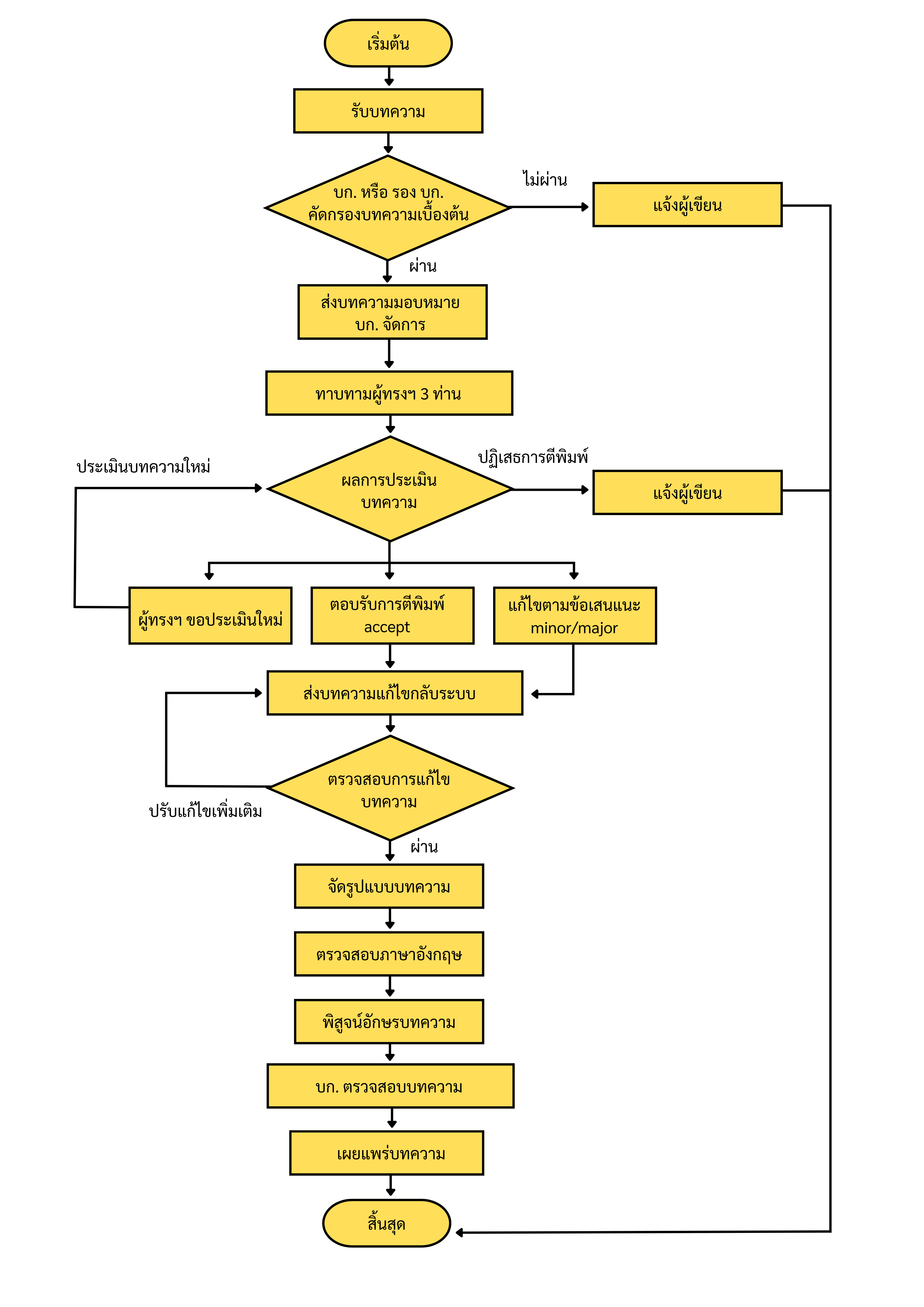
Step 1: Submission – The author submits the manuscript through the ThaiJo system.
Step 2: Initial Screening – The Editor or Associate Editor performs a preliminary review to ensure the manuscript aligns with the journal’s scope.
Step 3: Assignment & Plagiarism Check – The Managing Editor is assigned to perform a plagiarism check before proceeding to the formal evaluation.
Step 4: Reviewer Invitation – Three (3) external experts are invited to evaluate the manuscript via the ThaiJo system.
Step 5: Review Summary – The editorial team summarizes the evaluation results and provides feedback for the author to revise the manuscript.
Step 6: Revision & Resubmission – The author receives the feedback, revises the manuscript, and resubmits it through ThaiJo. If a reviewer requests a re-evaluation, the manuscript is sent back for a second round of review.
Step 7: Revision Verification – The editorial team verifies that all requested changes have been properly addressed by the author.
Step 8: Formatting – The manuscript is formatted according to the journal's specific layout and styling guidelines.
Step 9: English Language Editing – An English language check is performed on the abstract or the full-text manuscript.
Step 10: Proofreading & Final Similarity Check – The full-text is proofread for accuracy, and a final plagiarism check is conducted before publication.
Step 11: Final Editorial Approval – The Editor-in-Chief performs a final review of the article before it is scheduled for publication on ThaiJo.
Step 12: Publication – Each article is officially published and disseminated through the ThaiJo system.