
The Right to Access the Court and the Issue of Frivolous, Repetitive, or Bad-Faith Petitions in the Constitutional Court of Thailand : Challenges to the Judicial Process and Proposed Solutions
Article Sidebar
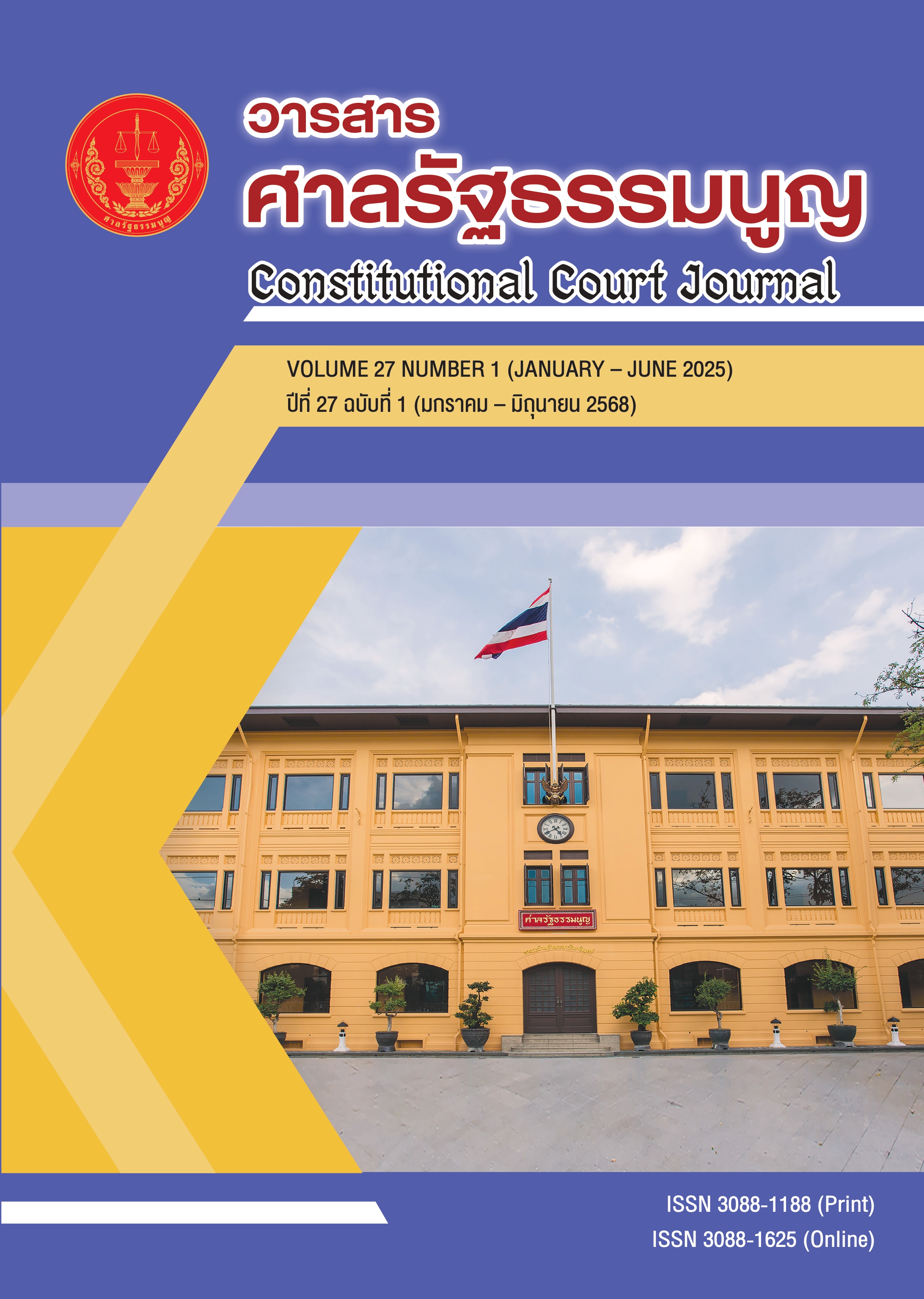
Main Article Content
Abstract
The exercise of judicial rights constitutes a fundamental element of the rule of law, ensuring that individuals may freely access the courts to seek justice. However, excessive, repetitive, or bad-faith invocation of such rights—termed vexatious litigation—has emerged as a systemic problem, particularly within the jurisdiction of the Thai Constitutional Court. The increasing number of petitions lacking legal merit or involving repetitive claims has significantly burdened the judiciary, diverted resources, delayed the adjudication of substantial constitutional cases, and undermined public trust in the Court as a guardian of constitutional supremacy.
Moreover, vexatious litigation is sometimes associated with individuals suffering from mental health conditions—such as paranoia, delusional disorder, or querulant delusion—who engage with the court system in disproportionate and irrational ways. These cases pose unique challenges and reveal the absence of effective legal mechanisms to screen and manage meritless or abusive petitions. Thailand’s existing legal framework lacks sufficient preventive or filtering measures to address this phenomenon comprehensively.
This study aims to assess the problem of vexatious litigation in the context of the Thai Constitutional Court. It adopts a legal-analytical and comparative approach by examining practices in other jurisdictions—namely, the United States, United Kingdom, Australia and Canada—where courts are empowered to impose pre-filing restrictions, require security deposits, or issue civil restraint orders against habitual litigants. These mechanisms are designed to prevent misuse of judicial procedures while upholding the constitutional right of access to justice.
The findings suggest that Thailand must develop a structured framework to filter and regulate vexatious filings. Suggested mechanisms include judicial authority to preemptively bar serial petitioners, the establishment of a vexatious litigant registry, mandatory security bonds, and incorporation of psychiatric evaluations where appropriate. Any such measures, however, must be crafted in accordance with the fundamental right of access to justice as guaranteed by both the Thai Constitution and international human rights instruments, such as the Universal Declaration of Human Rights (1948) and the International Covenant on Civil and Political Rights (1966).
The policy recommendations presented herein aim to enhance the Constitutional Court’s efficiency while preserving individuals' rights. They advocate a balanced approach to regulating vexatious litigation, thereby strengthening the court's institutional capacity and safeguarding public confidence in the constitutional justice system in alignment with the rule of law.
Article Details

This work is licensed under a Creative Commons Attribution-NonCommercial-NoDerivatives 4.0 International License.
Articles in this journal are copyrighted by the x may be read and used for academic purposes, such as teaching, research, or citation, with proper credit given to the author and the journal.use or modification of the articles is prohibited without permission.
statements expressed in the articles are solely the opinions of the authors.
authors are fully responsible for the content and accuracy of their articles.
other reuse or republication requires permission from the journal."
