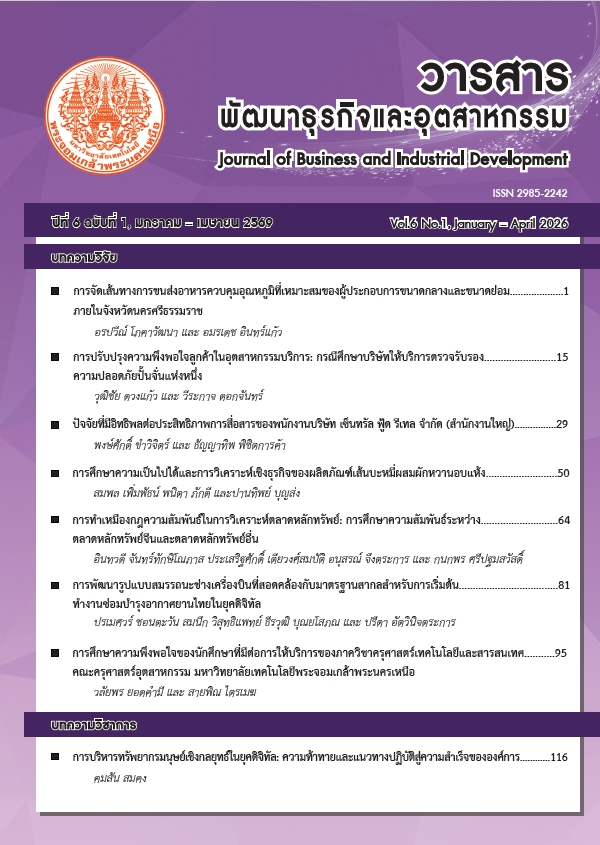
การพัฒนารูปแบบสมรรถนะช่างเครื่องบินที่สอดคล้องกับมาตรฐานสากลสำหรับการเริ่มต้นทำงานซ่อมบํารุงอากาศยานไทยในยุคดิจิทัล
คำสำคัญ:
ช่างเครื่องบิน, นายช่างภาคพื้นดิน, รูปแบบสมรรถนะช่างเครื่องบิน, ยุคดิจิทัลบทคัดย่อ
งานวิจัยนี้มีวัตถุประสงค์เพื่อ 1) ศึกษาองค์ประกอบสมรรถนะของช่างเครื่องบินที่สอดคล้องกับมาตรฐานสากลสำหรับการเริ่มต้นทำงานซ่อมบํารุงอากาศยานไทยในยุคดิจิทัล 2) พัฒนารูปแบบสมรรถนะของช่างเครื่องบินที่สอดคล้องกับมาตรฐานสากลสำหรับการเริ่มต้นทำงานซ่อมบํารุงอากาศยานไทยในยุคดิจิทัล และ 3) จัดทำคู่มือแนวทางการพัฒนาสมรรถนะของช่างเครื่องบินที่สอดคล้องกับมาตรฐานสากลสำหรับการเริ่มต้นทำงานซ่อมบํารุงอากาศยานไทยในยุคดิจิทัล การวิจัยครั้งนี้เป็นการวิจัยเชิงคุณภาพโดยใช้ระเบียบวิธีการวิจัยแบบเดลฟายร่วมกับการประชุมสนทนากลุ่ม โดยกลุ่มผู้ให้ข้อมูลมีทั้งหมด 3 กลุ่ม ได้แก่ 1) กลุ่มผู้เชี่ยวชาญด้านการซ่อมบำรุงอากาศยาน จำนวน 20 คน 2) กลุ่มผู้ทรงคุณวุฒิด้านการบริหารงานซ่อมบำรุงอากาศยาน จำนวน 13 คน และ 3) กลุ่มผู้เชี่ยวชาญด้านการพัฒนาคู่มือ จำนวน 5 คน เครื่องมือที่ใช้ในการวิจัย ได้แก่ แบบสัมภาษณ์ปลายเปิด แบบสอบถามปลายปิด แบบประเมินรูปแบบ และแบบประเมินคู่มือ ใช้วิธีการวิเคราะห์ด้วยสถิติสำหรับค่ามัธยฐานและค่าพิสัยระหว่างควอไทล์ และใช้วิธีการวิเคราะห์เชิงเนื้อหาสำหรับการประชุมสนทนากลุ่ม ผลการวิจัยพบว่ารูปแบบสมรรถนะช่างเครื่องบินที่สอดคล้องกับมาตรฐานสากลสำหรับการเริ่มต้นทำงานซ่อมบํารุงอากาศยานไทยในยุคดิจิทัล มี 3 องค์ประกอบหลัก 19 องค์ประกอบรอง ดังนี้ 1) ด้านความรู้ในการซ่อมบำรุงอากาศยาน มี 7 องค์ประกอบรอง ได้แก่ 1.1) กฎหมายและมาตรฐานวิศวกรรมการบิน 1.2) การจัดการคุณภาพและความปลอดภัย 1.3) วิทยาศาสตร์ธรรมชาติและความรู้เกี่ยวกับอากาศยาน1.4) ความรู้พื้นฐานเกี่ยวกับอากาศยาน 1.5) การซ่อมบำรุงอากาศยาน 1.6) ภาษาอังกฤษเพื่อการซ่อมบำรุงอากาศยาน และ1.7) ปัจจัยมนุษย์ 2) ด้านทักษะในการซ่อมบำรุงอากาศยาน มี 6 องค์ประกอบรอง ได้แก่ 2.1) การใช้และการสื่อสารภาษาอังกฤษเกี่ยวกับการซ่อมบำรุง 2.2) การบริหารการทำงาน 2.3) การคิดเชิงวิเคราะห์ 2.4) การใช้อุปกรณ์ดิจิทัลในการซ่อมบำรุงอากาศยาน 2.5) การใช้เครื่องมือช่างยุคดิจิทัล และ 2.6) การสื่อสารยุคดิจิทัล และ 3) ด้านคุณลักษณะเฉพาะบุคคลในการซ่อมบำรุงอากาศยาน มี 6 องค์ประกอบรอง ได้แก่ 3.1) ความรักในการทำงาน 3.2) การพัฒนาตนเองอย่างต่อเนื่อง 3.3) ความฉลาดทางอารมณ์ 3.4) จรรยาบรรณช่างซ่อมบำรุงอากาศยาน 3.5) ความรับผิดชอบในงาน และ3.6) จิตสำนึกด้านความปลอดภัย ส่วนคู่มือแนวทางการพัฒนาสมรรถนะของช่างเครื่องบินที่สอดคล้องกับมาตรฐานสากลสำหรับการเริ่มต้นทำงานซ่อมบํารุงอากาศยานไทยในยุคดิจิทัล ผู้เชี่ยวชาญเห็นว่า
มีความเหมาะสมและสามารถนำไปประยุกต์ใช้ได้
เอกสารอ้างอิง
Ancel, E., & Shih, A. (2012). The analysis of the contribution of human factors to the in-flight loss of control accidents. American Institute of Aeronautics and Astronautics, 1(1), 1–13.
Breve, C. (2011). Contributive factors to aviation accidents. Rev Saude Publica, 45(2), 1–4.
Caldwell, J. (2012). Crew schedules, sleep deprivation and aviation performance. Current Directions in Psychological Science, 21(2), 85–89.
Campbell-Laird, K. (2006). Pedagogical approaches to aviation phraseology and communication training in collegiate flight programs. Collegiate Aviation Review International, 24(1), 25–41.
Cromie, S., Ross, D., Corrigan, S., Liston, P., Darragh, L., & Demosthenous, E. (2015). Integrating human factors training into safety management and risk management: A case study from aviation maintenance. Proceedings of the Institution of Mechanical Engineers, Part O: Journal of Risk and Reliability, 229(3), 266–274.
Dillingham, G. L. (2010). Aviation safety: Improved data quality and analysis capabilities are needed as FAA plans a risk-based approach to safety oversight. DIANE Publishing.
Ferguson, M., & Nelson, S. (2013). Aviation safety: A balanced industry approach. Delmar Cengage Learning.
Fowler, R., Roberts, J., Matthews, E., & Lynch, J. (2021). Aviation English assessment and training. University Aviation Association, 39(2), 26–42.
Hines, T. (2003). Proving the competence of the aircraft maintenance engineer. In International Air Safety Seminar (pp. 1–24). Flight Safety Foundation.
Hobbs, A., & Williamson, A. (2003). Associations between errors and contributing factors in aircraft maintenance. Human Factors, 45, 186–201.
Hoffman, T. (2020, June). Aviation English, please. FAA Safety Briefing, 59(3). https://www.faa.gov/news/safety_briefing/2020/media/MayJun2020.pdf
Holanda, R. (2009). A history of aviation safety: Featuring the U.S. airline system. Author House Publishing.
Huang, J. (2009). Aviation safety through the rule of law: ICAO’s mechanisms and practices. Kluwer Law International.
Krause, S. (2003). Aircraft safety: Accident investigations, analyses, & applications. McGraw-Hill Education.
McDonald, N., Corrigan, S., Daly, C., & Cromie, S. (2000). Safety management systems and safety culture in aircraft maintenance organisations. Safety Science, 34, 151–176.
National Transport Safety Board. (2013). Mechanics: Managing risks to ensure safety.
Nyman, D., & Levitt, J. (2001). Maintenance planning, scheduling, and coordination. Industrial Press Inc.
Price, J., & Forrest, J. (2009). Practical aviation security: Predicting and preventing future threats. Butterworth-Heinemann.
Rankin, W. (2010). General aviation security: A safety management system model for collegiate learning. Journal of Aviation/Aerospace Education & Research, 19(2), 35–44.
Sekera, J., & Novak, A. (2021). The future of data communication in aviation 4.0 environment. Incas Bulletin, 13(3), 165–178.
Yeh, M., Swider, C., Abbott, K., Donovan, C., Neiderman, E., & Piccione, D. (2012). Human factors at the federal aviation administration (FAA): From research to reality. Proceedings of the Human Factors and Ergonomics Society Annual Meeting, 56(1), 56–60.
ดาวน์โหลด
เผยแพร่แล้ว
รูปแบบการอ้างอิง
ฉบับ
ประเภทบทความ
สัญญาอนุญาต
ลิขสิทธิ์ (c) 2026 วารสารพัฒนาธุรกิจและอุตสาหกรรม

อนุญาตภายใต้เงื่อนไข Creative Commons Attribution-NonCommercial-NoDerivatives 4.0 International License.



