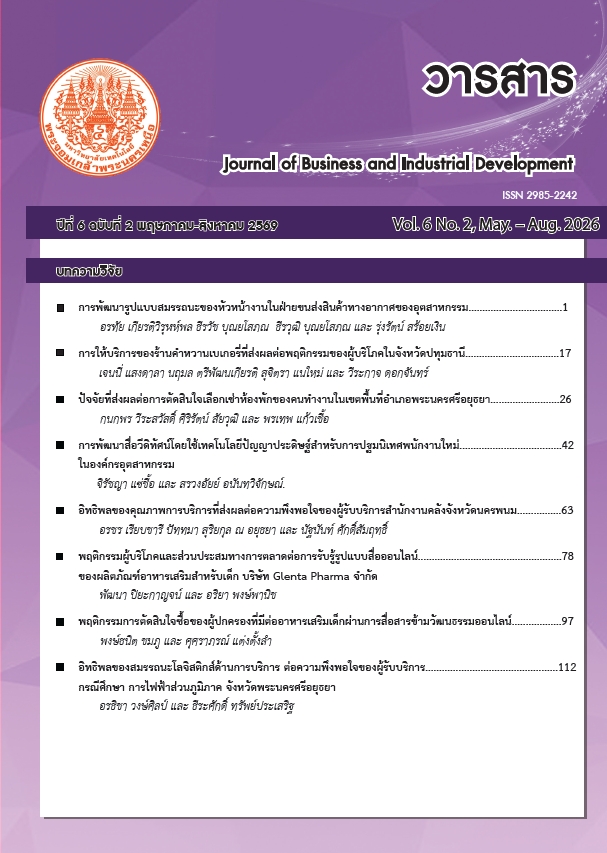
การพัฒนาสื่อวีดิทัศน์โดยใช้เทคโนโลยีปัญญาประดิษฐ์สำหรับการปฐมนิเทศพนักงานใหม่ในองค์กรอุตสาหกรรม
คำสำคัญ:
ปัญญาประดิษฐ์, ปฐมนิเทศพนักงานใหม่, สื่อวีดิทัศน์, การวิจัยและพัฒนา, ADDIE Model, การวิเคราะห์เนื้อหาบทคัดย่อ
งานวิจัยนี้มีวัตถุประสงค์ 4 ประการ ได้แก่ (1) เพื่อออกแบบและพัฒนาสื่อวีดิทัศน์โดยใช้เทคโนโลยีปัญญาประดิษฐ์ (AI) สำหรับการปฐมนิเทศพนักงานใหม่ในองค์กรธุรกิจภาคอุตสาหกรรม (2) เพื่อศึกษาความคิดเห็นและข้อเสนอแนะจากผู้มีส่วนเกี่ยวข้องภายในองค์กร (3) เพื่อประเมินประสิทธิภาพของสื่อในด้านความเข้าใจ ความพึงพอใจ และการลดภาระของฝ่ายทรัพยากรบุคคล และ (4) เพื่อพัฒนาแนวทางการใช้เทคโนโลยีดิจิทัลเพื่อยกระดับกระบวนการเรียนรู้ในองค์กร การวิจัยใช้รูปแบบการวิจัยและพัฒนา (R&D) ร่วมกับกระบวนการออกแบบสื่อตามรูปแบบ ADDIE เก็บข้อมูลเชิงคุณภาพจากผู้เชี่ยวชาญ 4 คน พนักงานใหม่ 11 คน และเจ้าหน้าที่ฝ่ายทรัพยากรบุคคล ในสถานประกอบการภาคอุตสาหกรรมแห่งหนึ่ง โดยใช้การสัมภาษณ์กึ่งโครงสร้างและแบบประเมินคุณภาพสื่อ วิเคราะห์ข้อมูลด้วยการวิเคราะห์เนื้อหา (Content Analysis) และการวิเคราะห์แก่นสาระ (Thematic Analysis) ผลการวิจัยพบว่า (1) สื่อวีดิทัศน์ที่พัฒนาขึ้นโดยใช้เทคโนโลยี AI มีความครบถ้วนของเนื้อหา ถูกต้องตามบริบทการทำงานจริง และมีรูปแบบการนำเสนอที่น่าสนใจ (2) พนักงานใหม่และผู้เชี่ยวชาญมีความคิดเห็นเชิงบวกต่อสื่อ โดยเฉพาะด้านความชัดเจนของเนื้อหาและความน่าสนใจของการนำเสนอ (3) พนักงานใหม่ทั้งหมด (11/11 คน) รายงานว่ามีความเข้าใจเนื้อหาชัดเจนขึ้น พนักงานใหม่ 10/11 คนมีความพึงพอใจต่อสื่อ และเจ้าหน้าที่ HR รายงานว่าเวลาในการปฐมนิเทศลดลงประมาณร้อยละ 40–50 และ (4) การสังเคราะห์แนวทางการใช้สื่อชี้ว่า AI-วีดิทัศน์สามารถใช้เป็นสื่อหลักในการปฐมนิเทศ ผสานเข้ากับระบบ LMS และพัฒนาเวอร์ชันเฉพาะสายงานได้ อย่างไรก็ตาม งานวิจัยนี้มีข้อจำกัดด้านขนาดกลุ่มตัวอย่างที่เล็กและการเก็บข้อมูลจากองค์กรเดียว จึงควรมีการศึกษาเพิ่มเติมในบริบทที่หลากหลายและใช้การวิจัยแบบผสมผสานเพื่อเสริมความแข็งแกร่งของผลการวิจัย
เอกสารอ้างอิง
Akter, Y., Ab Hamid, K., Akter, F., Rahman, M., Shakil, M. R. U., & Azizan, N. (2025). AI and the symbiotic HR: Redefining human-machine collaboration in the future workplace. In Harnessing AI to transform human resources in future workplace practices. IGI Global Scientific Publishing.https://doi.org/10.4018/979-8-3693-8669-9.ch001
Allen, D. G., Shore, L. M., & Griffeth, R. W. (2003). The role of perceived organizational support and supportive human resource practices in the turnover process. Journal of Management, 29(1), 99–118. https://doi.org/10.1177/014920630302900107
Bauer, T. N. (2010). Onboarding new employees: Maximizing success. SHRM Foundation.
Becker, G. S. (1964). Human capital: A theoretical and empirical analysis, with special reference to education. University of Chicago Press.
Bhardwaj, H. (2025). Integrating artificial intelligence into HRM practices. In A. K. Tyagi & N. Deepa (Eds.), Artificial intelligence and machine learning for human resource management (pp. xx–xx). Springer.
Branch, R. M. (2009). Instructional design: The ADDIE approach. Springer. https://doi.org/10.1007/978-0-387-09506-6
Creswell, J. W., & Poth, C. N. (2018). Qualitative inquiry and research design: Choosing among five approaches (4th ed.). Sage.
Davis, F. D. (1989). Perceived usefulness, perceived ease of use, and user acceptance of information technology. MIS Quarterly, 13(3), 319–340. https://doi.org/10.2307/249008
Devakirubai, T. S. (2025). Introduction to AI and HR in the service economy. In AI and innovation in HRM: The future of strategic HR in the service economy. https://doi.org/10.4324/9781003522157-13
Guest, G., Bunce, A., & Johnson, L. (2006). How many interviews are enough? An experiment with data saturation and variability. Field Methods, 18(1), 59–82. https://doi.org/10.1177/1525822X05279903
Khan, R. K., & Gowda, K. R. (2025). HR evolution from traditional methods to cutting-edge HR 5.0. In Harnessing AI to transform human resources in future workplace practices. IGI Global Scientific Publishing.
Knowles, M. S. (1984). Andragogy in action. Jossey-Bass.
Mayer, R. E. (2001). Multimedia learning. Cambridge University Press.
Nayak, A. P., & Sindhu, V. B. (2025). Ethical considerations in AI-enabled HR practices: A comprehensive review. In Harnessing AI to transform human resources in future workplace practices (pp. 65–92). https://doi.org/10.4018/979-8-3693-8669-9.ch003
Ng, E. S., Stanton, P., Umeh, C., Bamber, G. J., Stone, D., Lukaszewski, K., ... Varma, A. (2025). Megatrends affecting the world of work: Implications for human resource management. Personnel Review, 54(5), 1113–1149.
Patton, M. Q. (2015). Qualitative research & evaluation methods (4th ed.). Sage.
Rabban, T., & Singh, R. (2025). Talent management in the gig economy: Leveraging workforce strategies in the digital age. In Sustainability and adaptability of gig economies in global business (pp. 177–204). IGI Global Scientific Publishing.
Senge, P. M. (1990). The fifth discipline: The art and practice of the learning organization. Doubleday.
Shaikh, S. N., Sohu, J. M., Kherazi, F. Z., Qasim, S., Soomro, S., & Junejo, I. (2025). AI-driven transformation in HR: Revolutionizing recruitment, performance management, workforce planning, and learning and development. In Harnessing AI to transform human resources in future workplace practices (pp. 41–64). IGI Global Scientific Publishing.
Singh, M., Agrawal, K., & Srivastava, S. (2025). AI integration in human resource development practices and strategies. In AI and innovation in HRM (pp. 471–493). Routledge.
Tambe, P., Cappelli, P., & Yakubovich, V. (2019). Artificial intelligence in human resources management: Challenges and a path forward. California Management Review, 61(4), 15–42.https://doi.org/10.1177/0008125619867910
ดาวน์โหลด
เผยแพร่แล้ว
รูปแบบการอ้างอิง
ฉบับ
ประเภทบทความ
สัญญาอนุญาต
ลิขสิทธิ์ (c) 2026 วารสารพัฒนาธุรกิจและอุตสาหกรรม

อนุญาตภายใต้เงื่อนไข Creative Commons Attribution-NonCommercial-NoDerivatives 4.0 International License.



