
The Role of Parents in Participating in Early Childhood Education Management at Wangwareewonratwattana School
Article Sidebar
Main Article Content
Abstract
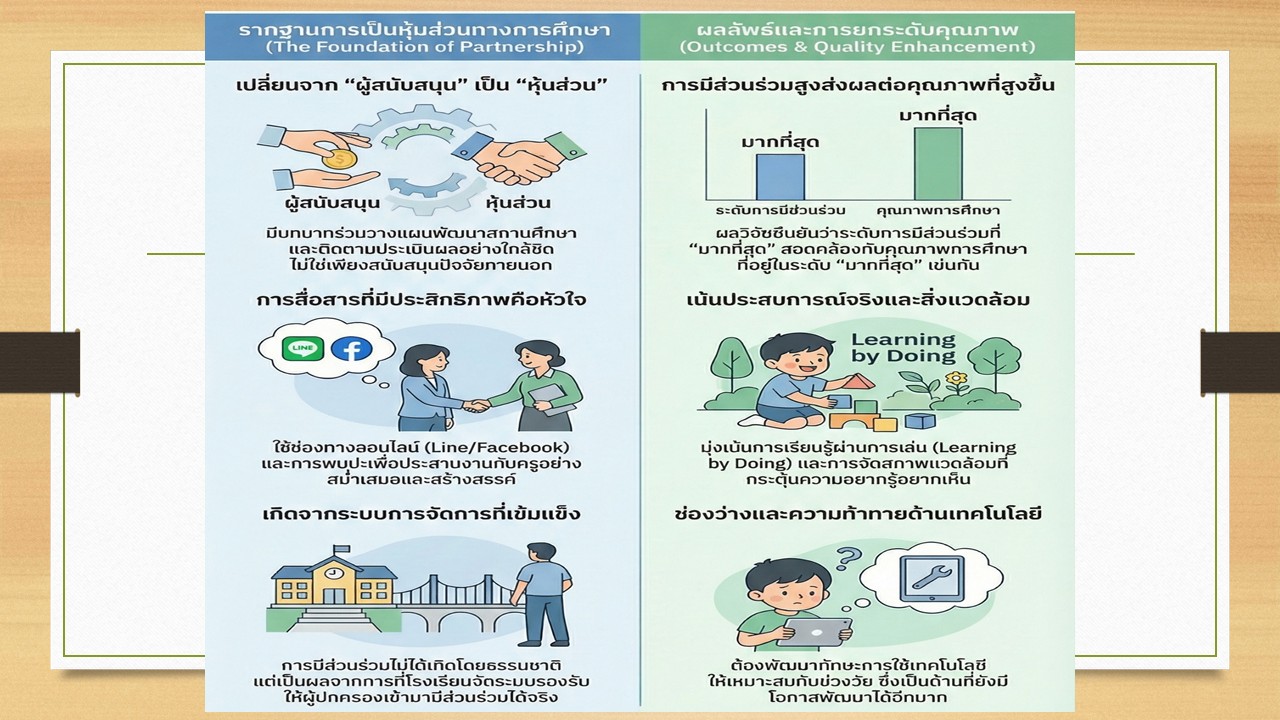
This research aimed to examine the roles of parents in early childhood education management and to examine the outcomes of implementing the school-based curriculum at Wangwareewonratwattana School in the academic year 2024 (B.E. 2567). The target group consisted of 30 participants, including school board members and parents of early childhood students enrolled at Wangwareewonratwattana School, selected through purposive sampling. The research instrument was a five-point Likert scale questionnaire. Data were analyzed using mean and standard deviation. The results revealed that the overall level of parental involvement in the management of early childhood education was the highest. The highest average score was in the area of communication and coordination with teachers/school, followed by participation in school development planning, and support for school activities and children's learning. Additionally, the outcomes of early childhood education implementation were also at the highest level. The highest-rated aspects were creating a learning-conducive environment and promoting learning processes and basic skill development. The findings indicate the significant role of parents in enhancing the quality of early childhood education. Furthermore, collaboration between home and school is a key factor in supporting the holistic development of young children.
Keywords: Parental Role, Involvement, Early Childhood Education
Article Details

This work is licensed under a Creative Commons Attribution-NonCommercial-NoDerivatives 4.0 International License.
This article is published under a Creative Commons Attribution-NonCommercial-NoDerivatives 4.0 International License (CC BY-NC-ND 4.0), which allows others to share the article with proper attribution to the authors and prohibits commercial use or modification. For any other reuse or republication, permission from the journal and the authors is required.References
กระทรวงศึกษาธิการ. (2560). หลักสูตรการศึกษาปฐมวัย พุทธศักราช 2560. พิมพ์ครั้งที่ 1. กรุงเทพฯ:สำนักงานคณะกรรมการศึกษาขั้นพื้นฐาน.
จันทิมา ศรีบุญเรือง. (2564). บทบาทของผู้ปกครองกับพัฒนาการเด็กปฐมวัย. วารสารวิจัยและพัฒนาการศึกษา, 12(2), 105-117.
คมศักดิ์ สายหยุด. (2561). พฤติกรรมของเด็กปฐมวัยที่มีผู้ปกครองเป็นแบบอย่างทางคุณธรรม. วารสารการศึกษา, 14(1), 55-69.
ณัฏฐ์นรี คำพา. (2563). ผลของสภาพแวดล้อมในห้องเรียนต่อพัฒนาการด้านสังคมของเด็กปฐมวัย. วารสารศึกษาศาสตร์ มหาวิทยาลัยเชียงใหม่, 47(3), 112-124.
ปรัชญา อ่อนน้อม. (2562). การพัฒนาความคิดสร้างสรรค์ของเด็กปฐมวัยโดยใช้กิจกรรมลงมือปฏิบัติ. วารสารครุศาสตร์, 47(2), 89-100.
วิโรจน์ สารรัตนะ. (2561). การส่งเสริมบทบาทผู้ปกครองในการจัดการศึกษาปฐมวัย. วารสารศึกษาศาสตร์ มหาวิทยาลัยขอนแก่น, 41(3), 20-33.
สำนักงานคณะกรรมการการศึกษาขั้นพื้นฐาน. (2560). หลักสูตรการศึกษาปฐมวัย พุทธศักราช 2560. กรุงเทพฯ: กระทรวงศึกษาธิการ.
อมรรัตน์ สุขสำราญ. (2562). รูปแบบการมีส่วนร่วมของผู้ปกครองในการพัฒนาเด็กปฐมวัย. วารสารวิจัยทางการศึกษา, 12(2), 45-58.
Epstein, J. L. (2001). School, Family, and Community Partnerships: Preparing Educators and Improving Schools. Westview Press.
-------------. (2011). School, Family, and Community Partnerships: Preparing Educators and Improving Schools. Routledge.
Fred C. Lunenburg and Allan C. Ornstein, Educational Administration: Concepts and practices, 6th ed. (BelMont, CA: Wadsworth, 2012),
-22.
Hoover-Dempsey and Sandler (2005). “Final Performance Report for OERI Grant # R305T010673 : The social Context of Parental
Involvement: A Path to Enhanced Achievement” (U.S. Department of Education, 2005), March 22, 74
Maria Montessori. (1967). The Absorbent Mind. Henry Holt & Co.
Piaget, J. (1964). Development and Learning. Journal of Research in Science Teaching.
UNESCO. (2015). Investing Against Evidence: The Global State of Early Childhood Care and Education. Paris: UNESCO Publishing.
Vygotsky, L. S. (1978). Mind in Society: The Development of Higher Psychological Processes. Harvard University Press.
