
ปัญญาประดิษฐ์ (AI) กับความกังวลของผู้ปกครองในบริบทการศึกษาปฐมวัย
Article Sidebar
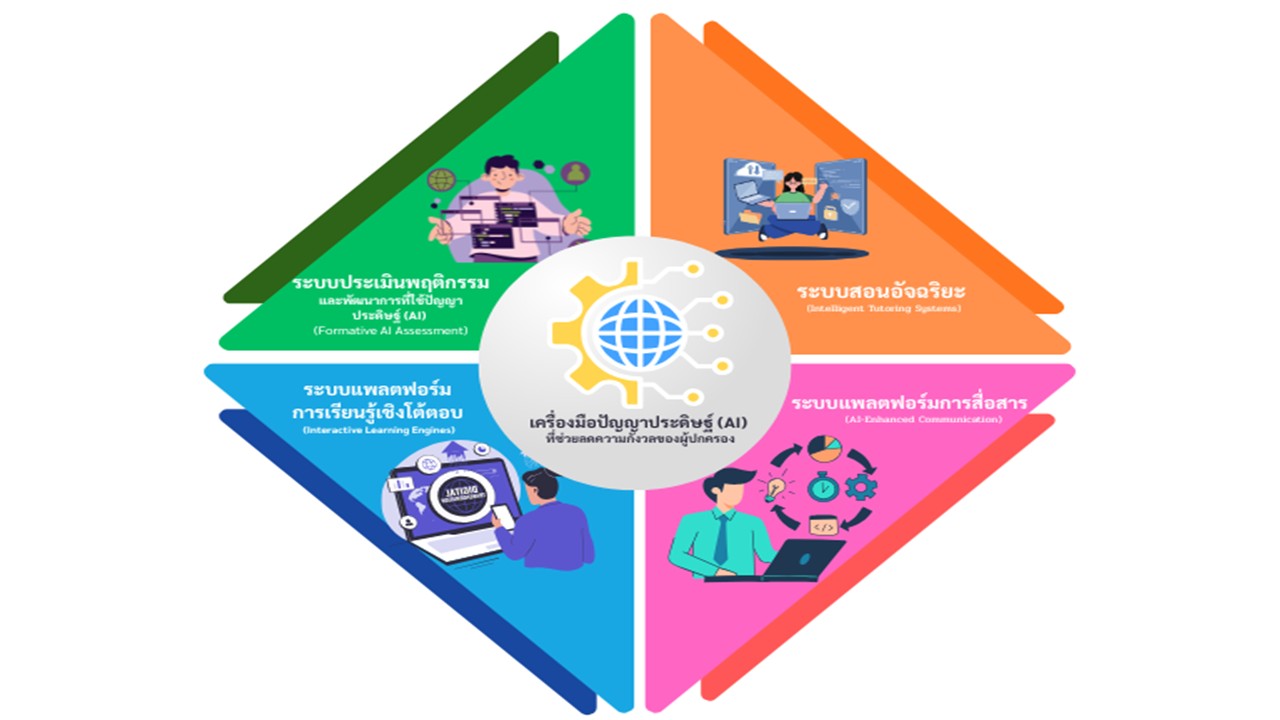
Main Article Content
บทคัดย่อ
ปัญญาประดิษฐ์ (AI) กับความกังวลของผู้ปกครองในบริบทการศึกษาปฐมวัย เป็นประเด็นสำคัญที่สะท้อนความเปลี่ยนแปลงของระบบการศึกษาในยุคดิจิทัล โดยมุ่งศึกษาความรู้ ความเข้าใจ ทัศนคติ และระดับความกังวลของผู้ปกครองต่อการนำ AI มาใช้ในการเรียนรู้ของเด็กปฐมวัย ทั้งในด้านความปลอดภัยของข้อมูล ความเหมาะสมตามพัฒนาการ เวลาใช้หน้าจอ จริยธรรม และความเป็นธรรม การศึกษาประเด็นดังกล่าวมีเป้าหมายเพื่อค้นหาข้อเท็จจริงเชิงประจักษ์ สร้างองค์ความรู้ใหม่ และพัฒนาแนวทางการออกแบบหรือกำกับใช้ที่สอดคล้องกับพัฒนาการเด็กปฐมวัยรอบด้านช่วยให้การศึกษาปัญญาประดิษฐ์ (AI) กับความกังวลของผู้ปกครองในบริบทการศึกษาปฐมวัยมีความรอบด้าน ครอบคลุมทั้งมิติด้านพัฒนาการเด็กปฐมวัยปัญญาประดิษฐ์ (AI) และบริบททางสังคม อันจะนำไปสู่ข้อเสนอเชิงนโยบายและแนวทางการออกแบบที่ปลอดภัยเหมาะสม และสร้างความไว้วางใจได้อย่างยั่งยืน ซึ่งเป็นหัวใจสำคัญของการศึกษาปฐมวัยในศตวรรษที่ 21
คำสำคัญ: ปัญญาประดิษฐ์, การศึกษาปฐมวัย, ความกังวลของผู้ปกครอง, จริยธรรม AI, การคุ้มครองข้อมูล
Article Details

อนุญาตภายใต้เงื่อนไข Creative Commons Attribution-NonCommercial-NoDerivatives 4.0 International License.
บทความนี้ได้รับการเผยแพร่ภายใต้สัญญาอนุญาต Creative Commons Attribution-NonCommercial-NoDerivatives 4.0 International (CC BY-NC-ND 4.0) ซึ่งอนุญาตให้ผู้อื่นสามารถแชร์บทความได้โดยให้เครดิตผู้เขียนและห้ามนำไปใช้เพื่อการค้าหรือดัดแปลง หากต้องการใช้งานซ้ำในลักษณะอื่น ๆ หรือการเผยแพร่ซ้ำ จำเป็นต้องได้รับอนุญาตจากวารสารเอกสารอ้างอิง
พนิตา ชอบทำกิจ และคณะ. (2567). จริยธรรมปัญญาประดิษฐ์และการคุ้มครองข้อมูลเด็กปฐมวัย
ในบริบทการศึกษาไทย. วารสารวิชาการมหาวิทยาลัยการจัดการและเทคโนโลยีอีสเทิร์น,
(2), 45–62.
วราภรณ์ ใจดี และคณะ. (2565). ความกังวลของผู้ปกครองต่อการใช้เทคโนโลยีดิจิทัลในเด็กปฐมวัยปฐมวัย.
วารสารการศึกษาปฐมวัย, 18(1), 23–40.
สถาบันส่งเสริมการสอนวิทยาศาสตร์และเทคโนโลยี. (2567). ปัญญาประดิษฐ์กับการจัดการเรียนรู้ใน
ศตวรรษที่ 21. สสวท.
สำนักงานคณะกรรมการการศึกษาขั้นพื้นฐาน. (2566). แนวทางการใช้ปัญญาประดิษฐ์อย่างรับผิดชอบ
ในสถานศึกษา. กระทรวงศึกษาธิการ.
สำนักงานคณะกรรมการคุ้มครองข้อมูลส่วนบุคคล. (2565). แนวปฏิบัติการคุ้มครองข้อมูลส่วนบุคคล
สำหรับสถานศึกษา. กระทรวงดิจิทัลเพื่อเศรษฐกิจและสังคม.
สำนักงานเลขาธิการสภาการศึกษา. (2565). แนวทางการใช้เทคโนโลยีดิจิทัลเพื่อการศึกษาปฐมวัย
อย่างเหมาะสม. กระทรวงศึกษาธิการ.
Akgun, S., & Greenhow, C. (2022). Artificial intelligence in education: Addressing ethical
challenges in K–12 settings. Educational Technology Research and Development,
(5), 2345–2362. https://doi.org/10.1007/s11423-022-10123-3
American Academy of Pediatrics. (2022). Media use in early childhood: Updated policy
recommendations. Pediatrics, 150(1), e2022058850.
https://doi.org/10.1542/peds.2022-058850
American Psychological Association. (2023). Health advisory on social media
use in adolescence. APA. https://www.apa.org/
Bond, M., Bedenlier, S., Marín, V. I., & Händel, M. (2023). Artificial intelligence
in education: A systematic review. International Journal of Educational Technology in Higher Education, 20(1), 1–28.
https://doi.org/10.1186/s41239-023-00376-2
Bond, M., Marín, V. I., Dolch, C., Bedenlier, S., & Zawacki-Richter, O. (2023).
Digital transformation in education: Trends, challenges and implications
For Assessment. Computers & Education, 195, 104695.
https://doi.org/10.1016/j.compedu.2023.104695
Chen, L., Chen, P., & Lin, Z. (2022). Artificial intelligence in education: A review. IEEE
Access, 10, 75264–75278. https://doi.org/10.1109/ACCESS.2022.3188512
Common Sense Media. (2022). Artificial intelligence and children: Policy recommendations.
https://www.commonsensemedia.org/
Crawford, K. (2021). Atlas of AI: Power, politics, and the planetary costs of artificial
intelligence. Yale University Press.
Chairattanawan, K., & Thapsut, M. (2025). Artificial intelligence and the advancement
of Thai education in crisis: Achieving SDG 4 through flexible online learning modalities. Nimitmai Review Journal, 8(2), 238–251.
https://so04.tci-thaijo.org/index.php/nmrj/article/view/280883
Department for Education. (2024). Generative artificial intelligence in education: Policy
guidance. UK Government. https://www.gov.uk/
European Commission. (2022). Proposal for a regulation laying down harmonised rules
on artificial intelligence (Artificial Intelligence Act). European Union.
Floridi, L., & Cowls, J. (2022). A unified framework of five principles for AI in society.
Harvard Data Science Review, 4(1), 1–15
https://doi.org/10.1162/99608f92.8cd550d1
Gao, F., & McBride, R. (2022). Parental trust in educational technologies. British Journal
of Educational Technology, 53(6), 1891–1907. https://doi.org/10.1111/bjet.13205
García, E., Martínez, A., & Santos, R. (2023). AI-enhanced communication platforms
in early education. Education and Information Technologies, 28(3), 2751–2768. https://doi.org/10.1007/s10639-022-11234-7
Goodall, J. (2022). Parental engagement and digital communication in early childhood
education. Educational Review, 74(4), 563–579.
https://doi.org/10.1080/00131911.2021.1902440
Hirsh-Pasek, K., Zosh, J. M., Golinkoff, R. M., Gray, J. H., Robb, M. B., & Kaufman, J.
(2020). Putting education in educational apps. Psychological Science in the
Public Interest, 21(1), 3–39.
Holmes, W., Persson, J., Chounta, I.-A., Wasson, B., & Dimitrova, V. (2022). Artificial
intelligence and education: A critical view through the lens of human rights. Learning, Media and Technology, 47(1), 1–17.
Kaur, D., Uslu, S., Rittichier, K., & Durresi, A. (2023). Trustworthy artificial intelligence: A
review. ACM Computing Surveys, 55(9), 1–38. https://doi.org/10.1145/3535103
Kosravi, H., Shum, S. B., Chen, G., & Gašević, D. (2022). Explainable AI in education:
Principles and opportunities. Computers and Education: Artificial Intelligence, 3, 100074. https://doi.org/10.1016/j.caeai.2022.100074
Khamyon, S. (2024). The Artificial Intelligence (AI) innovation in academic education
management: A perspective from educational leadership. Journal of Roi Kaensarn Academi, 9(10), 1885–1893.https://so02.tci-thaijo.org/index.php/JRKSA/article/view/273169
Kuhail, M. A., Alturki, N., Alramlawi, S., & Alhejori, K. (2023). Interacting with educational
chatbots: A systematic review. Education and Information Technologies, 28, 973–1018. https://doi.org/10.1007/s10639-022-11177-3
Madigan, S., Browne, D., Racine, N., Mori, C., & Tough, S. (2023). Association between
screen time and children’s developmental outcomes. JAMA Pediatrics, 177(4),
–391.
https://doi.org/10.1001/jamapediatrics.2022.6283
OECD. (2023). AI in education and skills. OECD Publishing. https://doi.org/10.1787/ee2d2f3e-en
Ottenbreit-Leftwich, A. T., Glazewski, K. D., Newby, T. J., & Ertmer, P. A. (2023). Teacher
value beliefs associated with using technology: Addressing professional and
student needs. Computers & Education, 191, 104636.
https://doi.org/10.1016/j.compedu.2022.104636
Su, J., & Yang, W. (2022). Artificial intelligence in early childhood education: A scoping
review. Computers and Education: Artificial Intelligence, 3, 100049.
https://doi.org/10.1016/j.caeai.2022.100049
UNESCO. (2023). Guidance for generative AI in education and research. UNESCO.
UNICEF. (2021). Policy guidance on AI for children. UNICEF Office of Global Insight
and Policy. https://www.unicef.org/
United Nations Committee on the Rights of the Child. (2021). General comment No.
(2021) on children’s rights in relation to the digital environment. United Nations.
VanLehn, K. (2023). Intelligent tutoring systems: Advances and future directions.
International Journal of Artificial Intelligence in Education, 33(2), 255–278.
Williamson, B. (2023). Governing artificial intelligence in education: Policy
networks, governance and the datafication of schooling. Learning, Media
and Technology, 48(3), 345–360. https://doi.org/10.1080/17439884.2023.218XXXX
World Economic Forum. (2022). Guidelines for AI governance in education. WEF.
World Health Organization. (2023). Guidelines on physical activity, sedentary behaviour
and sleep for children under 5 years of age. WHO. https://www.who.int/
Zosh, J. M., Hirsh-Pasek, K., & Golinkoff, R. M. (2021). Learning through play: A review
of the evidence. Developmental Review, 61, 100987.
